COMPLETE GUIDE
The most powerful — and most misunderstood — immigration option for extraordinary professionals.
Check Your Eligibility
No Employer Required
95% Approval Rate
Premium Processing Available
What Is the O-1A Visa?
The O-1A visa is a nonimmigrant work visa for individuals with extraordinary ability in the sciences, business, education, or athletics. Unlike the H-1B, the O-1A has no annual cap, no lottery, and no minimum degree requirement. It is one of the most flexible and powerful visa categories available.
What makes the O-1A unique is that it rewards achievement over credentials. You do not need a PhD or a specific job title. What matters is demonstrable evidence that you have risen to the top of your field.
Quick Answer
The O-1A visa lets extraordinary professionals work in the U.S. without a lottery, without an employer sponsor (an agent can petition), and with unlimited renewals. You need to meet at least 3 of 8 criteria demonstrating extraordinary ability. Processing can take as little as 15 business days with premium processing.
USCIS evaluates O-1A petitions against eight evidentiary criteria. You must demonstrate that you meet at least three. Here is each criterion explained with examples:
The 8 O-1A Criteria
1. Awards
Nationally or internationally recognized prizes or awards for excellence in your field. Examples: industry awards, best paper awards, innovation prizes, fellowships.
2. Membership
Membership in associations that require outstanding achievements as judged by recognized experts. Examples: IEEE Fellow, ACM Distinguished Member, invitation-only professional bodies.
3. Press / Media
Published material in professional or major trade publications or media about you and your work. Examples: features in TechCrunch, Forbes, Nature, or industry journals.
4. Judging
Participation as a judge of the work of others in the same or allied field. Examples: peer review for journals, grant review panels, hackathon judging, startup competition panels.
5. Original Contributions
Original scientific, scholarly, or business-related contributions of major significance. Examples: patents, open-source frameworks, novel algorithms, founding a company that disrupted an industry.
6. Scholarly Articles
Authorship of scholarly articles in professional journals or major media. Examples: peer-reviewed publications, whitepapers cited by others, invited book chapters.
7. Employment in Critical Role
Employment in a critical or essential capacity at organizations with a distinguished reputation. Examples: VP/Director at a Fortune 500, lead engineer at a well-funded startup, principal researcher at a top university.
8. High Salary
Commanding a high salary or remuneration relative to others in the field. Examples: compensation in the top percentile for your occupation, equity packages, performance bonuses that reflect market demand for your skills.
O-1A Application Process
The O-1A application involves several key steps. Here is the typical timeline from start to approval:
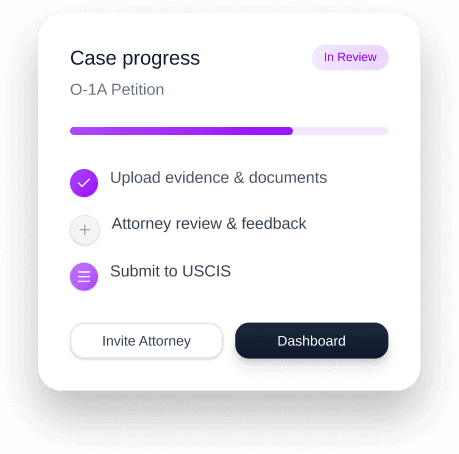
Step 1: Evidence Audit — Catalog all achievements against the 8 criteria (1-2 weeks)
Step 2: Obtain Advisory Opinion Letter — From a peer group or relevant organization (2-4 weeks)
Step 3: Draft Petition Letter — Attorney crafts the legal argument (1-2 weeks)
Step 4: Compile Supporting Evidence — Reference letters, contracts, exhibits (1-2 weeks)
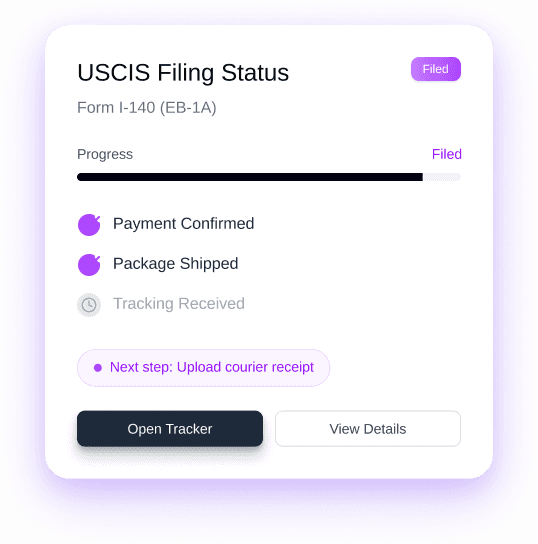
Step 5: File Form I-129 with USCIS — Submit the complete petition package
Step 6: USCIS Adjudication — Regular or premium processing
Step 7: Receive Approval Notice (I-797) — You can now apply for the visa stamp
Step 8: Visa Stamping at U.S. Consulate — Interview and entry to the U.S.
Processing Type
Timeline
Fee
Regular Processing
3-6 months
$0 (included)
Premium Processing
15 business days
$2,805
Processing Times
O-1A Costs Breakdown
Cost Item
Amount
I-129 Filing Fee
$460
Premium Processing (optional)
$2,805
Attorney Fees
$6,000 - $15,000+
Consultation / Advisory Letter
$500 - $2,000
Common O-1A Mistakes
1. Waiting until you have a "perfect" profile. Most successful petitioners do not meet all 8 criteria. Three strong criteria with solid evidence is sufficient.
2. Submitting weak reference letters. Generic letters that do not address specific achievements are a red flag. Each letter should be detailed and from a recognized expert.
3. Not providing enough supporting documentation. Every claim needs exhibits — press clippings, award certificates, citation counts, pay stubs, contracts.
4. Confusing O-1A with O-1B. The O-1B is for arts and entertainment. If you are in tech, science, or business, you need the O-1A.
5. Filing without an advisory opinion letter. While not strictly required, omitting it invites an RFE (Request for Evidence) and slows down your case.
FAQ