The J-1 Two-Year Home Residency Requirement: Waivers and Workarounds
If you're subject to the J-1 two-year home residency requirement, you can't get H-1B, L-1, or green card until you fulfill it—or get a waiver. Here's how to determine if you're subject to it and your waiver options.
If you're subject to the J-1 two-year home residency requirement, you can't get H-1B, L-1, or green card until you fulfill it—or get a waiver. Here's how to determine if you're subject to it and your waiver options.
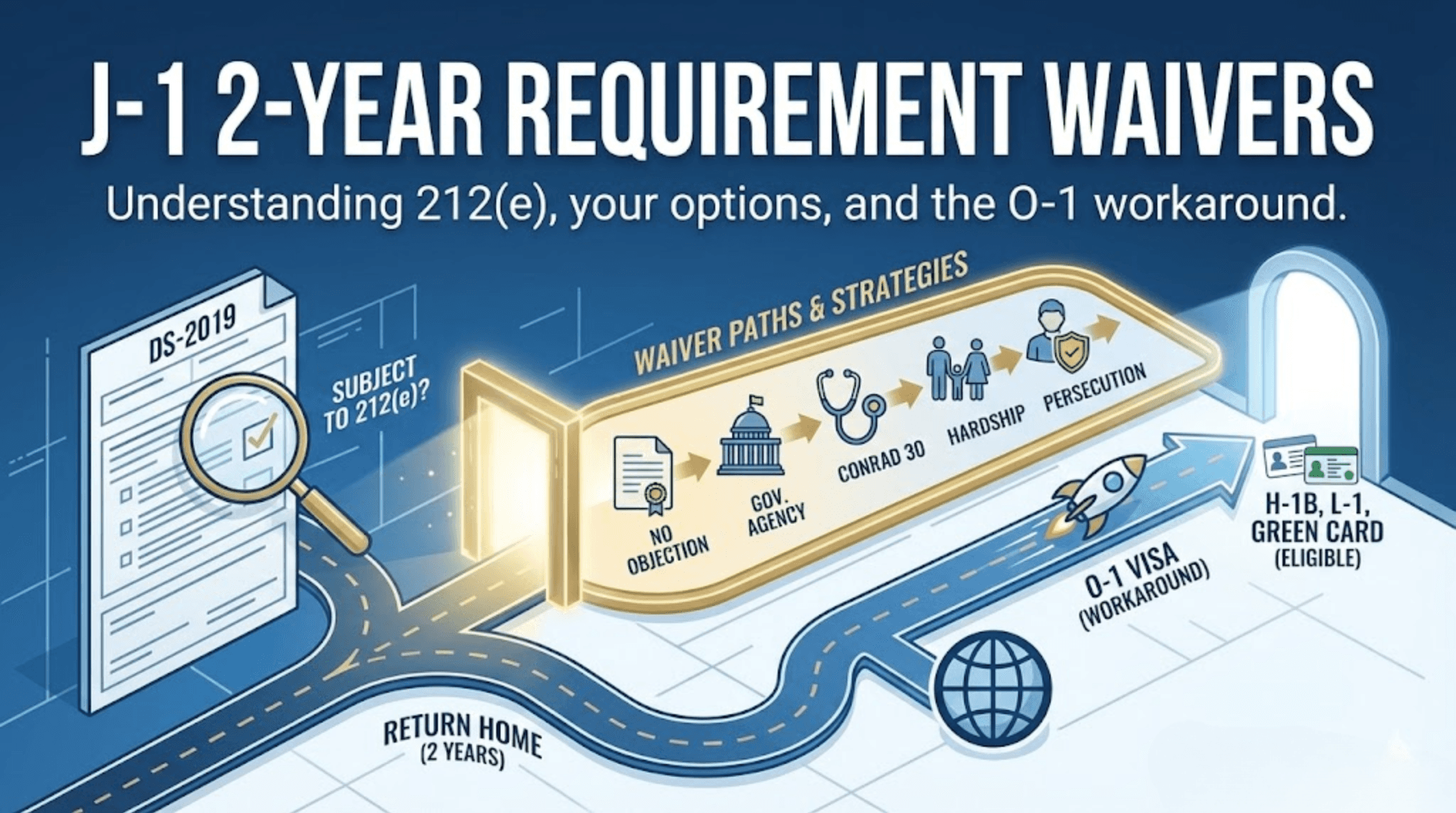
The J-1 two-year home residency requirement (Section 212(e)) requires certain J-1 visa holders to return to their home country for two years before being eligible for H, L, K visas or permanent residence. You may be subject if: (1) your program was government-funded, (2) your skills are on your country's skills list, or (3) you received graduate medical training. Waiver options include: No Objection Statement, Interested Government Agency, Conrad 30 (physicians), hardship, and persecution waivers.
Key Takeaways
Not all J-1 holders are subject to 212(e): Check your DS-2019 for determination.
If subject, certain visas are barred: Cannot get H, L, K visa or green card until fulfilled or waived.
Five waiver options exist: Each has different requirements and success rates.
No Objection Statement is most common: Home country says they don't object to you staying.
Waiver processing takes 4-6 months typically: Plan ahead.
You can still get O-1 while subject to 212(e): O visa is not affected.
Table of Content
Understanding the Two-Year Requirement
What is Section 212(e)?
A provision requiring certain J-1 exchange visitors to return to their home country for two years before being eligible for certain U.S. visas.
What it prevents:
H-1B, H-2, H-3 visas
L-1 visa
K (fiancé/spouse) visa
Permanent residence (green card)
What it doesn't prevent:
O-1 visa (important exception!)
B-1/B-2 visitor visa
F-1 student visa
Returning on another J-1
Are You Subject to 212(e)?
Check your DS-2019 form:
Look at item/box that indicates whether you're subject to two-year requirement.
You may be subject if:
1. Government funding:
U.S. government funded your program
Your home government funded your program
International organization funded your program
2. Skills list:
Your field is on your country's "skills list"
Skills list identifies fields where your country needs professionals
Varies by country (check with embassy)
3. Graduate medical education:
You came on J-1 for residency or fellowship
Medical training triggers automatic 212(e)
If none of these apply: You're likely not subject to requirement.
If your DS-2019 says "Not subject": You're clear—no waiver needed.
The Five Waiver Options
Waiver 1: No Objection Statement (NOS)
What it is: Your home country's government states they don't object to you staying in U.S.
How it works:
Request NOS from your country's embassy in Washington D.C.
Embassy sends NOS to State Department
State Department recommends waiver to USCIS
USCIS approves waiver
Who qualifies:
Most J-1 holders (except physicians)
Must not have been government-funded by home country
Country must be willing to issue NOS
Success rate: High if NOS is issued
Processing time: 4-6 months typically
Countries that commonly issue NOS:
India
China
Most countries (but each has own process)
Countries that rarely/never issue NOS:
Some countries with strict skills list policies
Check with your embassy
Waiver 2: Interested Government Agency (IGA)
What it is: A U.S. government agency requests waiver on your behalf because they need your services.
How it works:
U.S. agency sponsors your waiver request
Agency certifies your employment furthers their mission
State Department recommends waiver
Who qualifies:
Researchers working for government agencies
Employees at government-funded institutions
Those whose work benefits U.S. government programs
Common sponsoring agencies:
NIH (National Institutes of Health)
NSF (National Science Foundation)
NASA
Department of Energy national labs
VA (Department of Veterans Affairs)
Success rate: High if agency agrees to sponsor
Processing time: 4-8 months
Waiver 3: Conrad 30 (Physicians)
What it is: State-sponsored waiver for physicians who agree to work in medically underserved areas.
How it works:
State health department sponsors your waiver
You commit to 3 years of service in underserved area
Each state can sponsor 30 physicians per year (hence "Conrad 30")
Requirements:
J-1 physician subject to 212(e)
Agree to 3 years of full-time practice
Work in Health Professional Shortage Area (HPSA) or Medically Underserved Area (MUA)
Contract with healthcare facility
Success rate: High if you secure state sponsorship
Processing time: 4-6 months for waiver; then 3-year commitment
Note: After 3 years, you can work anywhere and pursue green card.
Waiver 4: Hardship to U.S. Citizen or Permanent Resident
What it is: Waiver based on exceptional hardship to your U.S. citizen or permanent resident spouse or child.
How it works:
Prove your return would cause "exceptional hardship" to U.S. citizen/resident family member
Hardship must be beyond normal difficulties of separation
What qualifies as exceptional hardship:
Serious medical conditions requiring U.S. care
Financial devastation
Persecution in home country affecting family
Other extreme circumstances
Who qualifies:
Those with U.S. citizen or permanent resident spouse or child
Must demonstrate exceptional (not just ordinary) hardship
Success rate: Moderate (depends on circumstances)
Processing time: 6-12 months
Important: Hardship to yourself doesn't count—only to U.S. citizen/resident family.
Waiver 5: Persecution Waiver
What it is: Waiver based on fear of persecution if you return to home country.
How it works:
Prove you would face persecution based on race, religion, political opinion, nationality, or social group
Similar standard to asylum
Who qualifies:
Those who would face persecution in home country
Must document basis for fear
Success rate: Varies based on circumstances
Processing time: 6-12 months
Note: This is essentially an asylum-type claim in waiver form.
The O-1 Workaround
Critical exception: O-1 visa is NOT affected by 212(e).
If you're subject to two-year requirement:
Cannot get H-1B, L-1, or green card
CAN get O-1
Strategy:
Apply for O-1 while pursuing waiver
Work on O-1 status
Once waiver approved, pursue green card
Why this matters:
Waiver takes 4-6 months
O-1 can be approved in 15 days (premium)
Don't wait for waiver to start working
Waiver Process Overview
Step 1: Determine your basis for waiver
NOS (most common)
IGA (if government agency will sponsor)
Conrad 30 (physicians)
Hardship (if U.S. citizen/resident family)
Persecution (if applicable)
Step 2: Obtain supporting documentation
For NOS: Request from home country embassy
For IGA: Secure agency sponsorship
For others: Gather evidence supporting your claim
Step 3: Submit DS-3035 to State Department
Waiver review request form
Submit online
Step 4: State Department reviews
4-8 weeks typically
Sends recommendation to USCIS
Step 5: USCIS adjudicates waiver
Reviews State Department recommendation
Issues I-612 waiver approval
2-4 months typically
Total timeline: 4-6 months for NOS; longer for other bases
What If Waiver Is Denied?
Options:
Fulfill the two-year requirement (return home for 2 years)
Try different waiver basis (if applicable)
Continue on visa types not affected (O-1, F-1, B-1/B-2)
Consult immigration attorney for alternatives
Common 212(e) Mistakes
Mistake 1: Assuming you're not subject
Don't guess—check your DS-2019 form.
Mistake 2: Starting waiver process too late
Waivers take 4-6+ months. Start early.
Mistake 3: Not considering O-1
O-1 is available even if subject to 212(e). Don't wait for waiver to work.
Mistake 4: Physicians not exploring Conrad 30
Conrad 30 is excellent option for physicians—don't overlook it.
How OpenSphere Evaluates J-1 Situations
212(e) Assessment: Based on your J-1 program details, determine if you're likely subject to requirement.
Waiver Path Recommendation: Based on your situation (country, funding, family), recommend most viable waiver option.
O-1 Alternative: If you qualify for O-1, pursue it while waiver processes.
Timeline Planning: Map your path from J-1 → waiver → H-1B/green card.
Comparison Table: Waiver Options
Waiver Type
Best For
Success Rate
Processing Time
No Objection Statement
Most J-1 holders
High
4-6 months
Interested Government Agency
Government researchers
High
4-8 months
Conrad 30
Physicians
High
4-6 months + 3-year commitment
Hardship
Those with USC/LPR family
Moderate
6-12 months
Persecution
Those facing home country danger
Varies
6-12 months
Are you a J-1 visa holder wondering if you're subject to the two-year requirement? Want to understand your waiver options?
Take the OpenSphere evaluation. You'll get 212(e) assessment and waiver strategy recommendations.