Quick Answer
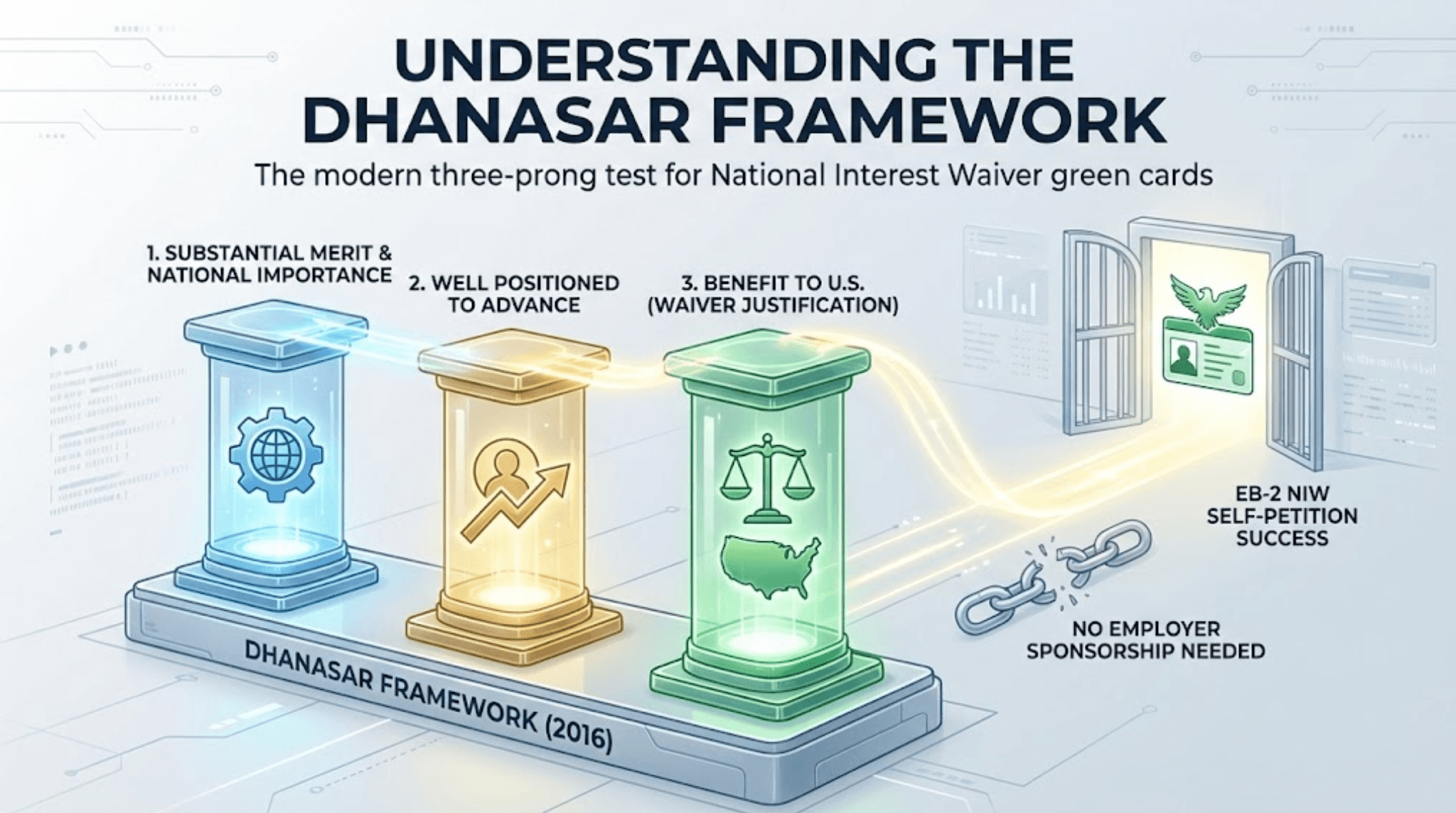
The EB-2 National Interest Waiver allows self-petition without employer sponsorship if your work benefits the national interest. The Dhanasar framework (2016) established three prongs: (1) your proposed endeavor has substantial merit and national importance, (2) you're well positioned to advance the endeavor, and (3) on balance, waiving the job offer requirement benefits the United States. Each prong has specific evidence requirements understanding this framework is essential for NIW success.
Key Takeaways
Dhanasar changed the game: 2016 decision modernized NIW analysis, making it more accessible.
Three prongs, all required: Must satisfy all three to succeed.
Prong 1: Your work matters and has national-level importance.
Prong 2: You specifically can advance this work.
Prong 3: U.S. benefits more from waiving job offer than requiring it.
Self-petition is the key benefit: No employer needed, though backlog still applies for India.
Understanding Dhanasar: The Modern NIW Framework
Before Dhanasar (NYSDOT standard):
Required showing benefit to national interest "to a substantially greater degree" than available U.S. workers
Very difficult standard to meet
Limited who could qualify
After Dhanasar (2016):
More flexible, totality-of-circumstances approach
Three-prong analysis
Opened NIW to more applicants
Still rigorous but more predictable
Prong 1: Substantial Merit and National Importance
What USCIS asks: Does your proposed endeavor have substantial merit AND national importance?
Two separate elements:
Element A: Substantial Merit
What it means:
Your work has inherent value
It advances knowledge, improves outcomes, or solves problems
Merit can be in any field (not just STEM)
What qualifies:
Scientific research
Business entrepreneurship
Technology development
Healthcare improvement
Education advancement
Arts and culture
Economic development
Evidence:
Description of your endeavor
Expert letters explaining merit
Publications showing value
Recognition of your work's importance
Element B: National Importance
What it means:
Impact extends beyond just your employer
Benefits the U.S. broadly or impacts significant interests
Doesn't require "national scope" in geographic sense
What qualifies:
Research with broad applications
Technology used across industries
Healthcare solutions for many patients
Economic impact beyond single company
Educational methods with widespread adoption
What doesn't qualify:
Work benefiting only one employer
Purely local impact
Personal career advancement
Evidence:
Show how work impacts broader U.S. interests
Letters explaining national-level implications
Data on widespread applications
Industry adoption evidence
Prong 2: Well Positioned to Advance the Endeavor
What USCIS asks: Are you specifically well positioned to advance this endeavor?
This prong focuses on YOU:
Your qualifications
Your track record
Your future plans
Why you can succeed
Factors USCIS considers:
1. Education and skills
Relevant degrees
Specialized training
Technical expertise
2. Track record
Past success in this area
Publications, patents, products
Recognition for this work
3. Model or plan
Your plan for advancing the endeavor
How you'll achieve impact
Resources and support you have
4. Progress to date
What you've already accomplished
Interest from others in your work
Momentum in your endeavor
Evidence for Prong 2:
Strong evidence:
Publications in your area
Patents or products
Funding or grants received
Industry partnerships
Letters from those who will use/support your work
Concrete plan with milestones
Weaker evidence:
Education alone without track record
Plans without supporting resources
Claims without documentation
Prong 3: Balancing the National Interest
What USCIS asks: On balance, would waiving the job offer requirement benefit the United States?
This is the "waiver" justification:
Why should U.S. waive normal requirement?
What's gained by not requiring job offer/labor certification?
Would national interest be served?
Factors that support waiver:
1. Urgency
Field is moving quickly
Delay would harm U.S. interests
Labor certification process would impede progress
2. Self-employment or entrepreneurship
Traditional job offer doesn't fit your endeavor
You're starting a company
Your work is inherently independent
3. Unique qualifications
Your specific skills are rare
Labor market test (PERM) is impractical
No comparable U.S. workers could be found anyway
4. Broad impact
Your work benefits many, not just one employer
Tying you to single employer would limit impact
National interest served by your flexibility
Evidence for Prong 3:
Explanation of why waiver serves national interest
Expert letters supporting waiver justification
Evidence of impact beyond single employer
Argument for why PERM process is inappropriate
Field-Specific NIW Strategies
STEM Researchers:
Prong 1 strengths:
Research inherently has substantial merit
Scientific advancement is nationally important
Publications demonstrate merit
Prong 2 strengths:
Publications show track record
Citations show impact
Grants show resources
Prong 3 arguments:
Research advances regardless of employer
Scientific progress benefits nation
Flexibility enables best research opportunities
Entrepreneurs:
Prong 1 strengths:
Job creation is nationally important
Innovation advances economy
Business success has substantial merit
Prong 2 strengths:
Business plan shows positioning
Funding demonstrates viability
Track record shows capability
Prong 3 arguments:
Entrepreneurs can't sponsor themselves traditionally
Business would be harmed by PERM delay
Job creation benefits outweigh labor certification
Healthcare Professionals:
Prong 1 strengths:
Healthcare has obvious national importance
Improving patient outcomes has merit
Addressing shortages is valuable
Prong 2 strengths:
Medical credentials
Clinical track record
Specialization in needed areas
Prong 3 arguments:
Healthcare needs are urgent
Underserved areas need practitioners
PERM process would delay care delivery
Common NIW Weaknesses and How to Address Them
Weakness 1: Prong 1—"National importance" not established
Problem: Work seems beneficial only to employer.
Solution: Frame impact broadly. Show how your specific work has implications beyond your employer.
Weakness 2: Prong 2—Insufficient track record
Problem: You have plans but limited evidence you can execute.
Solution: Document progress to date. Get letters from supporters. Show any traction.
Weakness 3: Prong 3—Waiver justification unclear
Problem: Not obvious why job offer should be waived.
Solution: Articulate specific reasons. Urgency, entrepreneurship, unique qualifications, or broad impact.
NIW vs EB-1A: Which Is Lower Bar?
Common question: Which is easier—NIW or EB-1A?
NIW advantages:
Doesn't require "extraordinary ability"
More flexible evidence
Good for those with solid but not exceptional credentials
EB-1A advantages:
No backlog (even for Indians)
Self-petition with immediate green card
Higher prestige
General guidance:
If you clearly meet EB-1A criteria: File EB-1A (no backlog)
If you're strong but not "extraordinary": NIW may be more achievable
For Indians: EB-1A is dramatically faster (no backlog vs 13+ years)
How OpenSphere Evaluates NIW Cases
Prong-by-Prong Assessment: OpenSphere evaluates your evidence against each Dhanasar prong.
Gap Identification: Shows which prong is weakest and what evidence would strengthen it.
Field-Specific Guidance: Based on your field, recommends framing and evidence strategies.
NIW vs EB-1A Comparison: Evaluates which path is stronger for your profile.
Comparison Table: Dhanasar Prongs
Prong | What It Asks | Key Evidence | Common Weakness |
Prong 1 | Merit + national importance | Publications, impact data, expert letters | Failing to show national-level impact |
Prong 2 | You can advance endeavor | Track record, plan, resources, support | Insufficient evidence of execution ability |
Prong 3 | Waiver benefits U.S. | Waiver justification, urgency, unique role | Not explaining why job offer should be waived |
Considering NIW and want to understand if you satisfy the Dhanasar framework? Need help identifying evidence for each prong?
Take the OpenSphere evaluation. You'll get prong-by-prong analysis with evidence recommendations.
FAQ
1. What's the difference between NIW and EB-1A?
NIW waives job offer requirement based on national interest; EB-1A is for extraordinary ability. EB-1A has no backlog; NIW has backlog for India/China.
2. Can I file NIW without a job?
Yes. NIW is self-petition—you don't need employer sponsorship.
3. Does NIW have a backlog?
Yes. NIW is EB-2 category—same backlog as employer-sponsored EB-2 (13+ years for India).
4. Can entrepreneurs file NIW?
Yes. Dhanasar explicitly allows entrepreneurship as valid endeavor.
5. Do I need to be in STEM for NIW?
No. NIW is available for all fields, though STEM has clearest "national importance" arguments.
6. How many expert letters do I need?
Typically 4-6 strong letters addressing all three prongs.
7. Can I file NIW and EB-1A simultaneously?
Yes. Many file both as dual strategy.
8. What's the approval rate for NIW?
Varies widely based on case quality. Well-prepared cases have 60-80% approval.
9. How long does NIW processing take?
I-140: 6-12 months (no premium usually). I-485: Same as other EB categories.
10. Is NIW worth it for Indians given the backlog?
It locks in priority date and provides self-petition flexibility. Worth considering alongside EB-1A pursuit.