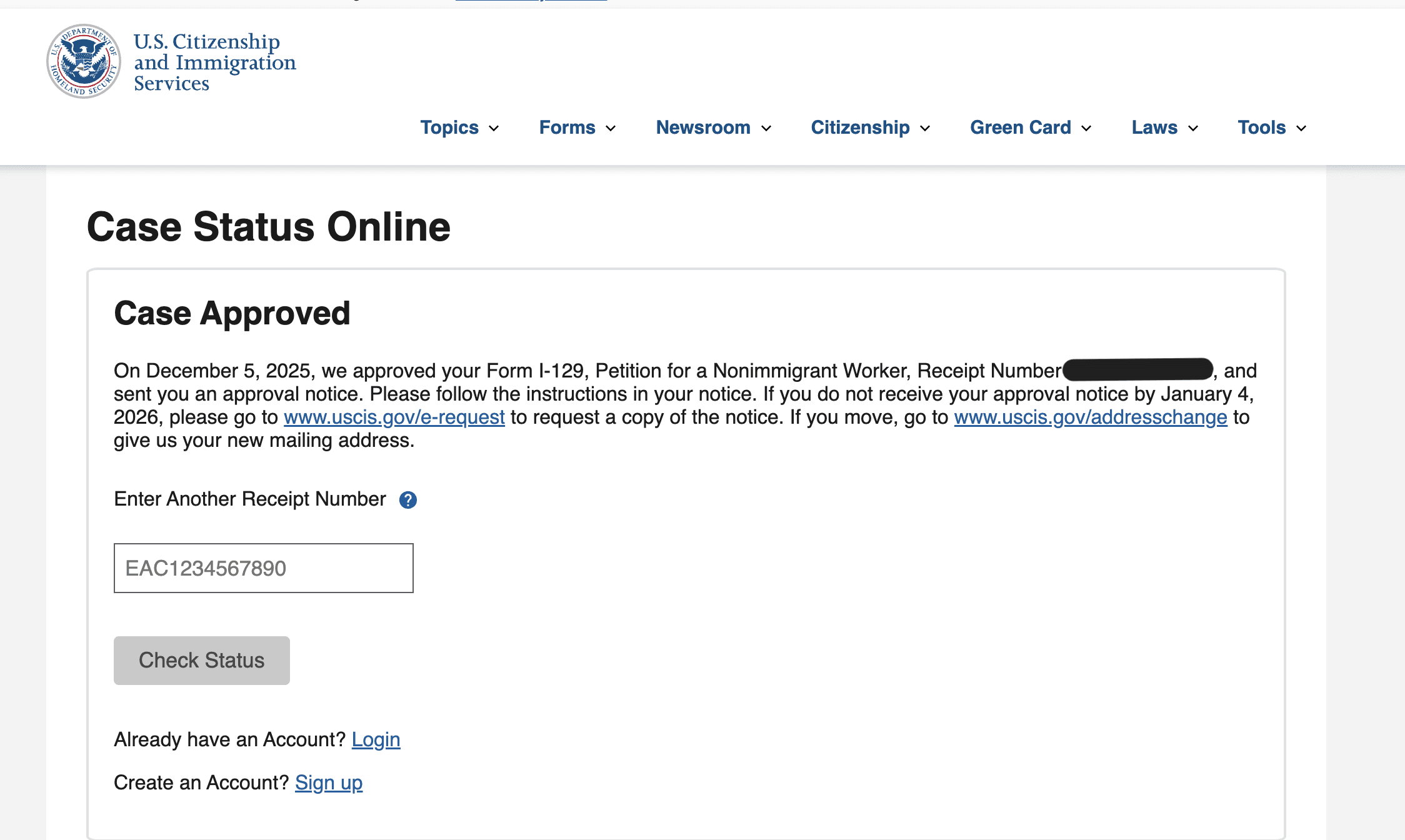
No PhD. No Patents. No Problem. How We Got a $350K Tech Executive EB-1A Approved on 6 Criteria
From Super Bowl streaming architecture to Forbes publications: Inside the petition strategy that proved "extraordinary ability" for a tech executive

From Super Bowl streaming architecture to Forbes publications: Inside the petition strategy that proved "extraordinary ability" for a tech executive

When our client came to us, he had an impressive career - VP of Solutions Engineering at a leading distributed database company, scaling revenue from $1M to $30M+, architecting systems for 125 million Super Bowl viewers. But like many tech professionals, he wondered: Can someone without a PhD or Nobel Prize really qualify for EB-1A?
The answer was yes. And his approved petition demonstrates exactly how.
Field | Data Engineering |
Current Role | Vice President of Solutions Engineering, Leading Database Company |
Education | MS in Telecommunications & Computer Networking, Ivy League University |
Result | EB-1A Approved |
Criteria Documented | 6 out of 10 |
Most EB-1A applicants try to meet the minimum 3 criteria. We documented 6 strong criteria - creating a petition so comprehensive that approval became the logical conclusion.
CRITERION 1: LEADING/CRITICAL ROLE IN DISTINGUISHED ORGANIATIONS
The Challenge: Our client had held senior roles, but "I'm a VP" isn't enough. We needed to prove his roles were critical to organizations with distinguished reputations.
The Solution: We documented three distinct organizations with a specific formula:
Organization credibility + Role specificity + Quantified impact = Approved criterion
Company A: Leading Database Company (Current Role)
Company distinction | Open-source distributed SQL database trusted by Fortune 500 companies; featured in Forbes, TechCrunch, BusinessWire, ZDNet |
Role criticality | Led solutions engineering team; drove enterprise client acquisition |
Quantified impact | Scaled revenue $1M to $30M+; acquired 40+ Fortune 500/Global 2000 clients; architected Super Bowl 2024 streaming platform for 125M viewers |
Company B: Cloud Platform Company (Previous Role)
Company distinction | American technology company specializing in cloud platform hosting; acquired by major tech company for $2.7B |
Role criticality | Technical leadership for pre-sales and enterprise implementations |
Quantified impact | Generated $25M+ in software revenue; "America's Data Engineer of the Year 2015"; President's Club 2015 & 2018 |
Company C: Technology Consulting Firm (Previous Role)
Company distinction | Technology consulting partner for NYSE, FINRA; IBM Lotus Award winner |
Role criticality | Senior Consultant leading Data Analytics practice engagements |
Quantified impact | Led FINRA engagement for financial market regulation architecture; transformed market regulation systems using big data platforms |
Key insight: Three organizations created a pattern of critical contributions that couldn't be dismissed as a single lucky role.
CRITERION 2: MEMBERSHIP IN ASSOCIATIONS REQUIRING OUTSTANDING ACHIEVEMENTS
The Challenge: USCIS doesn't care that you're a member of something. They care that membership requires outstanding achievements - and that you can prove it.
The Solution: We selected three memberships with documented selectivity criteria:
Association | Selectivity Evidence | Why It Matters |
|---|---|---|
Forbes Technology Council | 10-11% acceptance rate; invitation-only for CIOs, CTOs, and technology executives | The low acceptance rate speaks for itself |
Hackathon Raptors Fellowship | Rigorous peer review by 5 technology experts; must demonstrate extraordinary achievements in 2+ of 8 criteria | Fellowship (not just membership) indicates highest tier |
IETE Fellowship | Highest grade of membership; requires 35+ years age, 10+ years experience, 5+ years in senior responsibility OR outstanding contributions | Government-recognized scientific organization adds institutional credibility |
CRITERION 3: JUDGING THE WORK OF OTHERS
The Challenge: A few peer reviews won't cut it. We needed to show sustained, significant judging activity across respected venues.
The Solution: We built a judging portfolio spanning academic conferences AND prestigious industry awards:
Academic Peer Review
Venue | Scope | Evidence |
|---|---|---|
IEEE Conferences (multiple) | 25+ manuscripts reviewed (2019-2024) | Web of Science reviewer profile |
IEEE Silchar Subsection Conference 2024 | 21 papers reviewed across AI, data science, computing | Sample reviews + reviewer certificate |
IEEE ANTS 2024 | 4 papers on blockchain, IoT security, edge computing | Invitation email + sample reviews |
AKCGEC 2024 | 2 papers on deep learning applications | Invitation + review reports + certificate |
Industry Awards Judging
Award Program | Significance | Evidence |
|---|---|---|
CES 2025 Innovation Awards | 3,400+ submissions; one of the most influential technology awards globally | Judge invitation + website feature + thank you email |
Stevie Awards for Women in Business 2024 | International program with 200+ professional judges | Invitation + judging committee profile + certificate |
Stratus Awards for Cloud Computing 2024 | Business Intelligence Group's premier cloud recognition | Confirmation letter + website feature + LinkedIn post |
CRITERION 4: AUTHORSHIP OF SCHOLARLY ARTICLES
The Challenge: Tech professionals often have expertise but limited publications. We needed to build a publication record that demonstrated thought leadership.
The Solution: A three-pronged publication strategy:
Tier 1: Major Trade Publication (Forbes)
Article | Publication | Reach |
|---|---|---|
"Architecting Modern Fabric For Connected Platforms" | Forbes Technology Council | 109.2M monthly digital/social users |
Tier 2: Peer-Reviewed Academic Journals
Journal | Impact Factor | Article Topic |
|---|---|---|
IJCET | 18.59 | AI-driven data quality monitoring framework |
IJAIRD | 6.98 | Mitigating order sensitivity in large language models |
IJCA | 0.702 | Advanced encryption techniques for cloud computing |
IJRAR | - | AI event-driven architecture patterns for cloud computing |
Tier 3: Conference Presentations
Conference | Paper Topic |
|---|---|
AICECS | AI/ML for ADA web accessibility compliance |
ICDCC | Technology management framework using Pega Robotics |
ICDCC | Personalized activity recommendations for cardiovascular patients |
Total Google Scholar citations: 28
CRITERION 5: HIGH SALARY
The Challenge: "VP of Solutions Engineering" isn't a standard BLS category. How do you prove high salary for a non-standard role?
The Solution: Comparable evidence using the closest BLS occupation.
Compensation Component | Amount |
|---|---|
Base Salary | $245,000 |
Variable Compensation | $105,000 |
Total On-Target Earnings | $350,000 |
Stock Options | 40,000 shares (vesting over 48 months) |
How we proved it:
CEO letter documenting exact compensation structure
BLS data for "Computer and Information Systems Managers" (closest comparable role)
90th percentile comparison: BLS shows 90th percentile at $239,200 - our client's base salary alone ($245,000) exceeds this threshold
W-2 forms from 2021-2023 showing actual earnings
CRITERION 6: PUBLISHED MATERIAL ABOUT THE BENEFICIARY
The Challenge: Media coverage about you (not by you) is hard to manufacture. And USCIS has high standards for what counts as "major trade publications."
The Solution: We secured coverage in three technology trade publications and built a legal argument for why they qualify.
Publication | Readership | Article Focus |
|---|---|---|
HackerNoon | 100M+ global; 4M monthly | "How Distributed Databases Power Mission-Critical Business Apps" - Feature Article |
Grit Daily | Technology/business trade | "Building a Resilient Future: Highlights from AWS re:Invent 2024" - Feature Article |
GovInsider | 63,000+ monthly; Southeast Asia government tech focus | "The modern database that can help governments build smart cities" |
5 letters from industry leaders who could credibly evaluate extraordinary ability:
Reference | Title/Organization | Why They're Credible |
|---|---|---|
Recommender 1 | Former SVP Data Architecture, Major Financial Services Company | Led 40 teams, $48M budget; direct knowledge of enterprise data work |
Recommender 2 | Executive Director Software Engineering, Major Investment Bank | Ivy League MS, top leadership program; oversees large-scale digital transformation |
Recommender 3 | Managing Director Strategy & Analytics, Big 4 Consulting Firm | 15+ years in data transformation; Oxford leadership program |
Recommender 4 | VP Enterprise Data Architecture, Fortune 500 Financial Services | 25+ years in enterprise data; 15 years at current firm |
Recommender 5 | CEO & Founder, VC-Backed AI Startup | Founded AI company ($11M+ raised); industry peer |
What made these letters effective:
Established the writer's credentials first - Each letter opened with why the writer is qualified to evaluate extraordinary ability
Used specific examples - Not "he's talented" but "he scaled revenue from $1M to $30M"
Echoed regulatory language - Phrases like "extraordinary ability," "sustained acclaim," and "one of that small percentage" appear throughout
Diverse perspectives - Letters came from former colleagues, industry peers, and executives at unrelated companies
1. You Don't Need a PhD
This case proves that industry achievement - when properly documented - demonstrates extraordinary ability as effectively as academic credentials.
2. Quantity AND Quality Matter
Meeting 3 criteria is the minimum. Meeting 6 criteria with strong evidence creates an overwhelming case.
3. Numbers Transform Narratives
"I led a team" becomes compelling when it's "I scaled revenue from $1M to $30M+ and acquired 40+ Fortune 500 clients."
4. Build Your Profile Proactively
Several elements of this case - Forbes Technology Council membership, IEEE peer reviews, industry awards judging - were activities our client pursued before the petition. The best EB-1A cases are built over time.
5. Legal Strategy Matters
Citing relevant case law (especially for non-obvious arguments like trade publication definitions) shows adjudicators you understand the regulatory framework.
If you're a tech professional wondering whether your achievements qualify for EB-1A, consider:
Have you held senior roles where you drove measurable business outcomes?
Do you belong to selective professional organizations?
Have you reviewed papers, judged awards, or evaluated others' work?
Have you published articles, spoken at conferences, or been featured in trade media?
Does your compensation place you in the top 10% of your field?
If you answered yes to three or more of these questions, you may have a stronger case than you think.
Not sure if EB-1A is your best path - or if EB-2 NIW, O-1A, or another option fits better?
Our free evaluation takes 5 minutes and gives you a clear answer.
Get Your Free Visa Evaluation →
No lawyers. No jargon. Just a clear recommendation based on your profile.
This case study is based on an actual approved EB-1A petition.
Details are shared with client permission for educational purposes.
When our client came to us, he had an impressive career - VP of Solutions Engineering at a leading distributed database company, scaling revenue from $1M to $30M+, architecting systems for 125 million Super Bowl viewers. But like many tech professionals, he wondered: Can someone without a PhD or Nobel Prize really qualify for EB-1A?
The answer was yes. And his approved petition demonstrates exactly how.
Field | Data Engineering |
Current Role | Vice President of Solutions Engineering, Leading Database Company |
Education | MS in Telecommunications & Computer Networking, Ivy League University |
Result | EB-1A Approved |
Criteria Documented | 6 out of 10 |
Most EB-1A applicants try to meet the minimum 3 criteria. We documented 6 strong criteria - creating a petition so comprehensive that approval became the logical conclusion.
CRITERION 1: LEADING/CRITICAL ROLE IN DISTINGUISHED ORGANIATIONS
The Challenge: Our client had held senior roles, but "I'm a VP" isn't enough. We needed to prove his roles were critical to organizations with distinguished reputations.
The Solution: We documented three distinct organizations with a specific formula:
Organization credibility + Role specificity + Quantified impact = Approved criterion
Company A: Leading Database Company (Current Role)
Company distinction | Open-source distributed SQL database trusted by Fortune 500 companies; featured in Forbes, TechCrunch, BusinessWire, ZDNet |
Role criticality | Led solutions engineering team; drove enterprise client acquisition |
Quantified impact | Scaled revenue $1M to $30M+; acquired 40+ Fortune 500/Global 2000 clients; architected Super Bowl 2024 streaming platform for 125M viewers |
Company B: Cloud Platform Company (Previous Role)
Company distinction | American technology company specializing in cloud platform hosting; acquired by major tech company for $2.7B |
Role criticality | Technical leadership for pre-sales and enterprise implementations |
Quantified impact | Generated $25M+ in software revenue; "America's Data Engineer of the Year 2015"; President's Club 2015 & 2018 |
Company C: Technology Consulting Firm (Previous Role)
Company distinction | Technology consulting partner for NYSE, FINRA; IBM Lotus Award winner |
Role criticality | Senior Consultant leading Data Analytics practice engagements |
Quantified impact | Led FINRA engagement for financial market regulation architecture; transformed market regulation systems using big data platforms |
Key insight: Three organizations created a pattern of critical contributions that couldn't be dismissed as a single lucky role.
CRITERION 2: MEMBERSHIP IN ASSOCIATIONS REQUIRING OUTSTANDING ACHIEVEMENTS
The Challenge: USCIS doesn't care that you're a member of something. They care that membership requires outstanding achievements - and that you can prove it.
The Solution: We selected three memberships with documented selectivity criteria:
Association | Selectivity Evidence | Why It Matters |
|---|---|---|
Forbes Technology Council | 10-11% acceptance rate; invitation-only for CIOs, CTOs, and technology executives | The low acceptance rate speaks for itself |
Hackathon Raptors Fellowship | Rigorous peer review by 5 technology experts; must demonstrate extraordinary achievements in 2+ of 8 criteria | Fellowship (not just membership) indicates highest tier |
IETE Fellowship | Highest grade of membership; requires 35+ years age, 10+ years experience, 5+ years in senior responsibility OR outstanding contributions | Government-recognized scientific organization adds institutional credibility |
CRITERION 3: JUDGING THE WORK OF OTHERS
The Challenge: A few peer reviews won't cut it. We needed to show sustained, significant judging activity across respected venues.
The Solution: We built a judging portfolio spanning academic conferences AND prestigious industry awards:
Academic Peer Review
Venue | Scope | Evidence |
|---|---|---|
IEEE Conferences (multiple) | 25+ manuscripts reviewed (2019-2024) | Web of Science reviewer profile |
IEEE Silchar Subsection Conference 2024 | 21 papers reviewed across AI, data science, computing | Sample reviews + reviewer certificate |
IEEE ANTS 2024 | 4 papers on blockchain, IoT security, edge computing | Invitation email + sample reviews |
AKCGEC 2024 | 2 papers on deep learning applications | Invitation + review reports + certificate |
Industry Awards Judging
Award Program | Significance | Evidence |
|---|---|---|
CES 2025 Innovation Awards | 3,400+ submissions; one of the most influential technology awards globally | Judge invitation + website feature + thank you email |
Stevie Awards for Women in Business 2024 | International program with 200+ professional judges | Invitation + judging committee profile + certificate |
Stratus Awards for Cloud Computing 2024 | Business Intelligence Group's premier cloud recognition | Confirmation letter + website feature + LinkedIn post |
CRITERION 4: AUTHORSHIP OF SCHOLARLY ARTICLES
The Challenge: Tech professionals often have expertise but limited publications. We needed to build a publication record that demonstrated thought leadership.
The Solution: A three-pronged publication strategy:
Tier 1: Major Trade Publication (Forbes)
Article | Publication | Reach |
|---|---|---|
"Architecting Modern Fabric For Connected Platforms" | Forbes Technology Council | 109.2M monthly digital/social users |
Tier 2: Peer-Reviewed Academic Journals
Journal | Impact Factor | Article Topic |
|---|---|---|
IJCET | 18.59 | AI-driven data quality monitoring framework |
IJAIRD | 6.98 | Mitigating order sensitivity in large language models |
IJCA | 0.702 | Advanced encryption techniques for cloud computing |
IJRAR | - | AI event-driven architecture patterns for cloud computing |
Tier 3: Conference Presentations
Conference | Paper Topic |
|---|---|
AICECS | AI/ML for ADA web accessibility compliance |
ICDCC | Technology management framework using Pega Robotics |
ICDCC | Personalized activity recommendations for cardiovascular patients |
Total Google Scholar citations: 28
CRITERION 5: HIGH SALARY
The Challenge: "VP of Solutions Engineering" isn't a standard BLS category. How do you prove high salary for a non-standard role?
The Solution: Comparable evidence using the closest BLS occupation.
Compensation Component | Amount |
|---|---|
Base Salary | $245,000 |
Variable Compensation | $105,000 |
Total On-Target Earnings | $350,000 |
Stock Options | 40,000 shares (vesting over 48 months) |
How we proved it:
CEO letter documenting exact compensation structure
BLS data for "Computer and Information Systems Managers" (closest comparable role)
90th percentile comparison: BLS shows 90th percentile at $239,200 - our client's base salary alone ($245,000) exceeds this threshold
W-2 forms from 2021-2023 showing actual earnings
CRITERION 6: PUBLISHED MATERIAL ABOUT THE BENEFICIARY
The Challenge: Media coverage about you (not by you) is hard to manufacture. And USCIS has high standards for what counts as "major trade publications."
The Solution: We secured coverage in three technology trade publications and built a legal argument for why they qualify.
Publication | Readership | Article Focus |
|---|---|---|
HackerNoon | 100M+ global; 4M monthly | "How Distributed Databases Power Mission-Critical Business Apps" - Feature Article |
Grit Daily | Technology/business trade | "Building a Resilient Future: Highlights from AWS re:Invent 2024" - Feature Article |
GovInsider | 63,000+ monthly; Southeast Asia government tech focus | "The modern database that can help governments build smart cities" |
5 letters from industry leaders who could credibly evaluate extraordinary ability:
Reference | Title/Organization | Why They're Credible |
|---|---|---|
Recommender 1 | Former SVP Data Architecture, Major Financial Services Company | Led 40 teams, $48M budget; direct knowledge of enterprise data work |
Recommender 2 | Executive Director Software Engineering, Major Investment Bank | Ivy League MS, top leadership program; oversees large-scale digital transformation |
Recommender 3 | Managing Director Strategy & Analytics, Big 4 Consulting Firm | 15+ years in data transformation; Oxford leadership program |
Recommender 4 | VP Enterprise Data Architecture, Fortune 500 Financial Services | 25+ years in enterprise data; 15 years at current firm |
Recommender 5 | CEO & Founder, VC-Backed AI Startup | Founded AI company ($11M+ raised); industry peer |
What made these letters effective:
Established the writer's credentials first - Each letter opened with why the writer is qualified to evaluate extraordinary ability
Used specific examples - Not "he's talented" but "he scaled revenue from $1M to $30M"
Echoed regulatory language - Phrases like "extraordinary ability," "sustained acclaim," and "one of that small percentage" appear throughout
Diverse perspectives - Letters came from former colleagues, industry peers, and executives at unrelated companies
1. You Don't Need a PhD
This case proves that industry achievement - when properly documented - demonstrates extraordinary ability as effectively as academic credentials.
2. Quantity AND Quality Matter
Meeting 3 criteria is the minimum. Meeting 6 criteria with strong evidence creates an overwhelming case.
3. Numbers Transform Narratives
"I led a team" becomes compelling when it's "I scaled revenue from $1M to $30M+ and acquired 40+ Fortune 500 clients."
4. Build Your Profile Proactively
Several elements of this case - Forbes Technology Council membership, IEEE peer reviews, industry awards judging - were activities our client pursued before the petition. The best EB-1A cases are built over time.
5. Legal Strategy Matters
Citing relevant case law (especially for non-obvious arguments like trade publication definitions) shows adjudicators you understand the regulatory framework.
If you're a tech professional wondering whether your achievements qualify for EB-1A, consider:
Have you held senior roles where you drove measurable business outcomes?
Do you belong to selective professional organizations?
Have you reviewed papers, judged awards, or evaluated others' work?
Have you published articles, spoken at conferences, or been featured in trade media?
Does your compensation place you in the top 10% of your field?
If you answered yes to three or more of these questions, you may have a stronger case than you think.
Not sure if EB-1A is your best path - or if EB-2 NIW, O-1A, or another option fits better?
Our free evaluation takes 5 minutes and gives you a clear answer.
Get Your Free Visa Evaluation →
No lawyers. No jargon. Just a clear recommendation based on your profile.
This case study is based on an actual approved EB-1A petition.
Details are shared with client permission for educational purposes.
Explore Topics

0%
Explore Topics
0%