Quick Answer
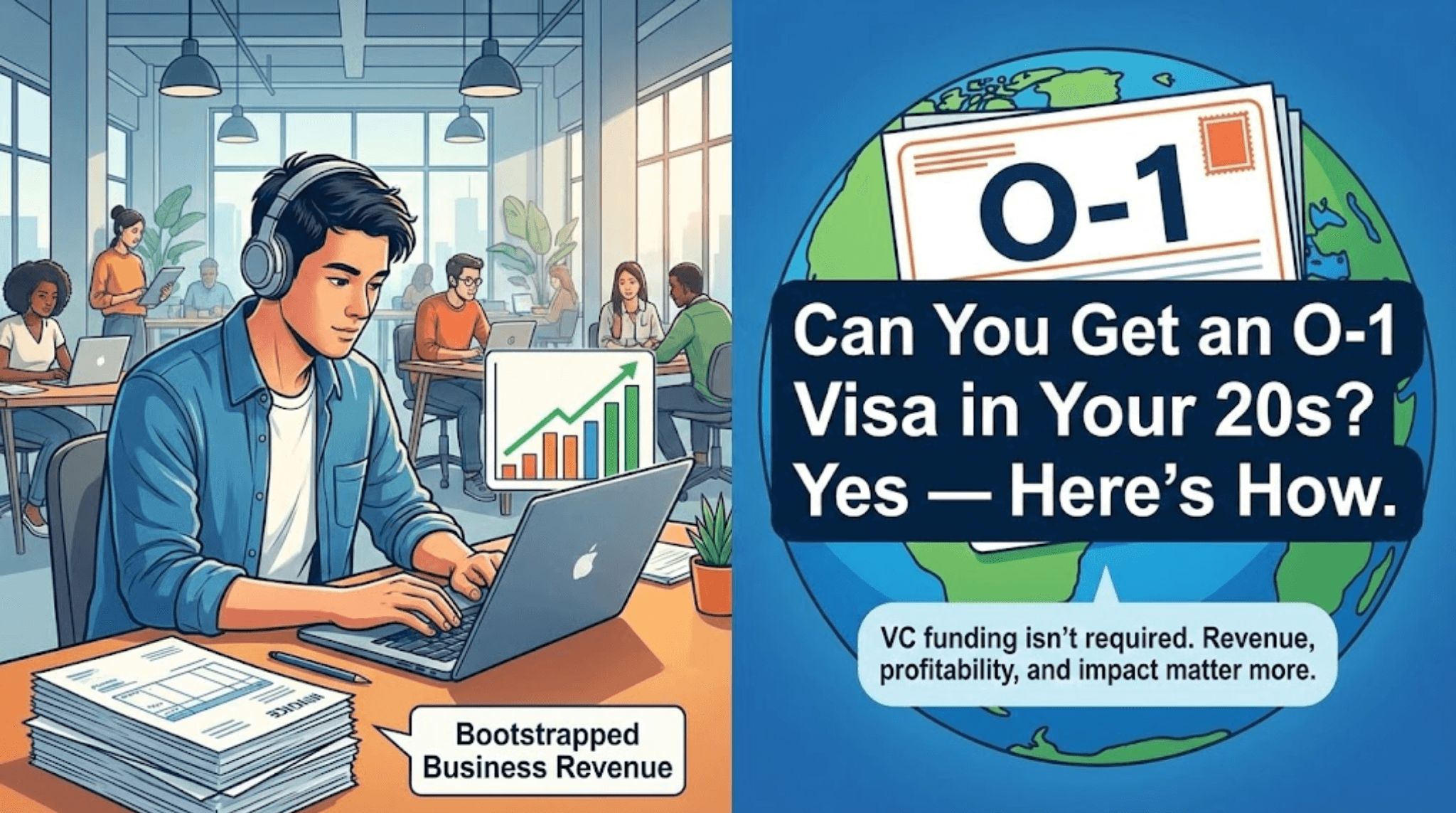
Yes, you can absolutely get an O-1A visa in your 20s with a bootstrapped, profitable business. USCIS does not require venture capital funding; what they require is evidence of "extraordinary ability" demonstrated through sustained recognition and achievement. Revenue generation, profitability, and business impact can serve as strong evidence for multiple O-1A criteria, often more compellingly than a funding round alone. Your age is irrelevant; your achievements relative to your field are what matter.
Key Takeaways
VC funding is not an O-1A requirement. USCIS evaluates extraordinary ability through 8 criteria, none of which mandate outside investment.
Revenue and profitability can strengthen your case. Business income can qualify as a company's distinguished reputation and USCIS explicitly recognizes the same for critical role criterion.
Age does not determine eligibility. "Extraordinary" is measured against your field and peers, not arbitrary age benchmarks. A 24-year-old who built a profitable SaaS can demonstrate the same level of distinction as a 40-year-old executive.
Bootstrapped founders often have stronger "original contributions" evidence. Building something profitable without external capital is itself evidence of innovation, market validation, and business acumen.
You only need three of the eight criteria. Aim for 4-5 if you want a comfortable margin, but you don’t have to meet all of them. Strategic evidence selection is key. Most successful bootstrapped founders focus on original contributions, critical role, high remuneration, and media coverage.
What USCIS Actually Looks For (Hint: It's Not Your Cap Table)
The O-1A visa is designed for individuals with "extraordinary ability" in business, sciences, education, or athletics. To qualify, you must demonstrate sustained national or international acclaim and be among the small percentage who have risen to the top of their field. USCIS requires either a major internationally recognized award (like a Nobel Prize) or evidence satisfying at least 3 of 8 regulatory criteria.
Here is what is critical to understand: nowhere in these criteria does USCIS require venture capital funding. The criteria focus on recognition, impact, and achievement, all of which bootstrapped founders can demonstrate without a term sheet.
The 8 O-1A Criteria: A Bootstrapped Founder's Perspective
Awards or prizes for excellence. Startup competitions, Forbes 30 Under 30, industry awards, and grants all count. Bootstrapped founders who have won pitch competitions or received recognition for innovation can claim this.
Membership in associations requiring outstanding achievement. Selective accelerators like Y Combinator or Techstars (even without equity) and industry associations with competitive admission qualify. You must personally be a member, not just your company.
Published material about you in major media. TechCrunch profiles, podcast features, industry publication coverage, and business media interviews all qualify. The coverage must focus on you and your work, not just your company's product announcements.
Judging the work of others. Serving as a startup mentor, hackathon judge, accelerator advisor, or grant reviewer demonstrates field expertise.
Original contributions of major significance. This is often the strongest criterion for bootstrapped founders. Building a novel product, creating technology others adopt, or developing methodologies that influence your industry all qualify. Profitability without external funding is itself evidence of market-validated innovation.
Authorship of scholarly articles. Technical authorships in respected publications, industry whitepapers, and contributed articles in professional journals count.
Critical or essential role in distinguished organizations. As founder and CEO of your company, you inherently hold a critical role. The key is demonstrating your organization's distinction through revenue, customer impact, or industry recognition.
High salary or remuneration. This is where bootstrapped founders often have an advantage., Future founder compensation does qualify. For entrepreneurs or founders of startup businesses, officers consider evidence that the business has received significant funding from government entities, venture capital funds, angel investors, or other such funders in evaluating the credibility of submitted contracts, job offer letters, or other evidence of prospective salary or remuneration for services.
Why Revenue Can Be Stronger Evidence Than Funding
Here is the insight most immigration attorneys miss: USCIS is increasingly skeptical of using VC funding alone to satisfy criteria. Recent guidance suggests that funding, by itself, is "unlikely to meet the award criterion" and should instead be used to support the critical role and original contributions criteria. This actually benefits bootstrapped founders.
A profitable, revenue-generating business demonstrates something funding cannot: market validation. When customers pay for your product, you have third-party evidence that your contribution has real-world value. When you achieve profitability without outside capital, you demonstrate the kind of business acumen and innovation that defines "extraordinary ability" in business.
Consider the evidence profile of a bootstrapped founder generating 300K USD ARR versus a funded founder with 2M USD raised but no revenue. The bootstrapped founder can show: paying customers (market validation), sustainable business model (original contribution), founder income from profits (high remuneration), and the ability to create value without external subsidy (distinguishing achievement). The funded founder must rely more heavily on the funding event itself, which USCIS views with increasing scrutiny.
What "Extraordinary" Means for Young Founders
"Extraordinary ability" is not measured against the general population or some arbitrary career milestone. It is measured against your field. A 25-year-old founder who has built a profitable SaaS, been featured in industry publications, and mentors at startup events has demonstrated distinction among entrepreneurs, regardless of age.
In fact, early achievement can strengthen your case. Building a sustainable business while still in your early 20s, without the safety net of corporate savings or family wealth, is itself a distinguishing factor. USCIS looks for individuals who have "risen to the very top of the field," and the field of entrepreneurship includes founders at every age. The question is not "how old are you?" but "what have you achieved relative to your peers?"
Bootstrapped vs. Funded: O-1A Evidence Comparison
Criterion | Funded Founder | Bootstrapped Founder |
Awards | VC selection, pitch wins | Grants, competitions, industry awards, media lists |
Original Contributions | Product innovation, market disruption | Profitable innovation, market-validated product, sustainable model |
High Remuneration | Current & prospective founder salary | Business profits, owner draws |
Critical Role | CEO of venture-backed company | Sole founder, complete business ownership and control |
Media Coverage | Funding announcement coverage | Profile pieces, industry expertise features, podcast appearances |
Strategic Roadmap for Bootstrapped Founders
If you are building a profitable business and considering an O-1A, here is how to strengthen your evidence profile:
Document your revenue and profitability rigorously. Tax returns, financial statements, and bank records showing consistent income become your "high remuneration" evidence.
Build your media profile proactively. Seek podcast interviews, contribute articles to industry publications, and pitch your story to business media. Start this 6 to 12 months before you plan to apply.
Create judging opportunities. Mentor at startup events, judge hackathons, advise accelerator programs, or review grant applications. These activities demonstrate recognized expertise.
Frame your product as an "original contribution." Document how your technology or methodology differs from competitors, how others have adopted your approach, and what measurable impact you have created.
Collect strong recommendation letters. USCIS weighs letters from independent experts who know you by reputation, such as industry leaders, customers, or peers who can speak to your impact without having worked directly with you.
Ready to Evaluate Your O-1A Eligibility?
OpenSphere helps bootstrapped founders and entrepreneurs understand exactly where they stand on O-1A eligibility, with no guesswork and no generic advice. Our evaluation breaks down which criteria you currently meet, which need strengthening, and what specific evidence to gather next.
Does the O-1A visa require proof of VC funding or investment?
No. USCIS does not require venture capital funding for O-1A eligibility. The visa evaluates "extraordinary ability" through 8 criteria, none of which mandate outside investment. Funding can be used as supporting evidence (particularly for awards or original contributions), but it is not required, and USCIS has indicated that funding alone is "unlikely to meet the award criterion."
Can business revenue count toward the "high salary" criterion?
Yes. For self-employed individuals and entrepreneurs, USCIS accepts business income as evidence of high remuneration. This includes Schedule C income (for sole proprietors), owner draws, and documented profits.
How much revenue do I need to qualify as a bootstrapped founder?
There is no specific revenue threshold. What matters is demonstrating that your compensation is "high" relative to others in your field. Generally, if your income places you in the top 10 percent of entrepreneurs or business professionals in your industry, you have a strong case. The key is providing comparative data (salary surveys, industry benchmarks) showing your remuneration exceeds typical levels.
Can I get an O-1A in my early 20s?
Absolutely. Age is not a factor in O-1A eligibility. USCIS evaluates whether you have "risen to the very top of the field" relative to your peers, not whether you have reached a certain age or career stage. Founders in their 20s regularly qualify by demonstrating significant achievements in entrepreneurship, such as building profitable businesses, receiving industry recognition, or creating widely adopted innovations.
What evidence should bootstrapped founders focus on?
The strongest criteria for bootstrapped founders are typically:
(1) Original contributions of major significance, such as your product, technology, or business model innovation;
(2) Critical role in a distinguished organization, meaning your leadership of a successful company;
(3) High remuneration, including your current or future founder income; and
(4) Published material about you, such as media coverage of your work and expertise.
Can my own startup sponsor my O-1A visa?
Yes, but with requirements. Your U.S. company can petition for your O-1A, but you must establish a legitimate employer-employee relationship. This typically requires having at least one other employee (such as a co-founder, manager, or board member, preferably a U.S. citizen or green card holder) who can authorize your employment. You cannot be the sole employee hiring yourself.
How long does the O-1A application process take?
Standard processing takes 1 to 3 months. Premium processing (available for an additional fee) guarantees a decision within 15 business days. Preparation typically takes 2 to 3 months before filing, as gathering evidence, obtaining recommendation letters, and compiling documentation requires significant effort.
Is there an annual cap on O-1A visas like the H-1B?
No. Unlike the H-1B, the O-1A has no annual numerical cap and no lottery. You can apply at any time, and approval is based solely on your qualifications. This makes the O-1A particularly attractive for entrepreneurs who need predictability in their immigration timeline.
Can the O-1A lead to a green card?
Yes. O-1A holders commonly transition to the EB-1A (Extraordinary Ability) green card category, which shares similar evidentiary requirements but with a slightly higher standard. The EB-1A allows self-petitioning without employer sponsorship and has no per-country backlogs, making it an efficient path to permanent residence for entrepreneurs.
What if my business is profitable but "nothing crazy" - can I still qualify?
Potentially yes. "Extraordinary ability" does not require unicorn-level success. It requires being among the "small percentage" at the top of your field. A sustainable, profitable business in your 20s, especially one built without outside funding, can demonstrate exceptional entrepreneurial ability. The key is framing your achievements in context: what have you accomplished relative to other founders at your stage? How does your revenue compare to industry benchmarks? What impact has your work had? These narrative elements matter as much as raw numbers.
Stop wondering if you qualify. Get a clear answer.
OpenSphere's O-1A evaluation gives you a criterion by criterion breakdown of your eligibility. Start your evaluation today at opensphere.com/evaluate