Quick Answer
Concurrent filing (I-140 + I-485 together) lets you adjust status while staying in the U.S., with benefits like EAD work permit and Advance Parole travel document during processing. Consular processing requires an interview at a U.S. embassy abroad but may be faster in some cases. Choose concurrent filing if you're in the U.S. and want flexibility; choose consular processing if you're abroad or face specific circumstances that make it advantageous.
Key Takeaways
Concurrent filing: File I-140 and I-485 together; stay in U.S. during processing.
Consular processing: I-140 approved first; then interview at U.S. consulate abroad.
EAD/AP benefits: Concurrent filing provides work permit and travel document while waiting.
Timing matters: Concurrent filing only available when priority date is current.
Risk profile differs: Concurrent filing keeps you in U.S.; consular processing requires leaving.
Chinese nationals: Consider avoiding consular processing due to administrative processing risks.
Understanding the Two Paths
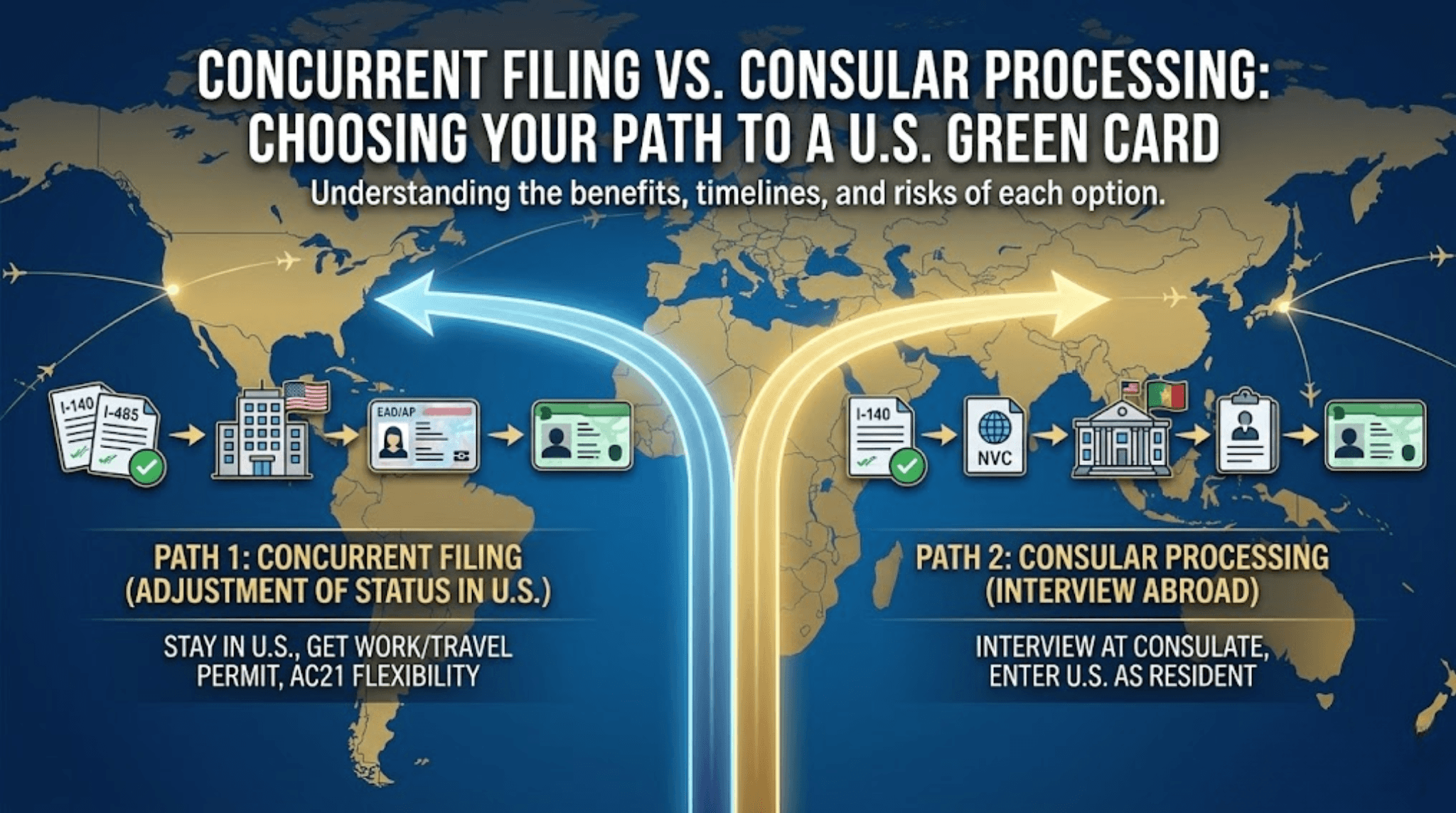
Path 1: Adjustment of Status (Concurrent Filing)
What it is:
File I-485 (Adjustment of Status) while in the U.S.
Can file concurrently with I-140 or after I-140 approval
Remain in U.S. during entire process
Interview at local USCIS office (if required)
Benefits:
Don't leave U.S. during processing
Get EAD (Employment Authorization Document)
Get Advance Parole (travel document)
Can change employers after 180 days (AC21)
Avoid consular interview
Requirements:
Must be physically in U.S.
Must have entered U.S. legally
Priority date must be current
Must maintain valid status (or be within grace period)
Path 2: Consular Processing
What it is:
I-140 is approved in U.S.
Case transfers to National Visa Center (NVC)
Interview at U.S. consulate in your country
Enter U.S. as permanent resident
Benefits:
May be faster in some situations
Required if you're outside U.S.
No need to maintain U.S. status during processing
Some prefer interview abroad
Requirements:
I-140 must be approved
Priority date must be current
Must attend interview at consulate
Must pass medical exam and background check
Concurrent Filing: Detailed Process
Step 1: File I-140 and I-485 Together
When you can do this:
Priority date is current (no backlog for your category/country)
You're in valid status in the U.S.
What you file:
I-140 (Immigrant Petition)
I-485 (Adjustment of Status)
I-765 (EAD application) - optional but recommended
I-131 (Advance Parole) - optional but recommended
Fees:
I-140: $700
I-485: $1,225
I-765: $0 (included with I-485)
I-131: $0 (included with I-485)
Biometrics: $85
Step 2: Receive EAD and Advance Parole
Timeline: 3-6 months after filing
EAD benefits:
Work for any employer
Not tied to visa sponsor
Valid while I-485 pending
Advance Parole benefits:
Travel outside U.S. and return
Re-entry as "parolee"
Can travel multiple times
Combo card: EAD and Advance Parole often issued together on single card.
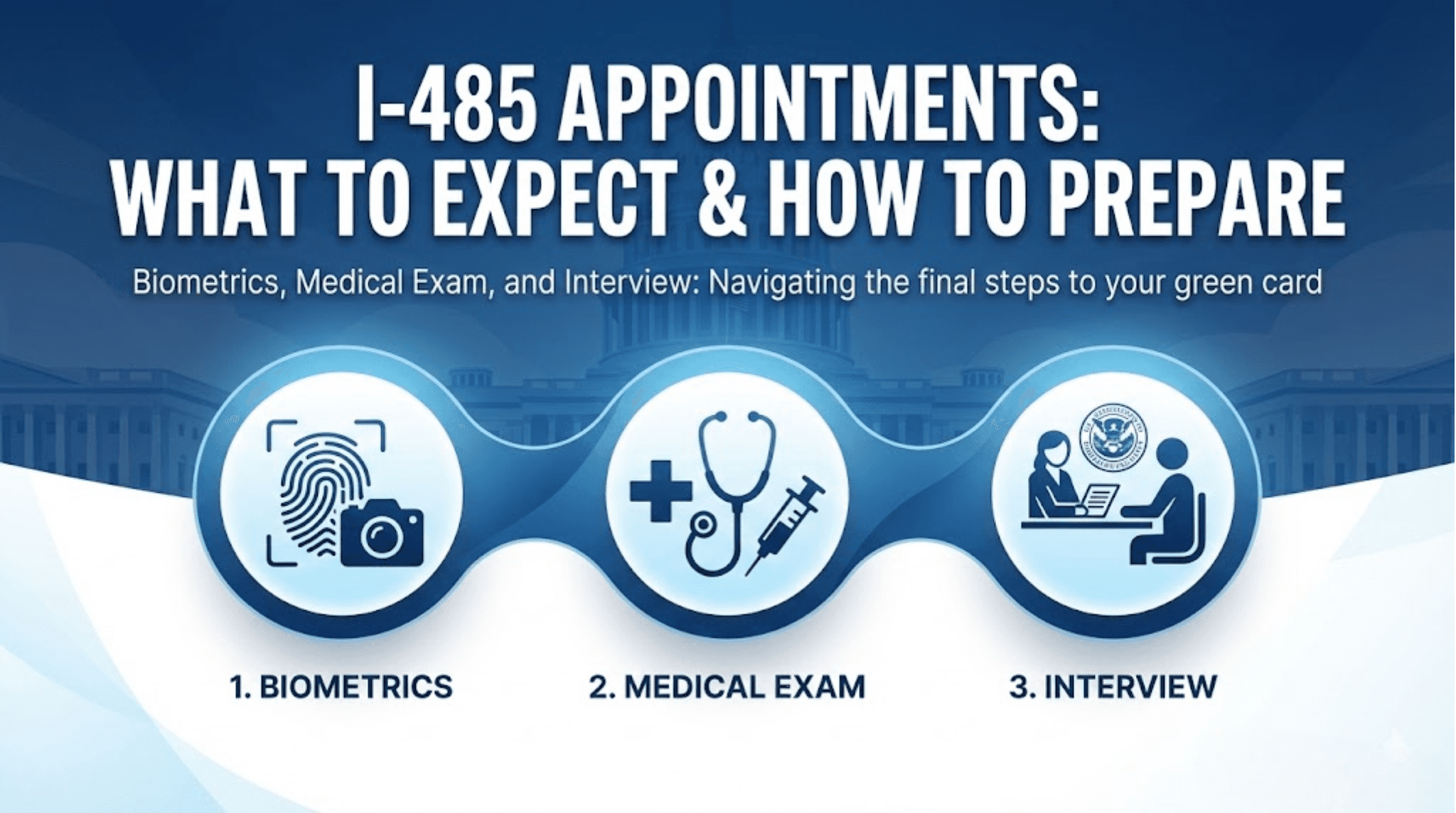
Step 3: Attend Biometrics Appointment
Timeline: 2-4 weeks after filing
What happens:
Fingerprints taken
Photo taken
Background check initiated
Step 4: Interview (If Required)
Timeline: 8-18 months after filing
What happens:
Interview at local USCIS office
Review documents
Questions about application and background
Many employment-based cases waive interview
Step 5: Green Card Approval
Timeline: 12-24 months total
What happens:
I-485 approved
Green card mailed
You're now permanent resident
Consular Processing: Detailed Process
Step 1: I-140 Approval
File I-140 with USCIS:
Indicate "consular processing" as preference
Specify consulate where you'll interview
Wait for approval:
Standard: 6-12 months
Premium (if available): 15 days
Step 2: National Visa Center (NVC) Processing
After I-140 approval:
Case transfers to NVC
NVC assigns case number
You submit DS-260 (immigrant visa application)
Pay fees ($325 IV fee + $120 Affidavit of Support fee)
Submit civil documents (birth certificate, police certificates, etc.)
Timeline: 2-4 months
Step 3: Interview Scheduling
After NVC processing complete:
NVC schedules interview at consulate
Timing depends on consulate backlog
Some consulates: weeks; others: months
Step 4: Medical Examination
Before interview:
Complete medical exam with panel physician
Vaccines required
Valid for 6 months
Cost: $200-$500 depending on country
Step 5: Consular Interview
At U.S. consulate:
Present documents
Answer questions
Biometrics (if not already done)
Decision usually same day
Possible outcomes:
Approved: Visa stamped in passport
Administrative processing: Additional review (weeks to months)
Denied: Explanation provided
Step 6: Enter U.S. as Permanent Resident
After visa approval:
Enter U.S. within visa validity (typically 6 months)
Present visa at port of entry
Passport stamped as permanent resident
Green card mailed to U.S. address
When to Choose Concurrent Filing
Choose concurrent filing if:
1. You're currently in the U.S.
Most straightforward option
Don't need to leave and return
2. You want EAD and Advance Parole
Work authorization not tied to employer
Travel flexibility during processing
Particularly valuable if current visa is expiring
3. You want AC21 portability
After 180 days, can change employers
Green card process continues with new employer
Important if job situation may change
4. You want to avoid consular interview
Some find USCIS interviews less stressful
Avoid administrative processing risks at consulates
Especially relevant for Chinese nationals
5. Priority date is current
Required for concurrent filing
If priority date isn't current, must wait
When to Choose Consular Processing
Choose consular processing if:
1. You're currently outside the U.S.
Can't file I-485 from abroad
Consular processing is only option
2. You have immigration violations
Certain violations bar I-485 but not consular processing
Overstay, unauthorized employment, etc.
Consult attorney for specific situation
3. Your consulate is fast
Some consulates process quickly
May be faster than USCIS in your area
4. You prefer to return home during process
Personal or family reasons
Business obligations abroad
5. Specific strategic reasons
Attorney may recommend based on your situation
Complex cases may benefit from one path
Special Considerations by Nationality
Chinese Nationals:
Risk: Administrative processing (221(g)) at consulates is common for Chinese nationals, especially in STEM fields.
Recommendation: Strongly consider concurrent filing if eligible. Avoids consular interview and associated administrative processing risk.
Indian Nationals:
Consideration: If using EB-1A (no backlog), concurrent filing is straightforward. If using EB-2/EB-3 (massive backlog), concurrent filing isn't available until priority date is current (many years).
Strategy: File I-140 early to lock priority date. When priority date eventually becomes current, decide based on circumstances at that time.
All Nationalities:
If priority date is current: Concurrent filing usually preferred for flexibility and benefits.
If priority date isn't current: Consular processing is the only option unless you wait.
Switching Between Paths
Can you switch from concurrent filing to consular processing?
Yes, but complicated:
Withdraw I-485
Request consular processing
Transfer case to NVC
Rarely done
Can you switch from consular processing to concurrent filing?
Yes, if:
You enter U.S. on valid status
Priority date is still current
File I-485 before interview
Timeline Comparison
Stage | Concurrent Filing | Consular Processing |
I-140 processing | Concurrent with I-485 | 6-12 months (or premium) |
NVC processing | N/A | 2-4 months |
EAD/AP | 3-6 months | N/A |
Interview scheduling | 8-18 months | Varies by consulate |
Total timeline | 12-24 months | 8-18 months |
Work authorization | EAD in 3-6 months | Upon entry as immigrant |
How OpenSphere Helps Choose Your Path
Eligibility Assessment: Based on your location, status, and priority date, determine which paths are available.
Risk Analysis: Evaluate administrative processing risk for consular processing based on nationality and field.
Timeline Comparison: Compare expected timelines for both paths based on current processing times.
Recommendation: Personalized recommendation based on your specific circumstances.
Comparison Table: Concurrent Filing vs Consular Processing
Factor | Concurrent Filing | Consular Processing |
Location during process | Stay in U.S. | Can be anywhere |
Work authorization | EAD while pending | Upon entry |
Travel during process | With Advance Parole | Freely (not in U.S.) |
Change employers | AC21 after 180 days | After entry |
Interview location | Local USCIS office | U.S. consulate abroad |
Admin processing risk | Lower | Higher (some nationalities) |
Best for | Those in U.S. wanting flexibility | Those abroad or specific situations |
Deciding between concurrent filing and consular processing? Want to understand which path is better for your situation?
Take the OpenSphere evaluation. You'll get personalized path recommendation with timeline analysis.
FAQ
1. Can I file I-485 if my priority date isn't current?
No. Priority date must be current to file I-485. Otherwise, must wait or use consular processing when date becomes current.
2. What's the "combo card"?
EAD and Advance Parole issued together on single card. Allows both work and travel.
3. Can I travel while I-485 is pending?
Only with Advance Parole. Leaving without AP may abandon your application.
4. What's AC21 portability?
After I-485 pending 180+ days, you can change to same/similar job without affecting green card.
5. How long is EAD valid?
Typically 2 years. Can renew if I-485 still pending.
6. What if my consulate has long wait times?
Consider whether concurrent filing is better option if you can enter U.S. on valid status.
7. Can I work while I-485 is pending without EAD?
You can continue on current work visa. EAD provides alternative work authorization.
8. What's administrative processing?
Additional security review at consulates. Can add weeks to months. More common for certain nationalities and fields.
9. Can my spouse file I-485 with me?
Yes. Spouse files as derivative beneficiary. Same timeline.
10. What if I-485 is denied?
You may need to leave U.S. Options depend on denial reason. Consult attorney.