Quick Answer
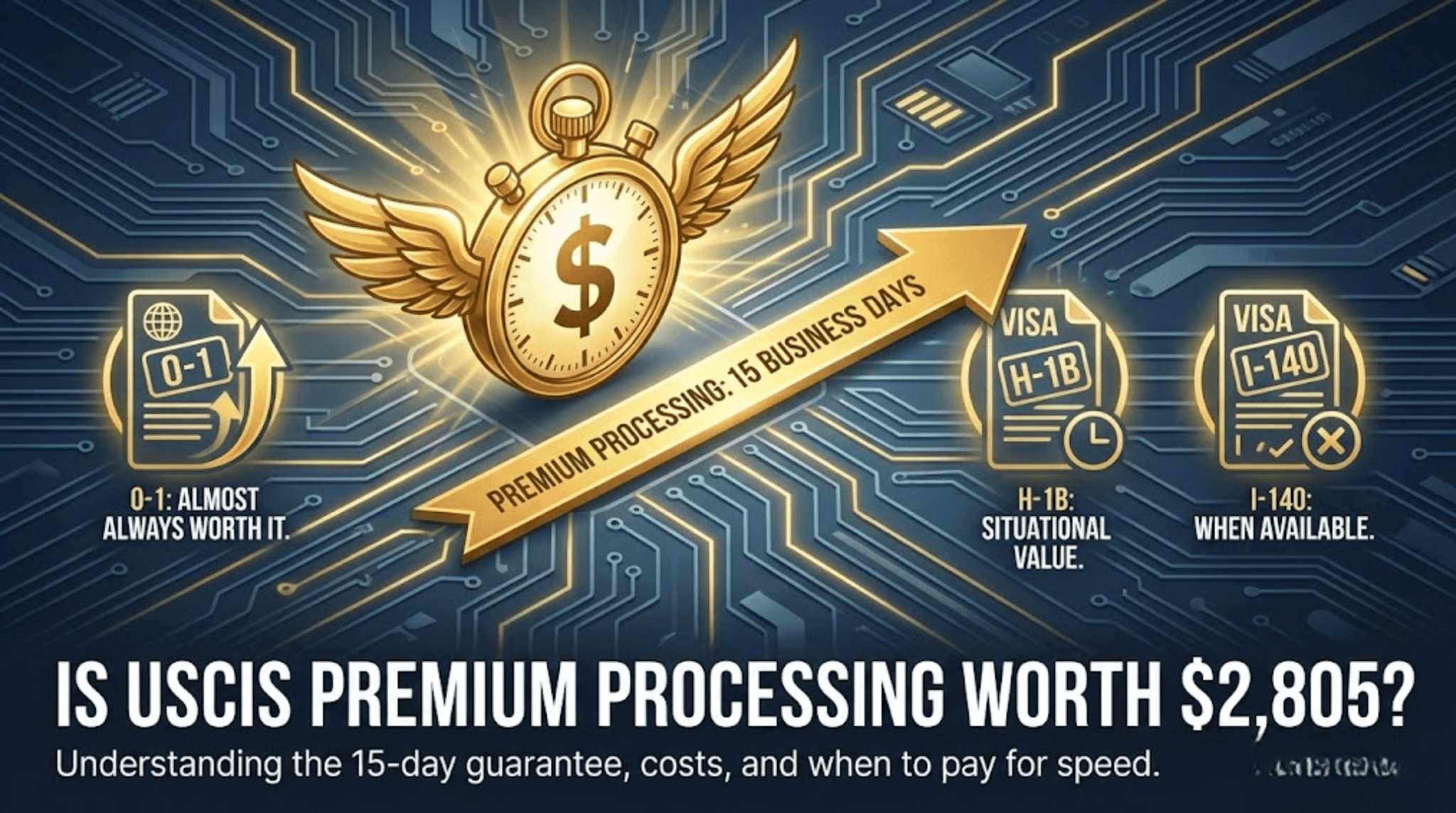
Premium processing ($2,805) guarantees USCIS will act on your petition within 15 business days but "act" means decision, RFE, or denial, not guaranteed approval. Premium processing is almost always worth it for O-1 (reduces uncertainty, fast timeline), situationally valuable for H-1B (depends on start date), and not available for many green card petitions. The $2,805 is refunded if USCIS misses the deadline, but this rarely happens.
Key Takeaways
15-day guarantee is for action, not approval: USCIS may approve, deny, or issue RFE within 15 days.
O-1: Almost always worth it: Fast decision reduces uncertainty; O-1 cases benefit from speed.
H-1B: Depends on timing: Useful if you need to start quickly; less valuable if waiting until October anyway.
Green cards: Limited availability: I-140 premium processing is sometimes available; I-485 has no premium option.
Refund if deadline missed: If USCIS doesn't meet 15-day deadline, fee is refunded.
Can upgrade after filing: You can add premium processing to pending petition.
Understanding Premium Processing
What it is:
Expedited processing service for certain petitions
USCIS guarantees action within 15 business days
"Action" = approval, denial, RFE, or NOID
What it costs:
$2,805 (as of 2024)
In addition to regular filing fees
Paid via I-907 form
What it guarantees:
Decision, RFE, or denial within 15 business days
If deadline missed, fee is refunded
Processing restarts if RFE issued
What it doesn't guarantee:
Approval
Specific outcome
Faster processing after RFE response
Which Petitions Allow Premium Processing
Premium processing IS available for:
Petition | Premium Available? | Fee |
H-1B (I-129) | Yes | $2,805 |
O-1 (I-129) | Yes | $2,805 |
L-1 (I-129) | Yes | $2,805 |
TN (I-129) | Yes | $2,805 |
H-1B1 (I-129) | Yes | $2,805 |
E-1/E-2 (I-129) | Yes | $2,805 |
I-140 (EB-1, EB-2, EB-3) | Sometimes* | $2,805 |
*I-140 premium processing availability varies. USCIS suspends and resumes it periodically.
Premium processing is NOT available for:
I-485 (Adjustment of Status)
I-130 (Family petitions)
N-400 (Naturalization)
I-765 (EAD) in most cases
I-131 (Advance Parole)
O-1 Premium Processing: Almost Always Worth It
Why premium processing is recommended for O-1:
1. Reduces uncertainty
O-1 outcomes are less predictable than H-1B
Knowing decision in 15 days allows planning
If denied, you have time to respond or refile
2. Fast timeline
Standard O-1 processing: 2-4 months
Premium processing: 15 days
Significant time savings
3. Evidence doesn't change
Your evidence is what it is
Waiting longer doesn't improve approval odds
Get answer quickly
4. Planning flexibility
Know outcome before making commitments
Can start work sooner upon approval
Reduces limbo period
When NOT to use premium for O-1:
You're not ready to respond to potential RFE
Budget constraints make $2,805 difficult
You're certain of approval and have plenty of time
Bottom line: For most O-1 petitions, premium processing is worth the cost.
H-1B Premium Processing: Situational Value
H-1B lottery winners: Premium value depends on timing
Scenario 1: Need to start working ASAP
You want to start before October 1
You need quick decision for planning
Premium processing: Worth it
Scenario 2: Waiting until October 1 anyway
You can't start until October 1 regardless
You have months until start date
Premium processing: Less valuable
H-1B transfer: Premium almost always worth it
You can start working once transfer is filed
Faster approval = more certainty
Premium processing: Worth it
H-1B extension: Depends on timing
If current status expiring soon: Worth it
If plenty of time remaining: Less urgent
Remember: For cap-subject H-1B, you can't start working until October 1 even with approval, so premium mostly helps with planning certainty.
I-140 Premium Processing: When Available
I-140 (EB-1A, EB-1B, EB-1C, EB-2, EB-3)
Availability:
USCIS periodically suspends and resumes I-140 premium
Check current availability before filing
When available, works like other premium processing
When worth it:
You need I-140 approved for H-1B extension (beyond 6 years)
You're trying to establish priority date quickly
You want certainty for planning
When less valuable:
I-485 can't be filed anyway (backlogged priority date)
You're not in a rush for I-140 decision
Budget is constrained
Note: Even with I-140 premium processing, I-485 has no premium option—green card final approval takes its own time.
The RFE Consideration
What happens if you get RFE with premium processing?
Initial petition:
USCIS issues RFE within 15 days
This satisfies premium processing requirement
Your $2,805 is not refunded (USCIS met their deadline)
After RFE response:
15-day clock restarts when you respond to RFE
New 15-day processing period begins
Another decision, RFE, or denial within 15 days
Implication:
Premium processing doesn't mean "no RFE"
It means faster RFE (if one is coming)
Total time = initial 15 days + RFE response time + another 15 days
Upgrading to Premium After Filing
You can add premium processing to a pending petition:
How:
File I-907 with $2,805 fee
Reference your pending petition
USCIS will expedite pending case
When this makes sense:
Circumstances changed and you need faster decision
Processing times have increased unexpectedly
You initially filed standard to save money but now need speed
Limitations:
Only works for petition types that allow premium
Processing already completed = too late
Cost-Benefit Analysis
$2,805 is worth it when:
High cost of waiting:
Job offer contingent on quick approval
Current status expiring
Life plans depend on visa outcome
Extended uncertainty is stressful
Time savings are significant:
Standard processing: 4-6 months
Premium processing: 15 days
You're saving 3.5-5.5 months
$2,805 may NOT be worth it when:
No urgency:
Plenty of time before status expiration
Outcome doesn't affect immediate plans
Waiting doesn't have significant cost
Budget constraints:
$2,805 is significant portion of total cost
Money could be better used elsewhere
Outcome doesn't change:
For H-1B cap: Can't start until October 1 anyway
For backlogged green card: I-140 approval doesn't accelerate I-485
Common Premium Processing Misconceptions
Misconception 1: "Premium means guaranteed approval"
Reality: Premium guarantees decision speed, not approval. You can get a fast denial.
Misconception 2: "Premium processing gets more careful review"
Reality: Same officers, same standards. Premium just prioritizes your case.
Misconception 3: "If I get RFE, premium was wasted"
Reality: Premium got you a faster RFE. That's still valuable—you know what's needed sooner.
Misconception 4: "Standard processing is more likely to be approved"
Reality: No evidence that processing speed affects approval rates.
How OpenSphere Recommends Premium Processing
For each petition type, OpenSphere evaluates:
Urgency factors:
Current status expiration
Job start date requirements
Life planning dependencies
Financial factors:
$2,805 as percentage of total cost
Budget constraints
Strategic factors:
Whether faster decision enables better planning
Risk of delay costs exceeding premium fee
Recommendation output:
"Premium recommended: Fast decision enables [specific benefit]"
"Premium optional: Standard processing adequate given timeline"
"Premium not recommended: Limited benefit for your situation"
Comparison Table: Premium Processing by Petition
Petition | Standard Time | Premium Time | Premium Value |
O-1 | 2-4 months | 15 days | Almost always worth it |
H-1B (new) | 3-6 months | 15 days | Situational (Oct 1 start) |
H-1B (transfer) | 2-4 months | 15 days | Almost always worth it |
L-1 | 3-6 months | 15 days | Usually worth it |
I-140 | 6-12 months | 15 days | Depends on situation |
Wondering whether premium processing makes sense for your petition? Need help calculating the cost-benefit?
Take the OpenSphere evaluation. You'll get premium processing recommendation based on your specific situation.
FAQ
1. What happens if USCIS misses the 15-day deadline?
Your premium processing fee ($2,805) is refunded. This rarely happens.
2. Does premium processing increase approval chances?
No evidence of this. Same standards apply; you just get faster decision.
3. Can I get premium processing for I-485?
No. I-485 (Adjustment of Status) doesn't have premium processing option.
4. Can I request refund if I get RFE?
No. RFE within 15 days satisfies USCIS obligation. Fee is only refunded if deadline is missed.
5. How do I add premium processing to pending case?
File Form I-907 with $2,805 fee, referencing your pending receipt number.
6. Does 15 days mean calendar days or business days?
Business days. Weekends and federal holidays don't count.
7. Is premium processing available for all I-140 categories?
Availability varies. USCIS periodically suspends I-140 premium. Check current status.
8. Can my employer pay for premium processing?
Yes. Anyone can pay. For H-1B, some employers pay; others ask employees to pay.
9. If I get denied with premium processing, can I refile?
Yes. You can refile new petition, potentially with premium processing again.
10. Is $2,805 tax deductible?
Generally no for personal immigration. Consult tax professional for your situation.