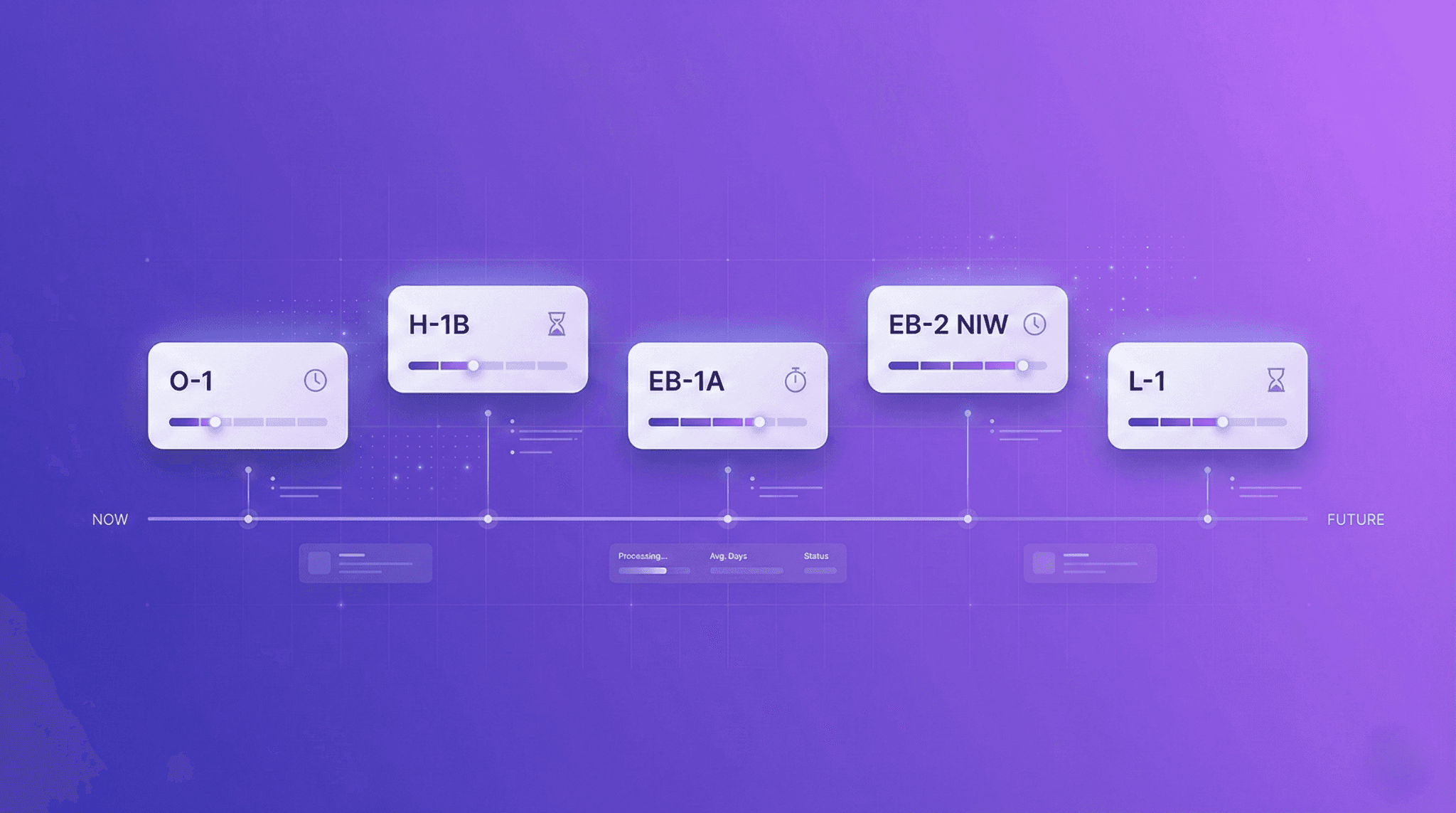
How Long Does Each Visa Actually Take? Processing Time Reality Check for 2025
USCIS estimates don't tell the full story. Here are real-world processing times for O-1, H-1B, EB-1A, EB-2 NIW, and other visas - including what they don't tell you.
USCIS estimates don't tell the full story. Here are real-world processing times for O-1, H-1B, EB-1A, EB-2 NIW, and other visas - including what they don't tell you.
Application submission: 90 days before graduation (earliest)
USCIS processing: 3-5 months
Recommendation: Apply 90 days before to ensure approval by graduation
Understanding RFE Impact on Timelines
RFE (Request for Evidence) rates by visa:
O-1: 40-50%
H-1B: 20-30%
EB-1A: 50-60%
EB-2 NIW: 30-40%
L-1: 30-40%
How RFEs affect timeline:
USCIS issues RFE: +3-4 weeks
You have 87 days to respond: +1-3 months (depending on how quickly you respond)
USCIS adjudicates response: +2-4 weeks
Total RFE delay: 3-6 months
Premium processing with RFE:
Decision on RFE response: 15 days
But preparation time still exists
Total RFE delay with premium: 2-3 months
Hidden Timeline Factors
Credential Evaluation:
If degree from outside U.S.: 2-4 weeks
Required for most visa types
Do this early to avoid delays
Medical Examination:
Required for I-485 (adjustment of status)
Appointment scheduling: 1-4 weeks
Results: 1-2 weeks
Total: 2-6 weeks
Police Certificates:
Required for some visa types
Can take 2-12 weeks depending on country
Translation of Documents:
Non-English documents must be translated
Certified translations: 1-2 weeks
Do this early
Biometrics Appointment:
USCIS schedules after filing
Typically 2-4 weeks after filing
Missing appointment delays case by 1-2 months
Service Center Variability
Processing times vary by USCIS service center:
California Service Center: Generally slower for EB-1A
Nebraska Service Center: Faster for O-1, slower for NIW
Texas Service Center: Moderate speed across categories
Vermont Service Center: Fastest for some categories
You typically can't choose service center (USCIS assigns based on your location or employer location).
How OpenSphere Gives Realistic Timelines
Full Timeline Calculator
Input your visa type, current status, country of birth, and evidence readiness. OpenSphere shows total timeline including all phases (prep, processing, RFE risk, backlog).
Evidence Readiness Impact
OpenSphere calculates: If evidence ready now: 2 months. If need to build: 9 months.
RFE Probability
Based on your evidence strength, OpenSphere estimates RFE likelihood and adjusts timeline.
Backlog Projections
For EB-2/EB-3, OpenSphere projects priority date movement based on historical trends.
Processing Time vs Real-World Timeline
Visa Type
USCIS Processing Time
Real-World Total Time
O-1 (premium)
15 days
1.5-9 months (depending on evidence)
H-1B (cap-subject)
2-4 months
6-7 months (including lottery wait)
EB-1A
12-18 months
24-36 months (start to green card)
EB-2 NIW (non-backlog)
12-18 months
24-36 months
EB-2 NIW (India)
12-18 months
25-30 years (including backlog)
EB-2 PERM (India)
4-8 months (I-140 only)
15-20 years (including PERM + backlog)
Want to know the real timeline for your specific visa path, including evidence preparation, RFE risk, and backlog impact?
Take the OpenSphere evaluation. You'll get a detailed timeline breakdown with best-case and worst-case scenarios.
No. It only guarantees a decision (approval or denial) within 15 days. It doesn't prevent RFEs or denials.
2. Can I expedite EB-1A or NIW?
No premium processing available for I-140 green card petitions (except in rare emergency cases).
3. What if I need to work before my visa is approved?
H-1B transfers and L-1 extensions: can start working once filed. O-1: must wait for approval. EB-1A/NIW: need separate work authorization.
4. How long does consular processing take?
2-6 months typically, but can be 12+ months if administrative processing is required (security clearances, background checks).
5. Can I check my case status?
Yes, via USCIS online case status tool. Updates are sporadic—don't panic if you don't see movement for weeks.
6. What causes administrative processing delays?
Security clearances, name checks, background investigations. Common for certain countries or fields (nuclear, defense, sensitive tech).
7. How accurate are USCIS processing time estimates?
Generally within 1-2 months, but outliers exist. Some cases take 2x longer than estimate.
8. Does filing early in the month help?
No proven advantage. USCIS processes in order received, but random factors (officer assignment, RFE likelihood) matter more.
9. Can my visa be expedited due to emergency?
Rarely. USCIS allows expedite requests for severe financial loss, emergency, humanitarian reasons, or nonprofit interests. Approval rate is low.
10. What happens if my current status expires while visa is pending?
Depends: If filed before expiration, you can stay while pending (but may not be able to work). If filed after expiration, you may accrue unlawful presence.