Quick Answer
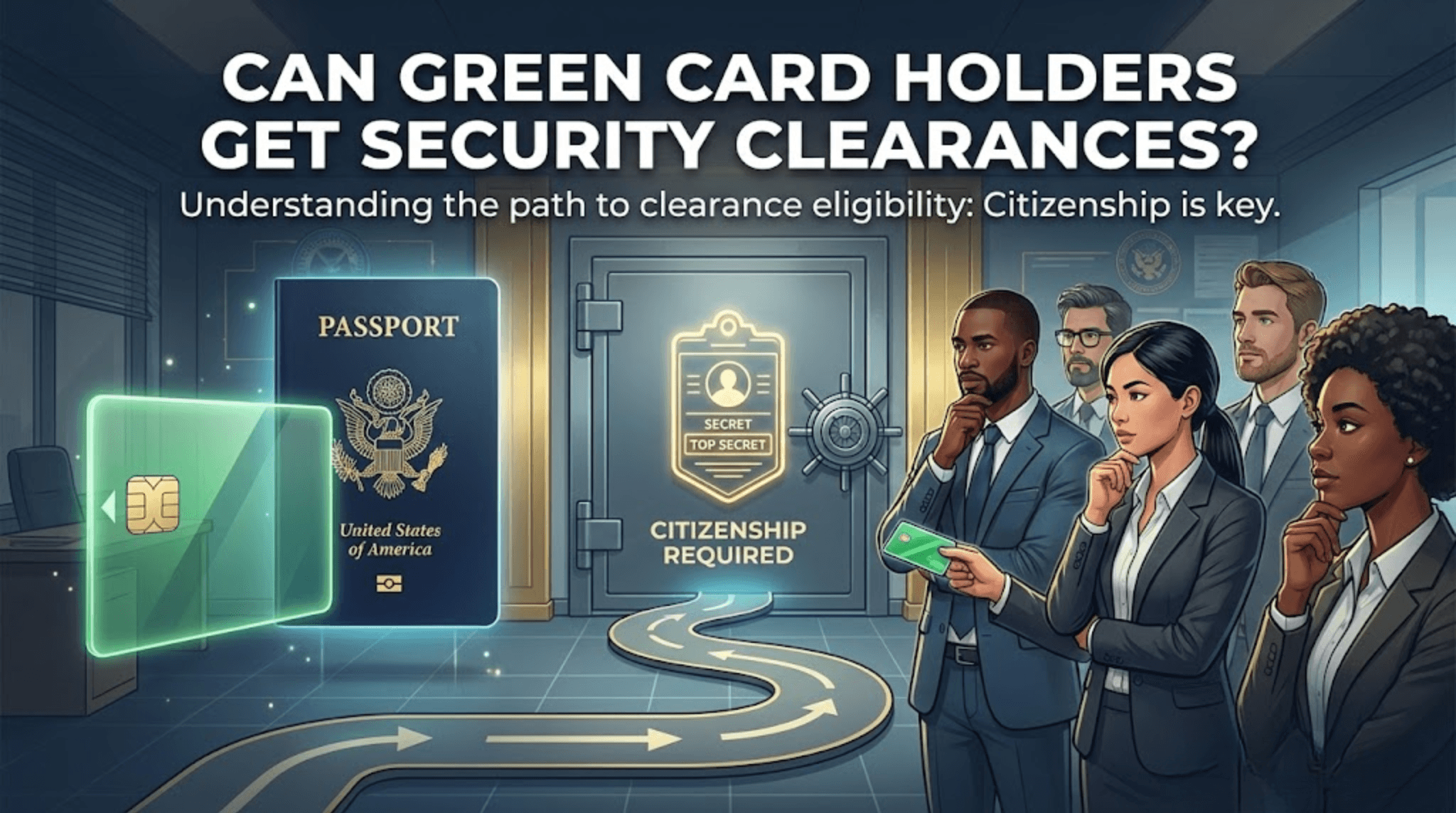
Most security clearances require U.S. citizenship green card holders generally cannot obtain Secret or Top Secret clearances. However, green card holders can work on many government projects that don't require clearances, and some positions have "Limited Access Authorization" for non-citizens. Defense contractors often sponsor visas but require naturalization before clearance-required roles. Plan your immigration path with eventual citizenship in mind if security clearance is a career goal.
Key Takeaways
Security clearances typically require citizenship: Secret, Top Secret, and higher clearances require U.S. citizenship.
Green card holders can work in defense: Many positions don't require clearance, just employment authorization.
Limited Access Authorization (LAA) exists: Rare exception for non-citizens in specific circumstances.
ITAR and export control are different: These restrict access based on citizenship but aren't security clearances.
Naturalization is the path to clearance: Plan immigration with eventual citizenship timeline in mind.
Foreign contacts affect clearance adjudication: Your immigration history and foreign ties are considered.
Understanding Security Clearance Levels
Confidential:
Lowest level
Access to information that could cause damage to national security
Requires U.S. citizenship (generally)
Secret:
Middle level
Access to information that could cause serious damage
Requires U.S. citizenship
Top Secret:
Highest standard level
Access to information that could cause exceptionally grave damage
Requires U.S. citizenship
Extensive background investigation
Top Secret/SCI (Sensitive Compartmented Information):
Top Secret plus additional access
Specific intelligence information
U.S. citizenship required
Polygraph may be required
Q and L Clearances (Department of Energy):
Q: Comparable to Top Secret
L: Comparable to Secret
U.S. citizenship required
The Citizenship Requirement
Why clearances require citizenship:
Trust and allegiance concerns
Ability to conduct thorough background investigation
Reduced foreign influence risks
Statutory and regulatory requirements
The rule:
Executive Order 12968 requires that access to classified information be limited to U.S. citizens
This applies to almost all security clearances
The rare exception:
Limited Access Authorization (LAA):
Temporary access for non-citizens
Only when compelling reason exists
Cannot exceed Secret level
Very rarely granted
Agency head must approve
In practice: Don't count on LAA. Plan for citizenship.
What Green Card Holders Can Do
Positions NOT requiring clearance:
Many defense and government contractor roles don't require security clearance:
Commercial technology roles
Non-classified research
Administrative positions
IT roles without classified access
Support functions
Green card holders can:
Work for defense contractors on unclassified projects
Conduct research without classified applications
Support government programs without clearance
Build career while pursuing citizenship
Export control (ITAR/EAR) is different:
ITAR (International Traffic in Arms Regulations) and EAR (Export Administration Regulations) restrict access to certain technology based on citizenship—but this isn't security clearance.
ITAR requirements:
Limits access to defense articles and technical data
Generally requires "U.S. Person" status
Green card holders ARE "U.S. Persons" for ITAR
So green card holders can access ITAR-controlled information
This is important: Green card holders face fewer ITAR restrictions than visa holders (who are not "U.S. Persons").
Defense Contractor Immigration Paths
Common scenario:
You're offered a job at defense contractor. What are your immigration options?
H-1B:
Defense contractors can sponsor H-1B
Many do, especially for engineering roles
Work on unclassified projects
Build toward green card
O-1:
If you qualify, O-1 is excellent option
No lottery
Work on unclassified projects
Green Card:
Employers often sponsor green cards
EB-2 or EB-3 through PERM
Or self-petition if you qualify (EB-1A, NIW)
Path to clearance:
H-1B/O-1 (work on unclassified)
Green card (still unclassified)
Naturalization (after 5 years as green card holder)
Apply for security clearance (after citizenship)
Timeline: 8-12 years from initial visa to clearance eligibility
How Immigration History Affects Clearance
When you apply for clearance, they investigate:
Foreign contacts:
Family abroad
Friends in foreign countries
Professional contacts
Frequency of communication
Foreign travel:
Countries visited
Purpose of travel
Duration and frequency
Foreign financial interests:
Bank accounts abroad
Property ownership
Business interests
Foreign citizenship:
Dual citizenship status
Renunciation of foreign citizenship
Passport usage
Not disqualifying but considered:
Having foreign-born family is common
Investigators look at totality of circumstances
Honesty is critical—disclose everything
The Naturalization-to-Clearance Timeline
Year 0: Arrive in U.S. on H-1B/O-1
Year 2-3: Green card approved
Year 7-8: Naturalization eligible (5 years as green card holder)
Year 8-9: Naturalization approved, become citizen
Year 8-9: Apply for security clearance
Year 9-10: Clearance investigation (6-18 months)
Year 10+: Clearance granted, access classified work
Total: Roughly 10 years from initial visa to security clearance
Factors that can extend timeline:
Green card backlog (India: adds 10+ years)
Investigation complications
Denial and reapplication
Employer Considerations
Will employers wait for your clearance?
Large defense contractors:
Often hire for unclassified work first
Support green card sponsorship
Move employees to classified work after naturalization
Long-term workforce planning
Smaller contractors:
May need clearance immediately
Less able to wait 10+ years
May not sponsor immigrants
Government agencies:
Federal employment often requires citizenship
Even non-clearance roles may require citizenship
Some exceptions for technical positions
Questions to ask employers:
What percentage of work requires clearance?
Do you sponsor green cards?
Can I work on unclassified projects initially?
Is there a path to cleared work after naturalization?
Special Considerations by Field
Aerospace:
Many positions ITAR-controlled (green card holders okay)
Clearance for classified programs (citizenship required)
Strong demand for engineers willing to pursue citizenship path
Cybersecurity:
Some positions require clearance
Many unclassified roles available
Growing demand across cleared and uncleared work
Nuclear:
DOE Q clearance required for classified
Green card holders can work in commercial nuclear
National labs often require citizenship
Intelligence Community:
Almost all positions require clearance
Citizenship is essential
Some contractor roles may hire for future clearance
The Foreign Influence Concern
What clearance investigators worry about:
Exploitation risk:
Could foreign governments pressure you through family?
Are you susceptible to blackmail?
Do you have loyalties that conflict with U.S. interests?
How to address concerns:
Be completely honest on SF-86
Document all foreign contacts
Explain relationships clearly
Show strong ties to U.S.
Not automatically disqualifying:
Having foreign-born spouse
Parents living abroad
Siblings in other countries
Visiting home country occasionally
Red flags:
Hiding foreign contacts
Unexplained foreign travel
Financial ties to adversary nations
Recent naturalization with suspicious timeline
How OpenSphere Helps with Defense/Government Careers
Timeline Projection: Based on your current status and green card path, project when you could be clearance-eligible.
Employer Strategy: Identify defense contractors who sponsor immigrants and offer uncleared work while you pursue citizenship.
Path Optimization: For defense career goals, compare paths that minimize time to citizenship (EB-1A vs employer-sponsored).
Foreign Contact Assessment: Understand how your background might be viewed in clearance investigation.
Comparison Table: Work Authorization vs Clearance
Status | Work for Defense Contractor? | ITAR Access? | Security Clearance? |
H-1B | Yes (unclassified) | No (not U.S. Person) | No |
O-1 | Yes (unclassified) | No (not U.S. Person) | No |
Green Card | Yes (unclassified) | Yes (U.S. Person) | No |
U.S. Citizen | Yes (all) | Yes | Yes (if approved) |
Pursuing a career in defense or government? Want to understand the timeline from visa to security clearance eligibility?
Take the OpenSphere evaluation. You'll get defense/government career path analysis with citizenship timeline.
FAQ
1. Can green card holders get security clearances?
Generally no. Security clearances typically require U.S. citizenship.
2. What about Limited Access Authorization?
LAA exists but is extremely rare. Don't plan your career around getting one.
3. Can I work at defense contractors on a visa?
Yes, on unclassified projects. Many defense contractors sponsor H-1B and green cards.
4. What's the difference between ITAR and security clearance?
ITAR restricts technology access; security clearance grants access to classified information. Green card holders can access ITAR-controlled information but not classified information.
5. How long after citizenship can I get clearance?
You can apply immediately after naturalization. Investigation takes 6-18 months.
6. Does foreign birth affect clearance?
Not automatically disqualifying. Investigators consider your whole situation.
7. Do I need to renounce foreign citizenship?
Not always required but may be asked depending on country and clearance level.
8. Can I speed up the path to clearance eligibility?
Fastest path: EB-1A (no backlog) → Green card in 2-3 years → Citizenship in 5 more years → Clearance eligible in ~8 years.
9. Will my family abroad be investigated?
Family backgrounds may be reviewed, especially immediate family. Routine for naturalized citizens applying for clearance.
10. What if my clearance is denied?
You can appeal. Denial doesn't affect citizenship status. May affect career options in classified work.