Quick answer
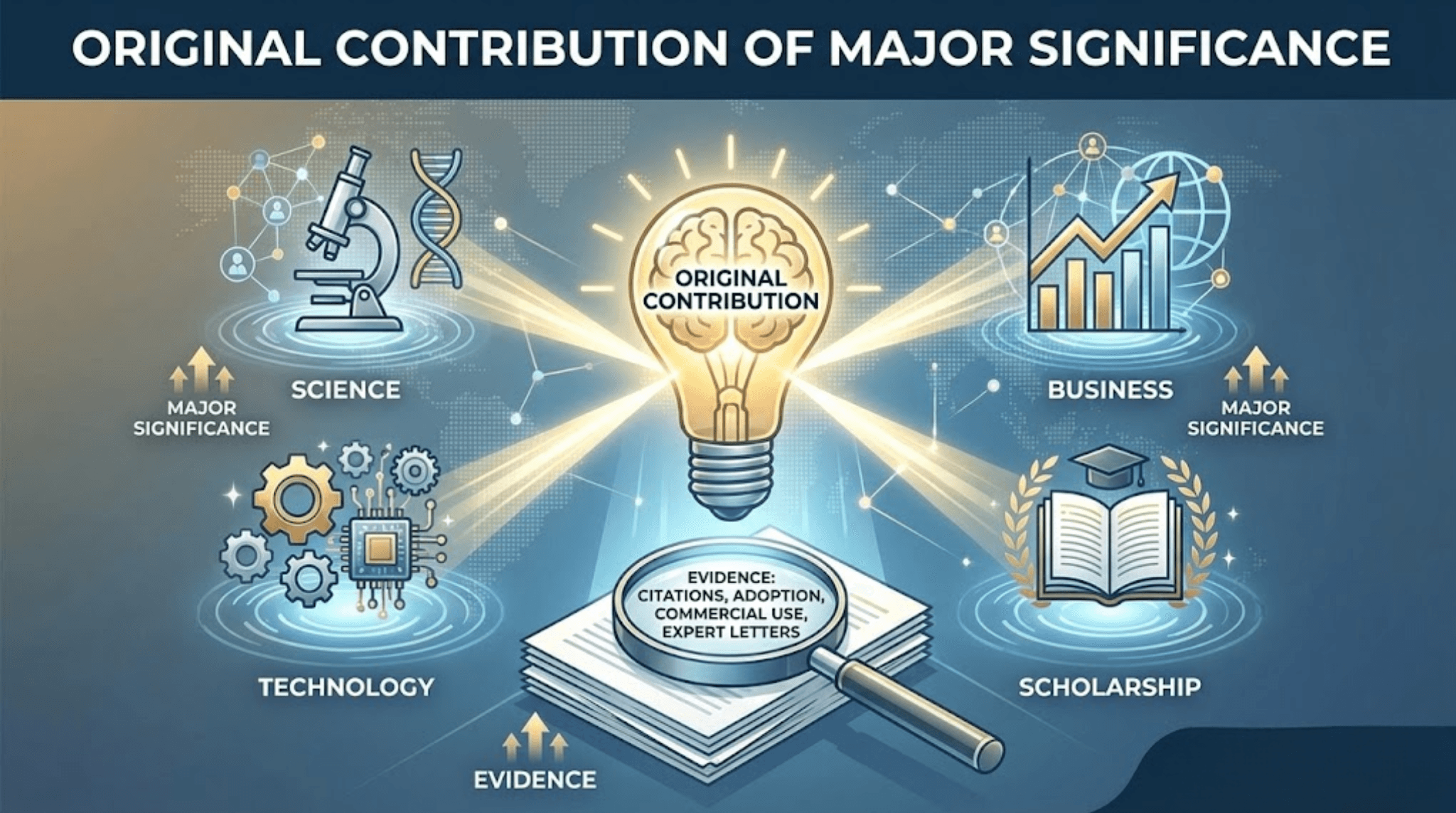
An original contribution of major significance means you created something new—a methodology, technology, discovery, or innovation—that demonstrably influenced how others work in your field. USCIS looks beyond the fact that your work was published or funded; they want evidence that your contribution provoked change, was adopted by others, or advanced the field in measurable ways.
Key takeaways
• "Original" is the easier bar: Being first, novel, or innovative qualifies. The harder part is proving "major significance."
• Impact matters more than output: Having publications or patents alone is not enough. USCIS wants evidence that your work influenced others.
• Citations and adoption are strong signals: Documented instances where others implemented, referenced, or built upon your work carry substantial weight.
• Expert letters must be specific: Generic praise fails. Letters should articulate precisely why your contribution matters and how it changed the field.
• Commercial use demonstrates significance: Products, revenue, licensing, or user adoption can prove your work has real-world value.
• Quality over quantity: One high-impact contribution with strong evidence beats ten minor ones with weak documentation.
What does "original contribution" really mean?
The regulatory language requires "evidence of the beneficiary's original scientific, scholarly, or business-related contributions of major significance in the field." This criterion appears in both O-1A and EB-1A applications, and USCIS applies similar standards to both.
Breaking this down: Your contribution must be (1) original—meaning you created or developed something new, and (2) of major significance—meaning it had a substantial impact on your professional field.
The originality component is typically straightforward to establish. If you invented a new algorithm, developed a novel methodology, created an innovative product, or introduced a unique approach, you have cleared the first hurdle. The challenge lies in demonstrating major significance.
Why "published" or "funded" isn't enough
A common misconception is that having work published in peer-reviewed journals or receiving research funding automatically satisfies this criterion. It does not.
USCIS officers understand that publication is a baseline expectation in many fields, particularly academia. The question they ask is not whether your work was published, but whether it provoked meaningful response from the field. Similarly, research funding demonstrates that institutions believed your work was worth pursuing—but that alone does not prove the work had major significance after completion.
The key distinction is between doing competent professional work and producing something that changed how others operate in your field.
What evidence actually works
Citation analysis: Documentation showing your publications are cited at levels substantially above average for your field provides concrete evidence of influence. However, raw citation counts need context—50 citations might be exceptional in one field but ordinary in another. Include benchmarks comparing your citation record to field norms.
Adoption evidence: Perhaps the strongest form of proof is documentation that others implemented your work. This could include evidence that hospitals adopted your clinical protocol, companies integrated your technology, or researchers replicated your methodology. Third-party documentation of adoption carries more weight than self-reported claims.
Commercial implementation: For business-related contributions, user numbers, revenue generated, licensing agreements, or evidence of commercial adoption demonstrates that your contribution solved real problems at scale. If your app was downloaded 300,000 times or your process was licensed by Fortune 500 companies, that is concrete significance.
Patents and licenses: A pending patent alone requires additional supporting evidence to document originality. However, patents that have been licensed, cited by other patents, or implemented in commercial products provide strong evidence of significance.
Expert letters: USCIS gives weight to testimonials from recognized experts who can articulate specifically how your contribution advanced the field. The letters should come from people who can explain, in detail, why your work matters—not just that you are a pleasant colleague. Letters from experts who know you only by reputation often carry more weight than those from direct collaborators.
The letter problem: why most fail
The single most common weakness in original contribution claims is vague expert letters. Letters that describe you as "talented," "hardworking," or "a pleasure to collaborate with" do nothing to establish that your contributions have major significance.
Effective letters must articulate:
What specifically you contributed
Why that contribution was original
How it changed practices, thinking, or outcomes in the field
What would be different if your contribution had not occurred
If your expert cannot explain these points with specificity, the letter undermines rather than strengthens your case.
Startup founders: a special case
For entrepreneurs, the original contribution criterion often connects directly to your company's innovation. If you developed a technology, product, or business model that addresses an unmet need, that can constitute an original contribution—but you must prove it reached major significance.
Evidence for founders typically includes: venture capital investment from recognized firms, significant user adoption metrics, media coverage in major outlets, industry recognition or awards, and letters from investors or industry leaders explaining why your innovation matters.
The key insight is that your startup's success must be attributed to your specific contributions, not just market conditions or team effort.
OpenSphere makes this simpler
Evaluating whether your contributions qualify as "major significance" requires understanding both USCIS standards and how evidence maps to those standards. OpenSphere's evaluation tool analyzes your specific achievements against the original contribution criterion and identifies what additional evidence you may need.
Take the evaluation: https://evaluation.opensphere.ai/best-visa-for-you
Q: How many original contributions do I need?
A: Quality matters more than quantity. One well-documented contribution of major significance is better than several weak claims. You only need to satisfy this as one of your three (O-1A) or three-plus (EB-1A) criteria.
Q: Does a patent automatically satisfy this criterion?
A: No. A pending or granted patent demonstrates originality but not necessarily major significance. You need additional evidence showing the patent was licensed, cited, or implemented.
Q: What if my citations are low but my work was implemented?
A: Implementation evidence can be stronger than citations. Document who adopted your work, when, and what outcomes resulted. Third-party verification is ideal.
Q: Can business contributions count, or only scientific ones?
A: The criterion explicitly includes "business-related contributions." Product innovations, operational methodologies, and market-creating developments all qualify if they reached major significance.
Q: How specific should expert letters be?
A: Extremely specific. Letters should reference particular contributions, explain their significance using concrete examples, and articulate field-wide impact. Generic endorsements fail.
Q: What if my contribution was part of a team effort?
A: You must demonstrate your individual contribution within the team project. Explain what you specifically developed and how your role was essential to the outcome.
Q: Does media coverage help prove this criterion?
A: Media coverage in major trade or professional publications can support significance claims, but it works best combined with other evidence like citations or adoption.
Q: How recent must my contributions be?
A: There is no strict recency requirement, but USCIS evaluates "sustained" acclaim. Recent contributions combined with ongoing recognition are strongest. Very old achievements without continued impact may raise questions.
Q: Can educational contributions count?
A: Developing curriculum, educational technology, or training methodologies can qualify if you demonstrate they were adopted beyond your institution and influenced how others teach or learn in your field.
Q: What happens if USCIS disagrees with my expert letters?
A: USCIS can question whether the letters adequately demonstrate significance. The solution is multiple independent experts providing consistent, specific, verifiable claims supported by documentary evidence.