Quick Answer
Legitimate PR support can help you get media coverage, but paid placements, "pay-to-play" articles, and contributor posts you write yourself are weak evidence that USCIS may scrutinize.
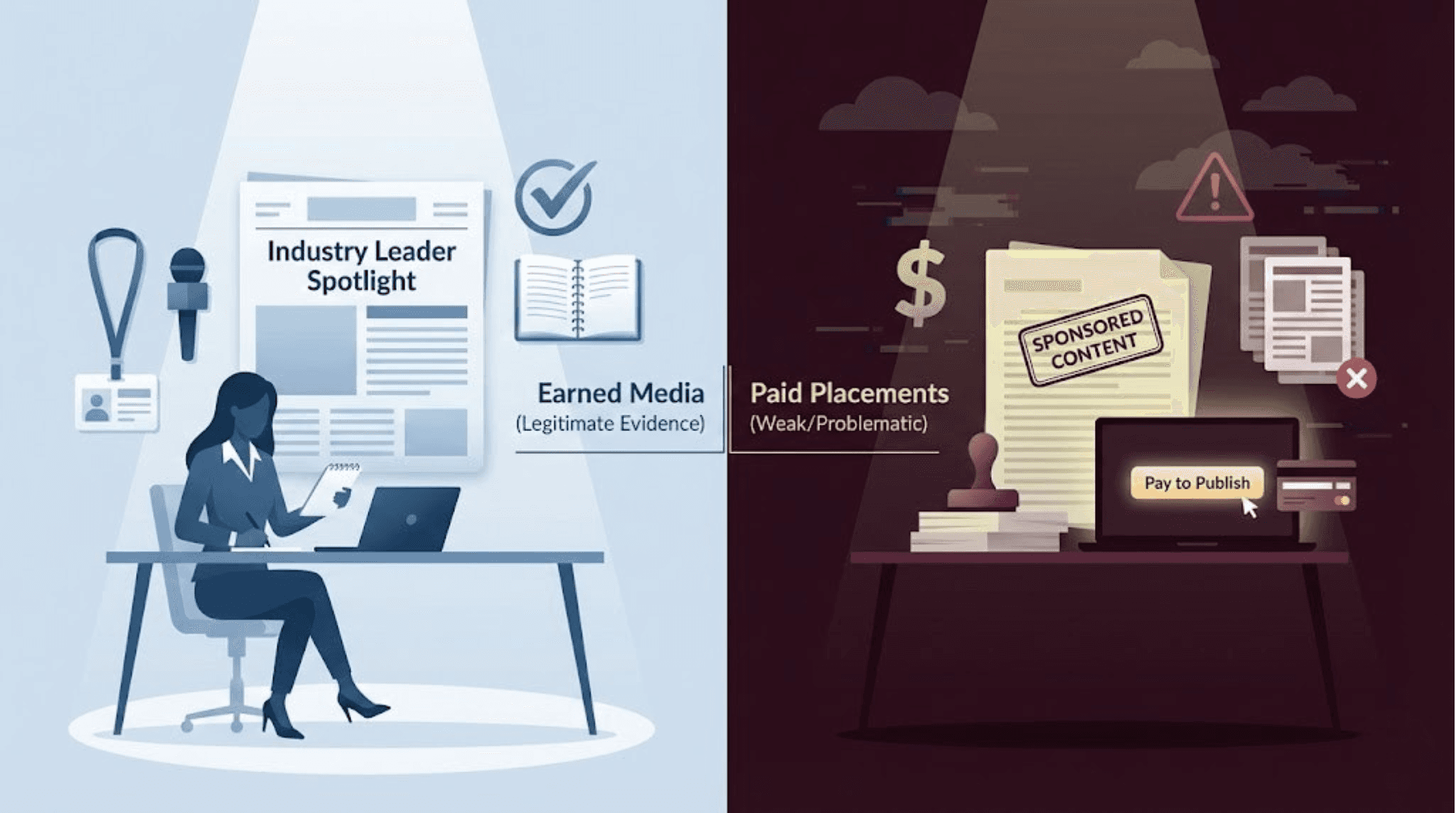
The distinction: hiring PR to pitch your story to journalists (legitimate) vs paying for guaranteed placement or writing articles attributed to journalists (problematic). Focus on earned media - coverage where journalists chose to feature you based on newsworthiness.
Key Takeaways
Earned media is strongest:
Articles where journalists independently chose to cover you carry the most weight.
PR support can be legitimate:
Hiring PR to pitch stories, prepare talking points, and connect with journalists is acceptable.
Pay-to-play is weak evidence:
Articles you paid for (sponsored content, advertorials) are weak and potentially harmful.
"Forbes contributor" articles are not press coverage:
Self-published content on contributor platforms doesn't satisfy the press criterion.
USCIS can detect patterns:
Multiple articles from obscure outlets, identical language across pieces, or lack of journalist bylines raise red flags.
Quality beats quantity:
One MIT Technology Review profile is stronger than 10 articles in unknown outlets.
What USCIS Looks For in Press Coverage
Criterion 3: Published material about the alien in professional or major trade publications or other major media
USCIS requirements:
Articles must be ABOUT you (not just quoting you)
Publication must be "major" (significant circulation or influence)
Content must relate to your work in your field
Editorial coverage (not advertising or sponsored content)
What makes coverage "major":
National or international reach
Significant circulation or readership
Editorial standards and journalistic integrity
Recognition in your field
The Spectrum: Legitimate vs Problematic Media Strategies
Fully Legitimate (Strong Evidence):
1. Organic Press Coverage
Journalists discover your work and write about it
No PR involvement
Strongest evidence possible
2. PR-Facilitated Earned Media
You hire PR firm to pitch your story
Journalists decide whether to cover you
Articles are written by journalists, not you
Still earned media (journalist made editorial choice)
3. Company PR/Communications
Your employer's PR team pitches your story
Funding announcements that feature you
Product launches highlighting your role
Gray Area (Proceed with Caution):
4. Expert Commentary/Quotes
Journalists quote you as expert source
You're not the subject, but you're featured
Weaker than articles about you, but still useful
5. Guest Articles in Legitimate Publications
You write article published under your byline
Publication has editorial review
Shows thought leadership, but not "press about you"
6. Podcast Appearances
You're interviewed on industry podcast
Can support press criterion if podcast is well-known
Weaker than written press
Problematic (Weak or Harmful Evidence):
7. Pay-to-Play Publications
You pay for "guaranteed" article placement
Article may look like journalism but is advertising
USCIS increasingly aware of these
8. "Forbes Contributor" and Similar Platforms
You write article published under contributor program
Not editorial content - essentially self-publishing
Does NOT satisfy press criterion
9. Press Release Distribution Only
You distribute press release via wire service
No journalist writes about you
Press releases alone are not press coverage
10. Sponsored Content/Advertorials
Articles marked "sponsored" or "partner content"
Paid advertising disguised as editorial
USCIS may view negatively
The "Forbes Contributor" Problem Explained
What it is: Forbes (and similar outlets) have contributor networks where anyone can apply to publish articles. Contributors write their own content with minimal editorial oversight.
Why people use it:
"Published in Forbes" sounds impressive
Relatively easy to get contributor status
Can write about yourself or your company
Why it doesn't work for immigration:
You wrote the article (not press "about you")
No editorial decision to cover you
USCIS knows these aren't editorial features
Immigration officers have seen this pattern repeatedly
What works instead:
Be featured IN a Forbes article written by staff journalist
Be quoted by Forbes reporter covering your industry
Get profiled in Forbes editorial content
How to tell the difference:
Staff articles: forbes.com/sites/forbes...
Contributor articles: forbes.com/sites/[contributorname]...
Look for "Contributor" label in byline
How PR Firms Can Help (Legitimately)
What good PR firms do:
Develop your story angle (what's newsworthy?)
Create press kit (bio, photos, key messages)
Build media list (relevant journalists)
Pitch journalists (personalized outreach)
Prepare you for interviews
Follow up with journalists
What they can't guarantee:
Actual coverage (journalists decide independently)
Specific outlets (editors make final calls)
Timeline (news cycles are unpredictable)
Red flags in PR firm pitches:
"Guaranteed placement in Forbes"
"We'll get you 10 articles in 30 days"
"Our network of publications will feature you"
Very low cost ($500-$1,000 for major coverage)
Legitimate PR costs:
Monthly retainer: $3,000-$15,000/month
Project-based: $5,000-$25,000 for campaign
No guarantees on specific placements
Building Media Presence Without Paying for Placements
Strategy 1: Newsjacking
What it is: Commenting on breaking news in your field to get quoted.
How to do it:
Monitor news in your industry
When news breaks, tweet/post thoughtful analysis
Reach out to journalists covering the story
Offer yourself as expert source
Example: AI researcher comments on new AI regulation; gets quoted in NYT article about the policy.
Strategy 2: Original Research or Data
What it is: Creating newsworthy data or findings that journalists want to cover.
How to do it:
Conduct survey or analysis in your field
Publish findings (blog, report, paper)
Pitch results to journalists
Offer exclusive access or interviews
Example: Startup founder surveys 500 customers about industry trend; TechCrunch writes about findings.
Strategy 3: HARO (Help A Reporter Out)
What it is: Platform where journalists post queries seeking expert sources.
How to do it:
Sign up for HARO (free)
Respond to relevant queries in your field
Provide thoughtful, quotable responses
Build relationships with journalists who use your quotes
Limitation: You're a source, not the subject. Better for building relationships than satisfying press criterion directly.
Strategy 4: Leverage Company News
What it is: Using company milestones (funding, launches, partnerships) to generate coverage featuring you.
How to do it:
Work with company PR on announcements
Ensure you're quoted or featured (not just company mentioned)
Offer interviews to journalists covering the news
Build profile pieces around company milestones
Example: Startup raises Series A; founder is profiled in TechCrunch article about the round.
Strategy 5: Speaking → Press
What it is: Using conference speaking to generate media interest.
How to do it:
Speak at major conferences
Alert press ahead of your talk
Share slides/insights after talk
Journalists covering conference may feature you
Example: Researcher presents at NeurIPS; MIT Technology Review writes about findings.
What USCIS Red Flags Look Like
Pattern 1: Multiple Articles from Obscure Outlets
8 articles all from sites you've never heard of
No major publication coverage
Suggests paid placements
Pattern 2: Identical Language Across Articles
Same quotes, same descriptions across multiple pieces
Indicates templated/paid content
Pattern 3: No Journalist Bylines
Articles without named authors
"Staff" or no attribution
Suggests sponsored or auto-generated content
Pattern 4: Heavy "About Us" or Company Focus
Articles that read like marketing materials
More about company than you personally
Press releases republished as articles
Pattern 5: Timing Coincidence
All articles published within weeks of each other
Looks like coordinated paid campaign
Organic coverage is spread over time
Pay-to-Play "Awards" to Avoid
Beyond press coverage, some awards are pay-to-play:
Red flags:
Award requires payment to apply or accept
No clear selection criteria
Anyone who pays gets the award
Organization is unknown in your field
Examples to avoid:
"40 Under 40" lists that charge fees
Industry awards from unknown organizations
"Best of [City]" awards requiring payment
These hurt your case: USCIS officers recognize pay-to-play patterns. Including these may actually weaken your credibility.
How OpenSphere Evaluates Press Evidence
Source Credibility Check: Input your press coverage. OpenSphere evaluates each outlet:
Major publication (Tier 1)?
Industry publication (Tier 2)?
Unknown/questionable (Tier 3)?
Coverage Quality Assessment: Is the article about you or just quoting you? Editorial or sponsored? Staff-written or contributor?
Red Flag Detection: OpenSphere identifies patterns that may concern USCIS: Too many obscure outlets, contributor articles, potential pay-to-play.
Gap Recommendations: "You have 3 industry publications but no major media. Consider pitching to [mainstream outlets] or using company news to generate broader coverage."
Media Strategy Effectiveness
Strategy | USCIS Value | Cost | Difficulty | Recommendation |
Organic coverage | Very Strong | $0 | High | Best if achievable |
PR-facilitated earned media | Strong | $5K-$25K | Moderate | Good investment for serious candidates |
Company PR/announcements | Strong | $0 (company pays) | Low-Moderate | Leverage whenever possible |
Expert quotes/HARO | Moderate | $0 | Low | Good supplement |
Guest articles | Weak-Moderate | $0 | Low | Supports thought leadership, not press criterion |
Contributor platforms | Very Weak | $0-$500 | Low | Avoid for immigration purposes |
Pay-to-play articles | Very Weak/Harmful | $500-$5K | Low | Avoid entirely |
Want to know if your press coverage is strong enough for O-1 or EB-1A - and whether your media strategy is on the right track?
Take the OpenSphere evaluation. You'll get press evidence assessment and legitimate media-building recommendations.
1. Is it illegal to pay for press coverage?
Not illegal, but paid coverage (sponsored content) doesn't satisfy USCIS criteria for earned media. It may also hurt your credibility.
2. Can I use Forbes Contributor articles?
Not as primary evidence for press criterion. They're self-published content, not editorial coverage about you.
3. How do I know if an outlet is "major"?
Consider: national/international reach, circulation numbers, recognition in your field, editorial standards. When in doubt, research the publication.
4. Should I hire a PR firm for immigration purposes?
Only if you have newsworthy stories to pitch. PR firms can help get earned media, but can't guarantee coverage.
5. What if all my coverage is from industry publications, not mainstream media?
Industry publications can satisfy the criterion if they're recognized in your field. "Major trade publications" are explicitly mentioned in USCIS criteria.
6. Can I use coverage in languages other than English?
Yes, with certified translation. International coverage can be valuable (shows global recognition).
7. How much press coverage do I need?
Quality over quantity. For O-1: 2-3 strong articles. For EB-1A: 3-5 strong articles. One NYT profile is stronger than 10 obscure mentions.
8. What if my press coverage is old (5+ years)?
Still counts, but recent coverage is stronger. Shows sustained recognition, not one-time mention.
9. Can I use TV or video coverage?
Yes. Document with transcripts, screenshots, and outlet information. Same credibility standards apply.
10. What about podcast appearances?
Can support your case if podcast is well-known in your field. Weaker than written press but useful as supplement.