Quick Answer
Many employers sponsor H-1B by default because HR knows the process. But O-1 offers advantages for employers: no lottery (guaranteed sponsorship works), faster processing, and retaining exceptional talent.
To convince your employer, frame O-1 as lower-risk (no lottery rejection), highlight your qualifications, offer to pay premium processing, and provide a clear comparison showing O-1's benefits. Most employer objections stem from unfamiliarity, not fundamental resistance.
Key Takeaways
Employers default to H-1B out of habit:
HR departments are familiar with H-1B; O-1 seems unfamiliar and complex.
O-1 benefits employers too:
No lottery risk, faster processing, retaining extraordinary talent the company already hired.
Frame O-1 as risk reduction:
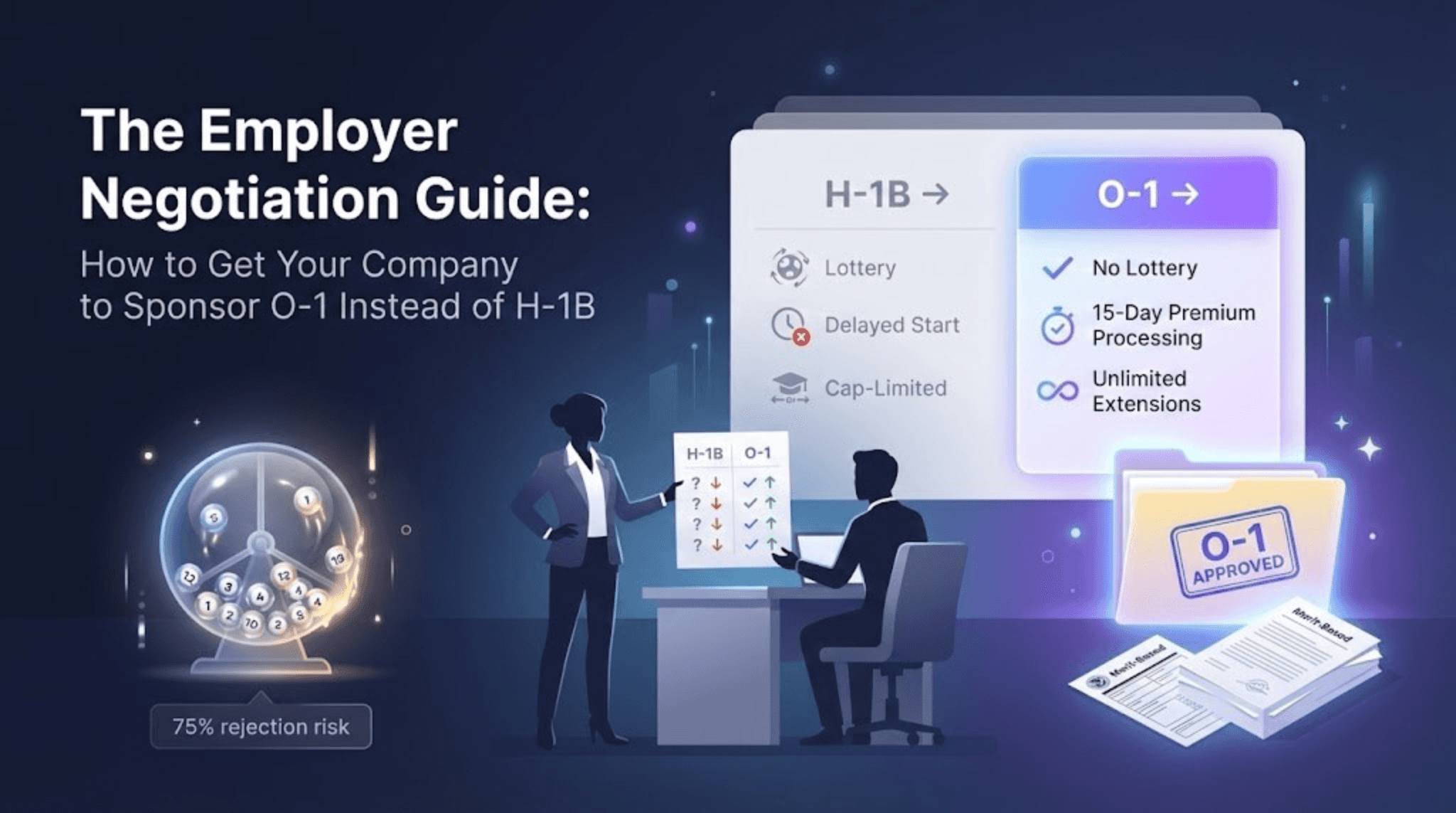
H-1B lottery = 75% rejection rate. O-1 = merit-based approval.
Offer to reduce employer burden:
Pay premium processing, provide evidence package, handle attorney coordination.
Timing matters:
Best to negotiate before accepting offer or during H-1B lottery uncertainty.
Provide comparison document:
Clear side-by-side showing O-1 advantages helps HR understand the case.
Why Employers Default to H-1B
Reason 1: Familiarity
HR has processed H-1B petitions before
Immigration attorneys are used to H-1B
H-1B is "standard" for international talent
Reason 2: Perceived Simplicity
H-1B: job offer + degree = file petition
O-1: seems to require proving "extraordinary ability"
HR doesn't want to evaluate whether you qualify
Reason 3: Cost Predictability
H-1B costs are known and budgeted
O-1 costs seem uncertain (more evidence required?)
Reason 4: Misunderstanding O-1 Requirements
HR thinks O-1 is for "celebrities only"
Don't realize many tech professionals qualify
Haven't seen O-1 petitions succeed at their company
Why O-1 Is Actually Better for Employers
Benefit 1: No Lottery Risk
H-1B reality:
400,000+ registrations for 85,000 slots
75% of candidates rejected randomly
Employer invests in hiring, then lottery rejects candidate
Must find replacement or lose the hire
O-1 reality:
No lottery
Merit-based: if employee qualifies, petition is approved
Employer retains the talent they already hired
No annual cap or filing window
Pitch: "With H-1B, there's a 75% chance you'll lose me to lottery rejection after investing in hiring me. O-1 eliminates that risk."
Benefit 2: Faster Timeline
H-1B timeline:
March: Lottery registration
Late March: Lottery results
April-June: File petition
October 1: Work authorization begins
Total: 6-7 months from registration to work
O-1 timeline:
File anytime (no lottery window)
Premium processing: 15-day decision
Work authorization begins upon approval
Total: 1-2 months from decision to file
Pitch: "I can start contributing on O-1 in weeks, not months. Premium processing gives us a decision in 15 days."
Benefit 3: Flexibility
H-1B limitations:
Tied to specific job and employer
Transfer required if changing roles
Cap on total years (6 years unless green card pending)
O-1 flexibility:
Can work for multiple employers (with separate petitions)
Easier to adjust role within company
Unlimited extensions (3 years at a time)
Pitch: "O-1 gives the company more flexibility if my role evolves. No need to refile for every job change."
Benefit 4: Retaining Exceptional Talent
Frame for employer:
You've identified this candidate as exceptional
H-1B lottery might reject them randomly
O-1 is designed for exactly this profile
Sponsoring O-1 signals company values exceptional talent
Pitch: "You hired me because I bring extraordinary value. O-1 is designed for people like me, and sponsoring it shows the company invests in exceptional talent."
Overcoming Common Employer Objections
Objection 1: "O-1 is too expensive"
Reality: O-1 costs are similar to H-1B.
Cost Component | H-1B | O-1 |
USCIS fees | $2,600-$7,400 | $1,655 |
Attorney fees | $2,000-$5,000 | $5,000-$15,000 |
Premium processing | $2,805 | $2,805 |
Total | $7,400-$15,200 | $9,400-$19,400 |
Response: "O-1 costs slightly more in attorney fees because of evidence preparation, but eliminates lottery risk. One successful O-1 hire is cheaper than two H-1B lottery rejections."
Offer: "I'll pay for premium processing ($2,805) to reduce company cost."
Objection 2: "Our immigration attorney doesn't handle O-1"
Reality: Most business immigration attorneys handle O-1. If current attorney doesn't, they can refer.
Response: "Most immigration attorneys handle O-1. If your current attorney prefers not to, I can recommend attorneys who specialize in O-1 for tech professionals."
Offer: "I've identified an attorney experienced with O-1 who can work with your HR team."
Objection 3: "We don't know if you qualify"
Reality: Qualification assessment can be done quickly.
Response: "I've done a preliminary assessment and believe I meet 3+ criteria based on [press coverage, awards, judging roles, publications, etc.]. An attorney can confirm in one consultation."
Offer: "I'll prepare an evidence summary showing which criteria I meet. The attorney can validate before we commit."
Objection 4: "It takes too long to gather evidence"
Reality: If you have the evidence, preparation takes 4-8 weeks.
Response: "I've already gathered my evidence: publications, press coverage, awards, and recommendation letters. The petition can be filed within 4-6 weeks."
Offer: "I'll compile the evidence package myself. HR just needs to sign the petition."
Objection 5: "We've never done O-1 before"
Reality: First time doesn't mean difficult.
Response: "O-1 is standard for companies that hire exceptional talent. [Major tech companies] sponsor O-1 regularly. Your immigration attorney can walk HR through the process."
Offer: "I can connect you with HR contacts at other companies who have done O-1, or provide resources explaining the process."
When to Have This Conversation
Best timing:
1. Before Accepting Offer
Negotiate O-1 as part of offer discussion
"I'd like to discuss visa sponsorship options. Have you considered O-1?"
Strongest negotiating position
2. After H-1B Lottery Rejection
You weren't selected, company must act or lose you
"Since H-1B lottery didn't work out, O-1 is our best option"
Company is motivated to find solution
3. During OPT Period
While on OPT, you have time to build case
"I'd like to explore O-1 instead of relying on H-1B lottery"
Shows proactive planning
4. When Current H-1B Is Expiring
H-1B approaching 6-year limit
"O-1 provides unlimited extensions. Let's switch"
Company wants to retain you
The O-1 Pitch Document
Create a one-page comparison document for HR:
Section 1: Why O-1?
No lottery (guaranteed if I qualify)
Faster processing (15 days with premium)
Unlimited extensions
Section 2: My Qualifications
Criterion 1: [Your evidence]
Criterion 2: [Your evidence]
Criterion 3: [Your evidence]
Total: I meet X of 8 criteria
Section 3: Cost Comparison
H-1B: $X (but 75% lottery rejection risk)
O-1: $Y (no lottery, merit-based)
Section 4: Timeline
Evidence compilation: 4 weeks
Petition preparation: 2 weeks
Premium processing: 15 days
Total: ~2 months
Section 5: What I'll Handle
Evidence gathering and organization
Recommendation letters
Attorney coordination (if needed)
Premium processing cost (optional offer)
Script: How to Start the Conversation
With HR:
"Hi [HR name], I wanted to discuss my visa situation. I know the company typically sponsors H-1B, but I'd like to explore O-1 as an alternative. The main benefit is there's no lottery - if I qualify, the petition gets approved. Given my background in [field] with [evidence summary], I believe I qualify. Would you be open to discussing this with the immigration attorney? I've prepared a summary of my qualifications and how O-1 compares to H-1B."
With Manager (who may advocate to HR):
"I wanted to flag a potential issue with my visa situation. H-1B lottery has only a 25% selection rate, which creates uncertainty for both of us. I've been researching O-1, which has no lottery and is designed for people with exceptional ability in their field. Based on my [publications/awards/experience], I believe I qualify. Would you be willing to support me in discussing this option with HR?"
If Employer Says No
Option 1: Understand Why
Is it cost? Offer to contribute.
Is it unfamiliarity? Provide resources.
Is it policy? Ask if exceptions are possible.
Option 2: Negotiate Partial Support
Employer pays filing fees, you pay attorney
Employer signs petition, you handle evidence
Option 3: Use Agent Petitioner
If employer won't petition, consider agent
You handle everything, work for employer as O-1 "agent worker"
More complex but possible
Option 4: Evaluate Employer Fit
If employer won't invest in your visa, consider whether they value you
Other companies may be more flexible
Don't stay in uncertain H-1B situation if better options exist
How OpenSphere Helps with Employer Conversations
Qualification Summary: OpenSphere generates evidence summary showing which O-1 criteria you meet. Perfect for sharing with HR.
Comparison Document: OpenSphere creates H-1B vs O-1 comparison customized to your situation.
Attorney Recommendations: OpenSphere can suggest O-1-experienced attorneys if your employer's attorney isn't familiar.
Talking Points: OpenSphere provides customized talking points based on your evidence strength and employer's likely objections.
H-1B vs O-1 for Employers
Factor | H-1B | O-1 |
Lottery | Yes (75% rejection) | No |
When to file | March only (first submission) | Anytime |
Processing time | 2-4 months | 15 days (premium) |
Work start | October 1 | Upon approval |
Extensions | 6 years max (unless green card pending) | Unlimited (3-year increments) |
Employee flexibility | Tied to single employer | Can work for multiple employers |
Employer risk | High (lottery may reject) | Low (merit-based) |
Ready to have the O-1 conversation with your employer? Want a qualification summary and comparison document to share?
Take the OpenSphere evaluation. You'll get employer-ready materials showing why O-1 makes sense.
1. Can my employer say no to O-1?
Yes. Visa sponsorship is employer's choice. But with a good pitch, many employers are open to alternatives.
2. Should I offer to pay for O-1 myself?
You can offer to pay premium processing or contribute to attorney fees. Paying all costs yourself is less common but possible.
3. What if HR has never heard of O-1?
Common. Provide educational materials and offer to connect them with knowledgeable attorneys.
4. Can I apply for O-1 after being rejected in H-1B lottery?
Yes. This is a common scenario. O-1 becomes the backup plan.
5. Will asking for O-1 make me seem high-maintenance?
Frame it as helping the company: "I want to reduce visa uncertainty for both of us."
6. What if I don't qualify for O-1?
Then H-1B lottery is your option. But many people underestimate their qualifications—get an evaluation.
7. Can my employer sponsor both H-1B and O-1?
Yes. Some employers register for H-1B lottery while building O-1 case as backup.
8. How do I find an O-1-experienced attorney?
Ask for referrals from colleagues who've done O-1, or search immigration attorney directories filtering by O-1 experience.
9. What if my employer's attorney advises against O-1?
Get a second opinion. Some attorneys are unfamiliar with O-1 and default to H-1B.
10. Can I switch from H-1B to O-1 later?
Yes. Many people start on H-1B and switch to O-1 once they've built evidence.