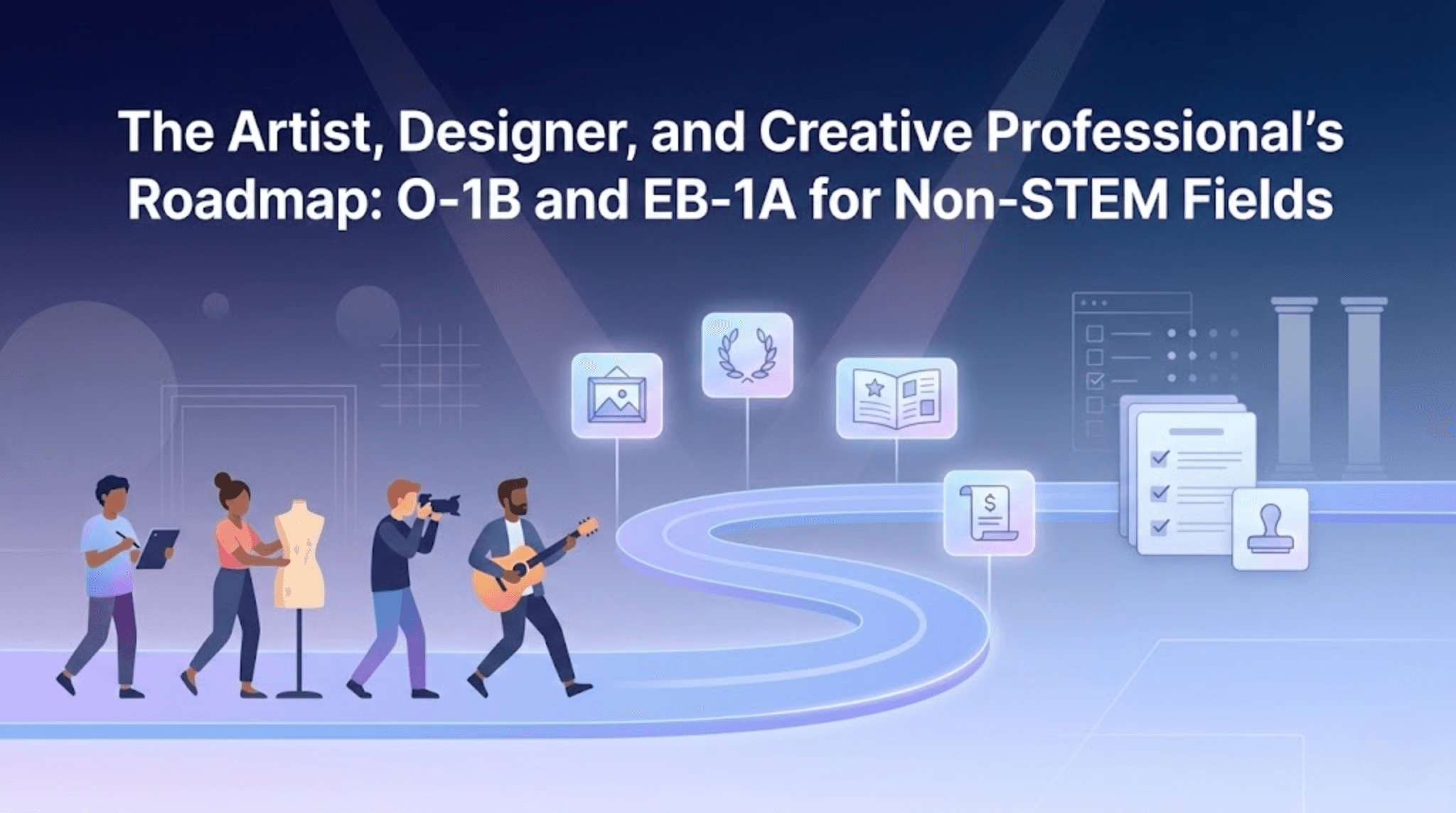
The Artist, Designer, and Creative Professional's Roadmap: O-1B and EB-1A for Non-STEM Fields
Artists, designers, filmmakers, and creative professionals have different evidence requirements than STEM professionals. Here's how O-1B and EB-1A work for creative fields - and what evidence actually matters.
Artists, designers, filmmakers, and creative professionals have different evidence requirements than STEM professionals. Here's how O-1B and EB-1A work for creative fields - and what evidence actually matters.
Creative professionals pursue O-1B (arts, entertainment) rather than O-1A (sciences, business). O-1B has a lower standard ("distinction") than O-1A ("extraordinary ability").
Evidence differs: instead of citations and publications, creative professionals show exhibitions, commercial success, critical reviews, high compensation, and industry recognition. EB-1A is available for truly extraordinary artists. The key is understanding which evidence types matter for creative fields.
Key Takeaways
O-1B is for arts and entertainment:
Lower standard than O-1A - requires "distinction" not "extraordinary ability."
O-1B Motion Picture/Television has higher standard:
If you work in film/TV, you must show "extraordinary achievement."
Evidence types differ from STEM:
Exhibitions, reviews, commercial success, and artistic recognition replace citations and publications.
EB-1A is available for top-tier artists:
Same criteria as O-1A, but evidence is interpreted for artistic fields.
Gallery representation and museum collections are strong evidence:
Shows institutional recognition of your work.
Commercial success matters:
Sales figures, commissioned work, and high compensation demonstrate recognition.
Table of Content
Understanding O-1B vs O-1A
O-1A (Sciences, Business, Education, Athletics):
Standard: "Extraordinary ability" (sustained national or international acclaim)
8 criteria (meet 3)
For scientists, engineers, business professionals, educators
O-1B (Arts, Entertainment):
Standard: "Distinction" (prominence in the field)
6 criteria (meet 3)
For artists, musicians, designers, filmmakers, writers
O-1B Motion Picture/Television:
Standard: "Extraordinary achievement" (higher than general O-1B)
Special criteria for film/TV industry
For actors, directors, producers, cinematographers in film/TV
Which category for which profession:
Profession
Category
Fine artist (painter, sculptor)
O-1B Arts
Graphic designer
O-1B Arts or O-1A Business (depends on role)
UX/UI designer
Often O-1A Business/Technology
Fashion designer
O-1B Arts
Architect
O-1A Sciences or O-1B Arts (depends on focus)
Musician
O-1B Arts
Film director
O-1B Motion Picture
Actor
O-1B Motion Picture
Writer (creative)
O-1B Arts
Game designer
O-1A Technology or O-1B Arts
O-1B Criteria for Arts (Meet 3 of 6)
Criterion 1: Performed as Lead or Starring Participant
What it means: Lead role in productions, exhibitions, or events with distinguished reputation.
Evidence for artists:
Solo exhibitions at reputable galleries
Featured artist at major art fairs
Lead designer on notable projects
Principal musician in recognized ensemble
Evidence for performers:
Lead roles in productions
Headlining performances
Featured artist billing
Criterion 2: National or International Recognition
What it means: Achieved national or international recognition for achievements.
Evidence:
Press coverage in major publications
Awards from recognized institutions
Inclusion in notable collections (museums, corporate collections)
Reviews by prominent critics
Criterion 3: Performed for Organizations with Distinguished Reputation
What it means: Worked for organizations that are distinguished in the field.
Evidence for artists:
Gallery representation by well-known galleries
Work acquired by major museums
Commissioned by recognized institutions
Performed at prestigious venues (Lincoln Center, Royal Albert Hall)
Evidence for designers:
Worked for major brands or design studios
Projects for Fortune 500 companies
Work featured in design museums
Criterion 4: Record of Major Commercial or Critically Acclaimed Success
What it means: Track record of commercial success or critical acclaim.
Evidence:
Sales figures (artwork sold, box office)
Auction results
Critical reviews in major publications
Commercial projects with measurable success
Downloads, streams, or views (for digital work)
Criterion 5: Recognition from Organizations, Critics, or Government
What it means: Recognition from experts, organizations, or authorities.
Evidence:
Awards from arts councils, foundations
Grants from recognized funders
Critical recognition in publications
Expert testimonials
Criterion 6: High Salary or Remuneration
What it means: Commanded high compensation compared to others in the field.
Evidence:
Commission rates
Project fees
Salary documentation
Auction prices
Comparison to field standards
Evidence Types for Creative Professionals
Exhibitions and Shows
Strong evidence:
Solo exhibitions at reputable galleries
Museum exhibitions
Art fair participation (Art Basel, Frieze)
Retrospectives or curated shows
Documentation needed:
Exhibition catalogs
Press releases
Gallery announcements
Photos of exhibition
Visitor numbers (if available)
Reviews and Press Coverage
Strong evidence:
Reviews in major art publications (Artforum, Art in America)
Features in design publications (Dezeen, Wallpaper*)
Coverage in mainstream media (NYT, Guardian)
Interviews about your work
Documentation needed:
Full articles (not just mentions)
Publication circulation/reach data
Evidence that outlet is recognized
Gallery Representation and Collections
Strong evidence:
Representation by established gallery
Work in museum permanent collections
Corporate collections of major companies
Private collections of notable collectors
Documentation needed:
Gallery representation agreement
Museum acquisition letters
Collection listings
Exhibition history
Awards and Grants
Strong evidence:
Major art awards (Turner Prize, MacArthur Fellowship)
Design awards (Red Dot, D&AD)
Government arts grants
Foundation fellowships
Documentation needed:
Award certificates
Selection criteria
Competition statistics
Press coverage of award
Commercial Success
Strong evidence:
High auction prices
Significant commission fees
Sold-out shows or editions
Licensing deals
Documentation needed:
Sales records
Auction results
Commission contracts
Revenue figures
EB-1A for Artists: Same Criteria, Different Evidence
EB-1A uses same 10 criteria as O-1A, but evidence is interpreted for artists:
O-1B has lower standard ("distinction" vs "extraordinary ability"), but evidence requirements differ. For qualified creative professionals, O-1B can be more achievable.
2. I'm a UX designer. Is that O-1A or O-1B?
Usually O-1A (technology/business focus). But could be O-1B if work is highly artistic. Consult attorney.
3. Do I need gallery representation for O-1B?
Not required, but very helpful. It's strong evidence of recognition in the art world.
4. Can I qualify for O-1B with only commercial work (no gallery shows)?
Possibly, if commercial work demonstrates distinction: major brands, awards, critical recognition, high compensation.
5. What if I work in multiple creative fields?
Focus on field where you have strongest evidence. Petition should emphasize one area of expertise.
6. How do I prove "distinction" for O-1B?
Combination of: reviews/press coverage, exhibitions/performances at notable venues, awards, commercial success, and recognition from experts.
7. Can graphic designers get O-1B?
Depends on nature of work. Purely commercial graphic design might be O-1A. Highly artistic work might be O-1B. Often a judgment call.
8. What's the advisory opinion requirement?
For O-1B, you need consultation letter from peer group or labor organization. Attorney handles this process.
9. Can I use Instagram followers as evidence?
Very weak alone. Social media presence can supplement other evidence but shouldn't be primary proof.
10. What's the difference between O-1B general and O-1B Motion Picture?
Motion Picture has higher standard and specific criteria for film/TV industry. General O-1B is for arts outside film/TV.