Quick Answer
Marriage timing affects immigration in several ways:
(1) spouse can be added as derivative beneficiary to your green card if married before I-485 is filed,
(2) cross-chargeability can help if your spouse is from a non-backlog country,
(3) marriage after I-485 filing requires additional steps to add spouse.
The best timing depends on your specific situation - marrying before filing is cleanest, but marriage during processing can still work with proper documentation.
Key Takeaways
Marriage before I-485 filing is cleanest
Spouse is automatically included as derivative beneficiary.
Marriage after I-485 but before approval works
Spouse files separate I-485 using your priority date.
Cross-chargeability can save years
If you're Indian and spouse is from non-backlog country, you may use their country's visa numbers.
Spouse's immigration status matters
If spouse has their own visa, marriage doesn't automatically change their status.
Marriage doesn't affect I-140
The immigrant petition (I-140) is filed for you alone; spouse is added at I-485 stage.
Document authenticity
USCIS scrutinizes marriages that occur conveniently close to immigration filings.
How Marriage Affects Employment-Based Green Cards
The basic structure:
I-140 (Immigrant Petition):
Filed for you (the employee/self-petitioner)
Establishes your eligibility and priority date
Spouse is NOT included at this stage
I-485 (Adjustment of Status):
Filed to adjust to permanent resident status
Spouse and children can be included as derivative beneficiaries
Spouse files their own I-485 linked to your case
Key insight: Marriage affects the I-485 stage, not the I-140 stage.
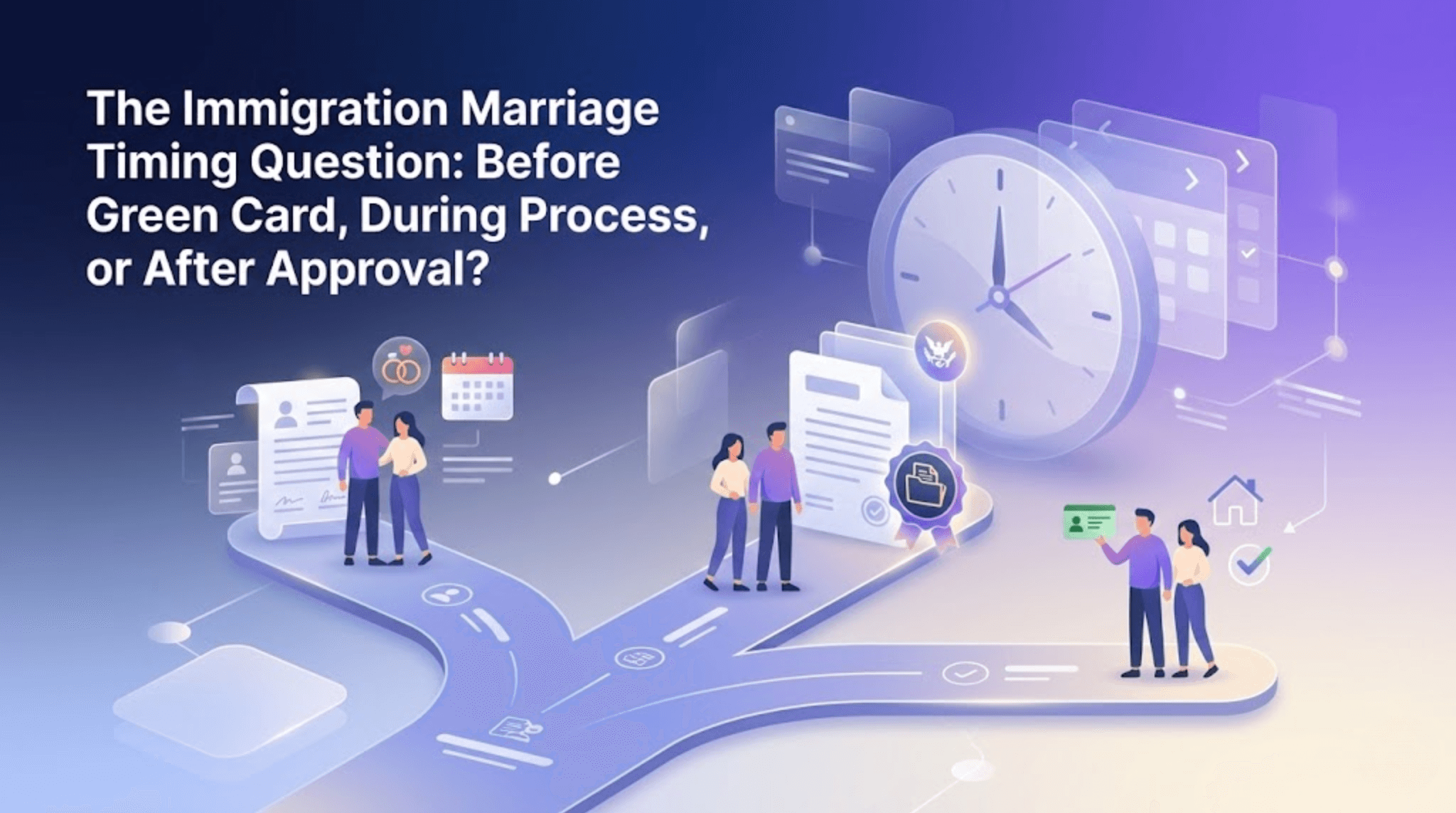
Scenario 1: Married Before Filing I-485
How it works:
You're already married when you file I-485
Spouse files I-485 at same time as you
Both applications processed together
Both receive green cards around same time
Documentation needed:
Marriage certificate
Spouse's birth certificate, passport
Spouse's immigration documents
Photos, evidence of bona fide marriage
Benefits:
Cleanest process
Spouse included from beginning
Both files move together
Less additional paperwork
Costs:
Spouse pays separate I-485 filing fee ($1,225)
Spouse needs medical exam ($200-$500)
Total additional: ~$1,500-$2,000
Scenario 2: Get Married After Filing I-485 (Before Approval)
How it works:
You filed I-485 while single
You get married while I-485 is pending
Spouse files their own I-485 using your approved I-140
Requirements:
Your I-140 must be approved
Your priority date must be current (for spouse to file)
Spouse files I-485 separately
Documentation needed:
Marriage certificate
Copy of your I-140 approval
Evidence spouse is derivative beneficiary
All standard I-485 documents for spouse
Complications:
Spouse's I-485 may not be processed simultaneously
If priority date retrogresses, spouse may have to wait
Two separate I-485 applications to track
Timeline:
Your I-485 continues processing
Spouse's I-485 starts from scratch (8-12 months)
Both may not be approved at same time
Scenario 3: Get Married After Green Card Approval
How it works:
You receive your green card while single
You get married after becoming permanent resident
Spouse does NOT automatically get green card
Spouse's path to green card:
You can sponsor spouse for family-based green card
But: Green card holders face 2+ year wait for spouse visa
(U.S. citizens have immediate spouse visas—no wait)
Timeline:
Green card holders: 2-3 years to sponsor spouse
After you become citizen (5 years): Immediate spouse visa
Strategy consideration:
If marriage is planned, marrying before green card approval is often faster for spouse
Cross-Chargeability: The Backlog Workaround
What is cross-chargeability?
Normally, your priority date uses visa numbers from your country of birth. But if married, you may use your spouse's country of birth if it has shorter backlog.
Example:
You: Born in India (10-15 year EB-2 backlog)
Spouse: Born in Canada (no backlog)
Result: You can "charge" to Canada, avoiding India backlog
Requirements:
Legally married
Spouse included on your application
Spouse born in non-backlog country (or shorter backlog)
Who benefits:
Indians married to non-Indians
Chinese married to non-Chinese
Anyone married to someone from lower-backlog country
How to use:
Indicate on I-485 that you're using spouse's country
Both you and spouse must file I-485 together
USCIS charges your visa number to spouse's country
Important: Spouse must actually be filing for green card with you. Can't use cross-chargeability if spouse isn't included.
Spouse Already Has Their Own Visa
Scenario: You're getting green card through employment. Spouse already has H-1B (or other visa) through their own employer.
Option A: Spouse joins your case as derivative
Spouse abandons their H-1B
Becomes your dependent (derivative beneficiary)
Gets green card through your case
Option B: Spouse maintains separate status
Spouse keeps their H-1B
Spouse pursues their own green card through their employer
Two separate green card processes
Option C: Spouse uses your case for faster path
If your case is faster (EB-1A with no backlog vs spouse's EB-2 with backlog)
Spouse joins your case as derivative
Gets green card faster than their own path
Considerations:
Which path is faster?
Does spouse want to continue working for current employer?
What happens if your case is denied?
Marriage Authenticity and USCIS Scrutiny
USCIS looks for marriage fraud indicators:
Marriage shortly before or after immigration filing
Large age difference
Different addresses
Limited evidence of shared life
Previous immigration marriages
How to document bona fide marriage:
Joint bank accounts
Joint lease or property ownership
Joint insurance policies
Photos of relationship over time
Travel together
Birth certificates of children (if applicable)
Affidavits from friends and family
Even legitimate marriages need documentation: Don't assume USCIS will take your word. Document your relationship thoroughly.
Special Situations
Situation 1: Engaged but Not Married
Fiancé(e)s are NOT derivative beneficiaries. You must be legally married.
Strategy: If planning to marry, do so before filing I-485 if possible.
Situation 2: Same-Sex Marriage
Same-sex marriages are fully recognized by USCIS (since 2013). Same rules apply as opposite-sex marriages.
Situation 3: Marriage Abroad
Marriages performed abroad are generally recognized if valid where performed.
Documentation needed:
Original marriage certificate
Certified translation if not in English
Apostille or authentication (depending on country)
Situation 4: Divorce During Process
If you divorce while I-485 is pending:
Your case continues (employment-based, not dependent on marriage)
Spouse's derivative I-485 is typically denied
Children may continue as your derivatives
How OpenSphere Evaluates Marriage Impact
Cross-Chargeability Calculator
Input both spouses' countries of birth. OpenSphere shows whether cross-chargeability saves time and how much.
Timeline Comparison
Compare: spouse joining your case vs spouse pursuing own green card vs waiting until you're citizen.
Documentation Checklist
OpenSphere provides marriage documentation checklist to prevent RFEs and fraud suspicion.
Timing Recommendation
Based on your case status, OpenSphere recommends optimal timing for marriage relative to immigration filings.
Marriage Timing Impact
Timing | Process | Complications | Best For |
Before I-140 | Spouse added at I-485 stage | None (cleanest) | Planning ahead |
Before I-485 | Spouse files I-485 with you | None | Standard situation |
After I-485 filed | Spouse files separate I-485 | Two applications, timing issues | Already in relationship |
After green card | Sponsor spouse (2+ year wait) | Significant delay for spouse | Unexpected timing |
Planning to get married and want to understand how timing affects your immigration case? Need to know if cross-chargeability applies?
Take the OpenSphere evaluation. You'll get marriage timing analysis and cross-chargeability calculation.
Analyze Marriage Timing Impact
1. Does getting married speed up my green card?
Not directly for employment-based cases. But cross-chargeability can eliminate backlog if spouse is from non-backlog country.
2. Can my spouse work while my green card is processing?
If spouse is derivative beneficiary with pending I-485, they can file for EAD (work permit). Processing takes 3-6 months.
3. What if we get married during my I-140 processing?
I-140 doesn't include spouse. Marriage impacts I-485 stage only.
4. Can I add my spouse after I-485 is approved?
No. After you get green card, spouse must be sponsored through family-based process (2+ year wait for green card holder sponsors).
5. What if my spouse is undocumented?
Complex situation. Depends on how they entered U.S., their immigration history. Consult attorney.
6. Does cross-chargeability work for children?
Children use the parent's country of birth. Cross-chargeability typically helps the primary applicant use spouse's country.
7. What if we're in a long-distance relationship?
Doesn't affect immigration eligibility, but you need evidence of bona fide relationship. Documentation is important.
8. Can my spouse travel while I-485 is pending?
Spouse needs Advance Parole document to travel and return. Leaving without AP can abandon the application.
9. What if my spouse is also going through their own green card process?
They can maintain their own process or join yours as derivative. Choose based on which is faster.
10. Will USCIS interview us about our marriage?
Possibly. Employment-based cases sometimes include marriage interviews, especially if there are fraud indicators.