
Quick Answer
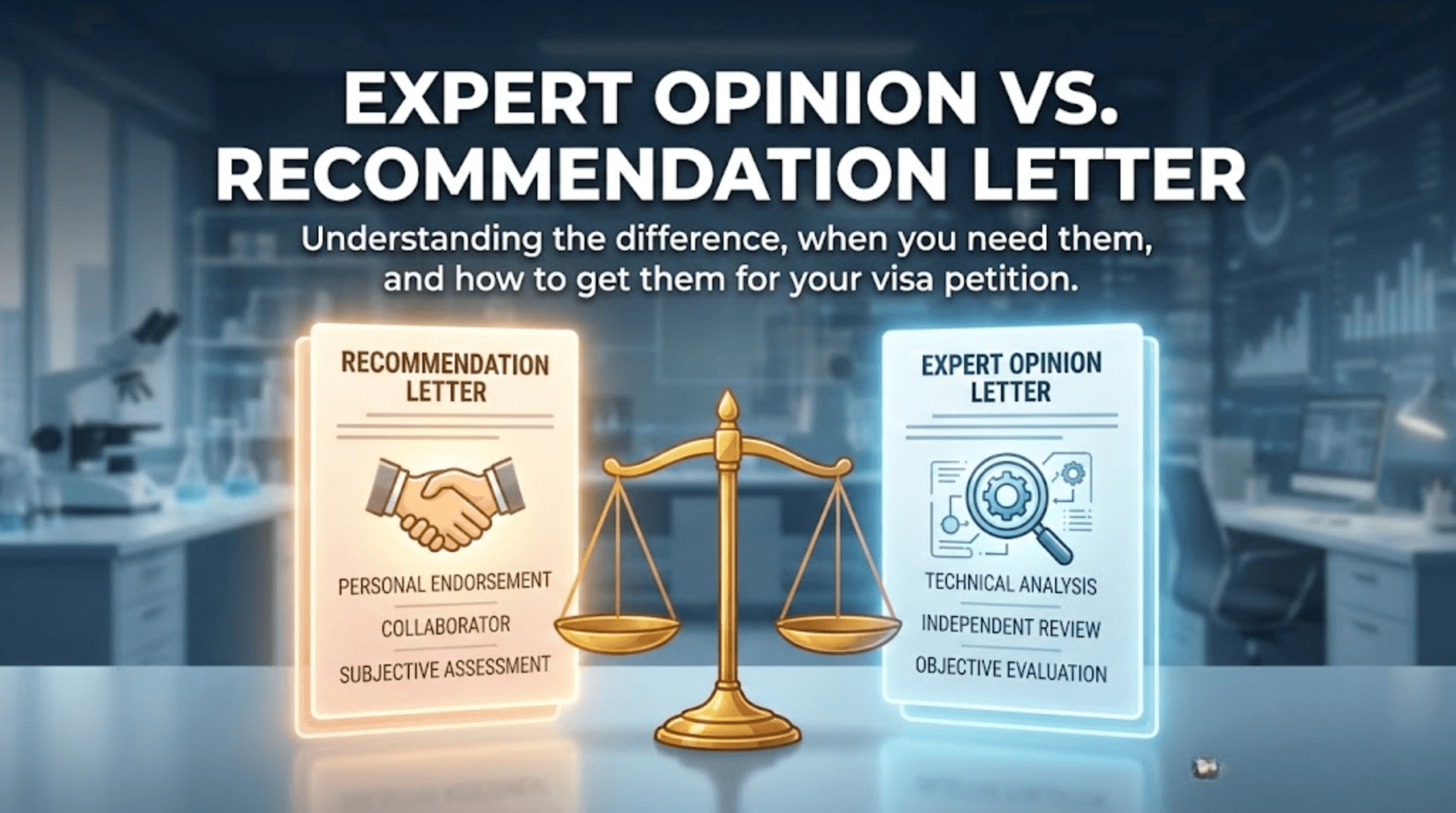
Strong recommendation letters come from independent experts who can credibly evaluate your work's significance not just supervisors and collaborators. USCIS looks for: detailed descriptions of your specific achievements, comparison to others in the field, explanation of why your work is extraordinary, and writer credibility. Avoid: generic praise, letters only from people who know you personally, and templated language. The ideal mix: 2-3 independent experts + 2-3 people who know your work directly.
Key Takeaways
Independence matters most: Letters from people with no personal/professional relationship carry more weight.
Specificity over superlatives: "Your algorithm reduced processing time by 40%" beats "outstanding researcher."
Mix of letter writers: Combine independent experts with direct collaborators for different perspectives.
Writer credibility: Who writes matters as much as what they write.
Avoid template language: USCIS sees thousands of letters—generic language stands out negatively.
5-7 letters is typical: More isn't always better; quality trumps quantity
Types of Recommendation Letters
Type 1: Independent Expert Letters (Most Valuable)
Who:
Experts who know your work but don't know you personally
Researchers who cited your work
Industry leaders who have observed your impact
Professors at other institutions
Why they're valuable:
No personal bias
External validation
USCIS explicitly values independent opinions
What they can speak to:
Significance of your work in the field
How your contributions compare to others
Impact they've observed
Type 2: Direct Collaborator Letters (Important)
Who:
Co-authors
Research supervisors
Project teammates
Managers who oversaw your work
Why they're valuable:
Deep knowledge of your specific contributions
Can describe your role in detail
Firsthand observation of your abilities
Limitations:
Not independent
May be seen as biased
Should not be majority of letters
Type 3: Supervisor/Employer Letters (Necessary but Not Sufficient)
Who:
Current or past supervisors
Employers
Department heads
Why they're necessary:
Can describe your role and responsibilities
Support "critical role" criterion
Verify employment details
Limitations:
Expected and therefore less impactful
Not independent
Should be supplemented with independent letters
The Ideal Letter Mix
For O-1 (5-7 letters typical):
2-3 independent expert letters
2-3 direct collaborator/supervisor letters
Optional: 1-2 additional specialists
For EB-1A (6-8 letters typical):
3-4 independent expert letters
2-3 direct collaborators/supervisors
1-2 industry or government experts (if relevant)
The key ratio: At least 40-50% should be from independent sources.
What Strong Letters Contain
Element 1: Writer Credentials
Include:
Writer's title and position
Their expertise and qualifications
Why they're qualified to evaluate you
Their recognition in the field
Example: "I am Professor of Computer Science at MIT and Director of the AI Lab. I have published over 200 papers and received the ACM Turing Award. I am writing to provide my assessment of [Name]'s contributions to machine learning."
Element 2: How They Know Your Work
Include:
How they became aware of your work
For independent letters: through publications, citations, reputation
For collaborators: direct working relationship
Example (independent): "I became aware of [Name]'s work through their seminal 2022 paper on neural architecture search, which I cited in my own research. I have followed their subsequent publications with great interest."
Example (collaborator): "I have worked directly with [Name] for three years as their research supervisor at Stanford, where I observed their exceptional research abilities firsthand."
Element 3: Specific Achievements
Include:
Concrete accomplishments
Quantifiable impact
Specific projects or contributions
Named publications or products
Example: "[Name] developed a novel compression algorithm that reduced storage requirements by 60% while maintaining 99% accuracy. This work, published in NeurIPS 2023, has been adopted by three Fortune 500 companies for production systems."
Avoid:
"[Name] is an outstanding researcher"
"[Name] does excellent work"
Generic praise without specifics
Element 4: Comparison to Peers
Include:
How the applicant compares to others
Ranking or percentile language
"One of the best" statements
Example: "In my 25 years in this field, I have supervised over 100 PhD students and collaborated with hundreds of researchers. [Name] is among the top 5% of researchers I have encountered in terms of both creativity and impact."
Element 5: Field Significance
Include:
Why the work matters to the field
Impact on research direction
Influence on others' work
Industry or societal benefit
Example: "[Name]'s framework for privacy-preserving machine learning has fundamentally changed how researchers approach this problem. Their methodology is now the standard approach used by at least 15 research groups worldwide."
Element 6: Extraordinary Ability Conclusion
Include:
Explicit statement that applicant has extraordinary ability
Statement they're among top in field
Recommendation for visa/green card
Example: "Based on my assessment, [Name] has demonstrated extraordinary ability in computer science. They are among the small percentage of researchers who have risen to the top of their field. I strongly recommend approval of their petition."
How to Request Letters
Step 1: Identify potential writers
List everyone who could write
Categorize: independent vs. collaborator
Assess credibility and willingness
Step 2: Reach out appropriately
For collaborators: "Hi [Name], I'm applying for an O-1 visa based on my work in [field]. Would you be willing to write a recommendation letter describing our work together and your assessment of my contributions? I can provide a draft or talking points if helpful."
For independent experts: "Dear Professor [Name], I'm [Your Name], a researcher working on [topic]. I'm applying for an O-1 visa and am seeking letters from independent experts who are familiar with work in this area. I noticed you cited my [paper] in your recent publication. Would you be willing to write a brief letter assessing the significance of my research contributions? I would be happy to provide my CV and any background information."
Step 3: Provide supporting materials
Your CV
Key publications
Talking points or draft (optional)
Deadline and submission instructions
Format requirements
Step 4: Follow up appropriately
Send reminder 2 weeks before deadline
Thank them promptly
Keep them informed of outcome
Red Flags to Avoid
Red Flag 1: All Letters from Collaborators
Problem: Every letter is from supervisor, co-author, or colleague.
Why it's bad: USCIS questions objectivity. No independent validation.
Fix: Ensure at least 40-50% of letters are from independent sources.
Red Flag 2: Generic/Template Language
Problem: Letters use identical phrases or obvious templates.
Why it's bad: USCIS sees thousands of letters. Templates are obvious.
Fix: Personalize each letter. Specific details should differ.
Red Flag 3: Superlatives Without Specifics
Problem: "Outstanding," "exceptional," "brilliant" without concrete examples.
Why it's bad: Empty praise is unconvincing.
Fix: Every superlative should be supported by specific achievement.
Red Flag 4: Writer Lacks Credibility
Problem: Letter writer has no standing in the field.
Why it's bad: Their opinion carries no weight.
Fix: Choose writers with recognized expertise.
Red Flag 5: Letters Don't Match Evidence
Problem: Letter claims achievements not documented elsewhere.
Why it's bad: Raises credibility concerns about entire petition.
Fix: Ensure letters align with documented evidence.
Letter Logistics
Format requirements:
On letterhead (institutional or company)
Signed and dated
Writer's contact information
1-3 pages (2 pages typical)
What to provide writers:
Clear deadline
Your CV and key achievements
Specific points you'd like covered
Format requirements
Submission instructions
Timeline:
Request 4-6 weeks before needed
Send reminder at 2 weeks
Follow up at 1 week if not received
How OpenSphere Helps with Letters
Writer Selection: Based on your network, OpenSphere recommends optimal letter writer mix.
Template Guidance: OpenSphere provides letter structure and talking points customized to your achievements.
Independence Assessment: Evaluate whether your planned letter writers meet independence requirements.
Gap Identification: "You need 2 more independent letters. Consider reaching out to researchers who cited your work."
Comparison Table: Letter Types
Letter Type | Weight with USCIS | What They Prove | How Many Needed |
Independent expert | Highest | External validation of significance | 3-4 for EB-1A |
Collaborator | Moderate | Detailed knowledge of contributions | 2-3 |
Supervisor | Moderate | Role and responsibilities | 1-2 |
Famous person (generic) | Low | Little if letter is generic | Avoid |
Need help identifying the right letter writers and crafting effective requests? Want to ensure your letter mix meets USCIS expectations?
Take the OpenSphere evaluation. You'll get letter strategy recommendations and outreach guidance.
1. How many recommendation letters do I need?
O-1: Typically 5-7. EB-1A: Typically 6-8. Quality matters more than quantity.
2. Can I use the same letters for O-1 and EB-1A?
Yes, but may want to update or add letters for EB-1A since it's a higher standard.
3. Should I provide a draft letter to writers?
Optional. Some writers prefer drafts; others prefer talking points. Ask what they'd find helpful.
4. What if an independent expert doesn't know me personally?
That's actually good—it shows independence. They should explain how they know your work (citations, publications, reputation).
5. Do letters need to be in English?
If original is not in English, you need certified translation. English originals are preferred.
6. Can I use letters from famous people who don't know my work well?
Generic letters from famous people are weak. Specific letters from credible experts are stronger.
7. What if a writer is slow to respond?
Send polite reminder at 2 weeks. Have backup writers identified.
8. Should letters mention the visa type?
Letters can conclude with recommendation for O-1 or EB-1A approval. This makes writer's support explicit.
9. Can I use letters from outside my immediate field?
If they can credibly speak to your work's significance, yes. Interdisciplinary validation can be powerful.
10. What if I don't know any independent experts?
Reach out to researchers who cited your work. Many are willing to help, especially if you explain the context.