Quick Answer
Expert opinion letters differ from recommendation letters: they provide technical analysis and context rather than personal endorsement. Expert opinions are most valuable when your achievements require specialized knowledge to understand explaining why an algorithm is significant, why a patent matters, or how your work compares to the field. The writer must be a recognized expert with no personal connection to you, and the letter should educate the USCIS officer on the significance of your contributions.
Key Takeaways
Different from recommendation letters: Expert opinions provide analysis, not endorsement.
Most valuable for technical fields: When USCIS officer can't evaluate significance without expertise.
Writer must be independent: Expert should not know you personally or have worked with you.
Educational purpose: Letter should teach officer why your work matters.
May involve payment: Unlike recommendation letters, expert opinion writers may charge fees.
Not always necessary: Simple, clearly significant achievements may not need expert analysis.
Expert Opinion vs Recommendation Letter
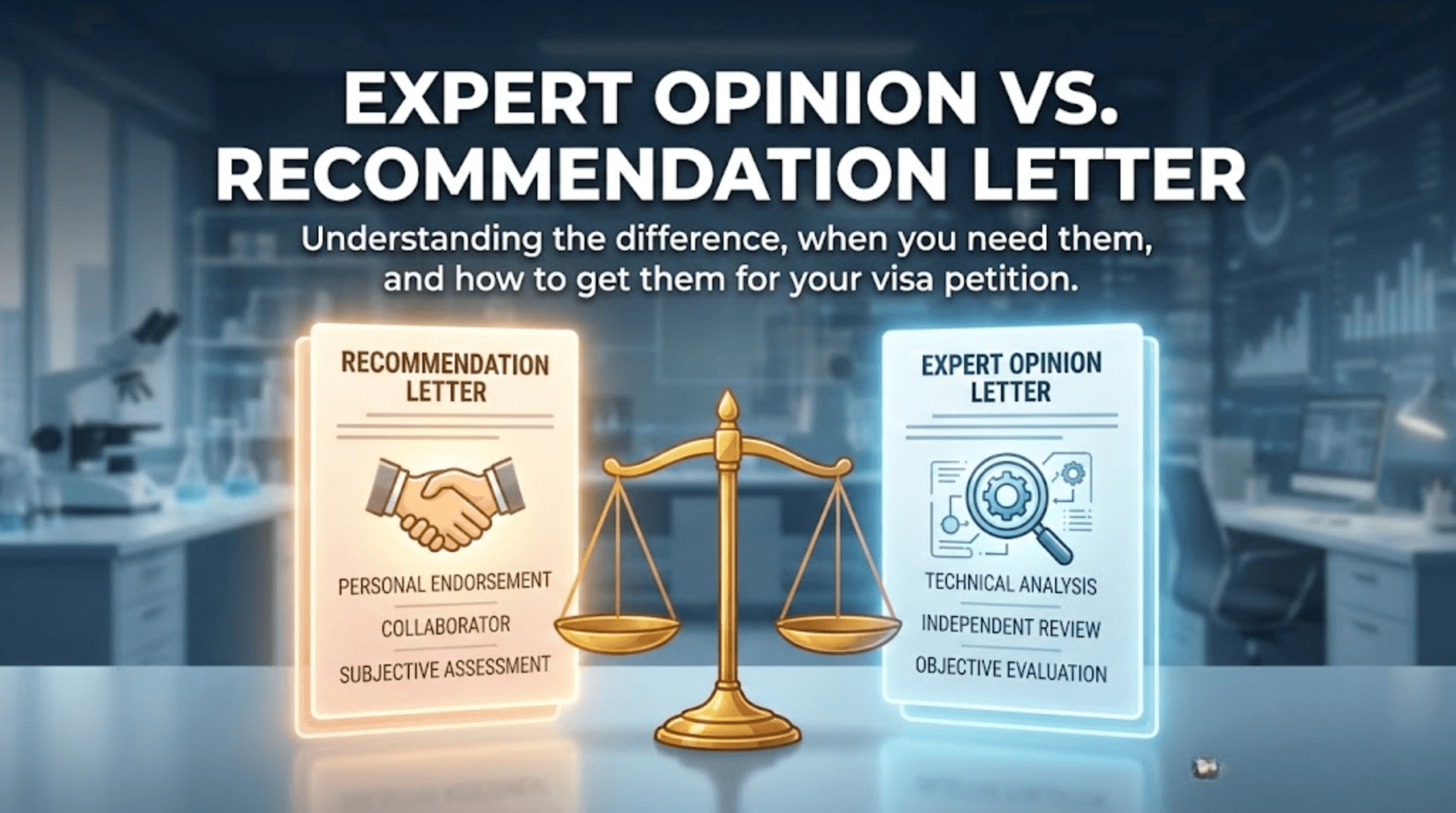
Recommendation Letter:
Writer knows you or your work directly
Personal assessment of your abilities
"I believe this person is extraordinary"
Based on direct observation or collaboration
Expert Opinion Letter:
Writer is independent field expert
Technical analysis of your achievements
"This work is significant because..."
Based on expert knowledge of field
Both are valuable, but serve different purposes:
Recommendations: Personal validation
Expert opinions: Technical education for adjudicator
When You Need Expert Opinion Letters
Situation 1: Highly Technical Achievements
When: Your contributions require specialized knowledge to understand.
Example: You developed a novel cryptographic protocol. A USCIS officer can't evaluate whether this is significant without understanding cryptography.
Expert opinion provides: Explanation of why the protocol matters, how it compares to alternatives, and why it represents extraordinary achievement.
Situation 2: Non-Obvious Impact
When: Your work's significance isn't immediately apparent.
Example: You created a dataset that's widely used but doesn't sound impressive on its surface.
Expert opinion provides: Context on why this dataset is important, how it's used, and why creating it represents significant contribution.
Situation 3: Field Context Needed
When: USCIS needs to understand field norms to evaluate your achievements.
Example: You have 100 citations. Is that a lot? Depends on field and career stage.
Expert opinion provides: Field-specific context explaining that your citation count is in top 5% for your career stage and field.
Situation 4: Disputed or Unusual Claims
When: Your achievements might be questioned without expert validation.
Example: You claim your methodology "changed the field" but don't have traditional metrics to prove it.
Expert opinion provides: Independent validation from recognized expert that your claim is accurate.
Who Qualifies as an Expert
Requirements:
1. Recognized expertise
Advanced degree in relevant field (PhD typical)
Publication record in the area
Professional position demonstrating expertise
Industry recognition
2. Independence
Never worked with you directly
No personal relationship
No financial interest in your success
Can provide objective assessment
3. Credibility with USCIS
Position at recognized institution
Clear qualifications stated in letter
Able to speak authoritatively on your field
Ideal expert profile:
Professor at major university
Senior researcher at national lab
Chief scientist at major company
Recognized industry expert
Published author in your specific area
How to Find Expert Opinion Writers
Method 1: Researchers Who Cited Your Work
They know your work through their own research
Built-in independence
Can speak to significance
Approach: "I noticed you cited my work on [topic]. I'm applying for an O-1 visa and seeking expert opinions on the significance of my research. Would you be willing to provide a brief expert assessment?"
Method 2: Authors of Related Work
Leading researchers in your subfield
Familiar with landscape and context
Can compare your work to field standards
Approach: "As a leading researcher in [field], would you be willing to review my work and provide an expert opinion for an immigration petition?"
Method 3: Through Professional Networks
Professional association connections
Conference contacts
Colleagues' recommendations
Approach: Ask colleagues if they know experts who might be willing to provide opinions.
Method 4: Expert Witness Services
Some experts provide opinion letters professionally
Typically charge fees ($500-$2,000)
Ensure they have genuine expertise
Considerations: Paid experts are legitimate, but payment should be for their time reviewing your work, not for the opinion itself.
What Expert Opinion Letters Should Contain
Section 1: Expert's Qualifications (1 paragraph)
Establish why this person is qualified to opine.
Example: "I am Professor of Electrical Engineering at Stanford University, where I have conducted research in signal processing for 25 years. I have published over 150 peer-reviewed papers, hold 12 patents, and am a Fellow of IEEE. I am writing to provide my expert opinion on the significance of [Name]'s contributions to the field."
Section 2: Scope and Methodology (1 paragraph)
Explain what they reviewed and how they formed their opinion.
Example: "I have reviewed [Name]'s publications, patent filings, and citation metrics. I have also examined how their work has been received by the research community and its adoption in industry. My assessment is based on my expertise in this field and my understanding of what constitutes significant contributions."
Section 3: Technical Analysis (2-4 paragraphs)
This is the core of the letter—explaining why the work is significant.
Include:
What the applicant accomplished
Why it matters (problem solved, advancement made)
How it compares to other approaches
Impact on field or industry
Example: "[Name]'s algorithm for distributed consensus achieves Byzantine fault tolerance with 40% lower latency than previous approaches. This is significant because distributed systems are foundational to cloud computing, and latency improvements directly translate to performance gains for millions of users. Prior to [Name]'s work, the standard approach required three rounds of communication; their method requires only two. This improvement has been adopted by major companies including Google and Amazon."
Section 4: Comparison to Field Standards (1-2 paragraphs)
Place the work in context of what's normal or exceptional in the field.
Example: "In the field of distributed systems, publishing at OSDI or SOSP represents the highest level of peer recognition. [Name] has published three papers at these venues, placing them among the top researchers globally. Their citation count of 500 is in the top 3% of researchers at their career stage in this field."
Section 5: Conclusion (1 paragraph)
Explicitly state your expert opinion on significance.
Example: "Based on my analysis, [Name]'s contributions represent extraordinary achievement in distributed systems research. Their work has influenced the direction of the field and has been adopted in production systems serving billions of users. In my expert opinion, [Name]'s achievements place them among the top researchers in this field."
Common Expert Opinion Mistakes
Mistake 1: Expert Doesn't Demonstrate Independence
Problem: Letter doesn't establish that expert is independent.
Fix: Expert should explicitly state they have no personal/professional relationship with applicant.
Mistake 2: Opinion Without Analysis
Problem: Expert says work is significant but doesn't explain why.
Fix: Include detailed technical analysis supporting the opinion.
Mistake 3: Expert Lacks Relevant Credentials
Problem: Expert's expertise isn't clearly in applicant's field.
Fix: Choose expert whose qualifications directly relate to the work being evaluated.
Mistake 4: Generic Analysis
Problem: Letter could apply to anyone in the field.
Fix: Include specific analysis of this applicant's specific contributions.
Paid Expert Opinions: Ethics and Legitimacy
Is it okay to pay for expert opinions?
Yes, with important caveats:
Legitimate:
Paying for expert's time to review materials
Compensating for effort of writing letter
Professional expert witness services
Not legitimate:
Paying for favorable opinion
Paying for expert to say specific things
Fabricating expert credentials
Disclosure: Payment doesn't need to be disclosed, but opinion must be genuine expert assessment.
Typical costs:
Pro bono (free): Experts who want to help
$500-$1,000: Brief opinion letter
$1,000-$2,000: Detailed analysis
How OpenSphere Helps with Expert Opinions
Need Assessment: Based on your evidence, OpenSphere indicates whether expert opinions would strengthen your case.
Expert Identification: OpenSphere helps identify potential experts based on who has cited your work or published in your area.
Letter Framework: OpenSphere provides structure and talking points for expert opinion letters.
Quality Review: Evaluate whether draft expert opinions meet USCIS expectations.
Comparison Table: Expert Opinion vs Recommendation
Factor | Expert Opinion | Recommendation Letter |
Purpose | Educate on technical significance | Personal endorsement |
Writer relationship | Must be independent | Can be collaborator |
Content focus | Technical analysis | Personal assessment |
When most valuable | Complex technical achievements | All cases |
Payment | Acceptable for time | Generally not appropriate |
Typical length | 2-4 pages | 1-2 pages |
Wondering if you need expert opinion letters for your O-1 or EB-1A case? Need help finding qualified experts?
Take the OpenSphere evaluation. You'll get assessment of whether expert opinions would strengthen your case.
1. Are expert opinion letters required for O-1 or EB-1A?
Not required, but often valuable for technical fields where significance isn't obvious to non-experts.
2. How many expert opinion letters do I need?
If using them: 2-3 is typical. They supplement, not replace, recommendation letters.
3. Can the same person write recommendation and expert opinion?
No—these serve different purposes. Expert opinions must be from independent parties.
4. Is paying for expert opinions ethical?
Yes, if paying for their time, not their opinion. The assessment must be genuine.
5. What if I can't find independent experts?
Try researchers who cited your work, authors in your field, or professional expert witness services.
6. How technical should the letter be?
Technical enough to establish significance, accessible enough for non-expert USCIS officer. Define terms, explain importance.
7. Do expert opinion writers need to be U.S.-based?
No. International experts can provide opinions. What matters is their expertise and independence.
8. Can I use expert opinions from industry instead of academia?
Yes. Industry experts with relevant credentials can provide valuable opinions, especially for commercial impact.
9. How long should expert opinion letters be?
Typically 2-4 pages. Long enough to provide thorough analysis, focused enough to maintain impact.
10. Should expert mention they reviewed specific materials?
Yes. Stating what they reviewed (publications, patents, citation data) establishes basis for their opinion.