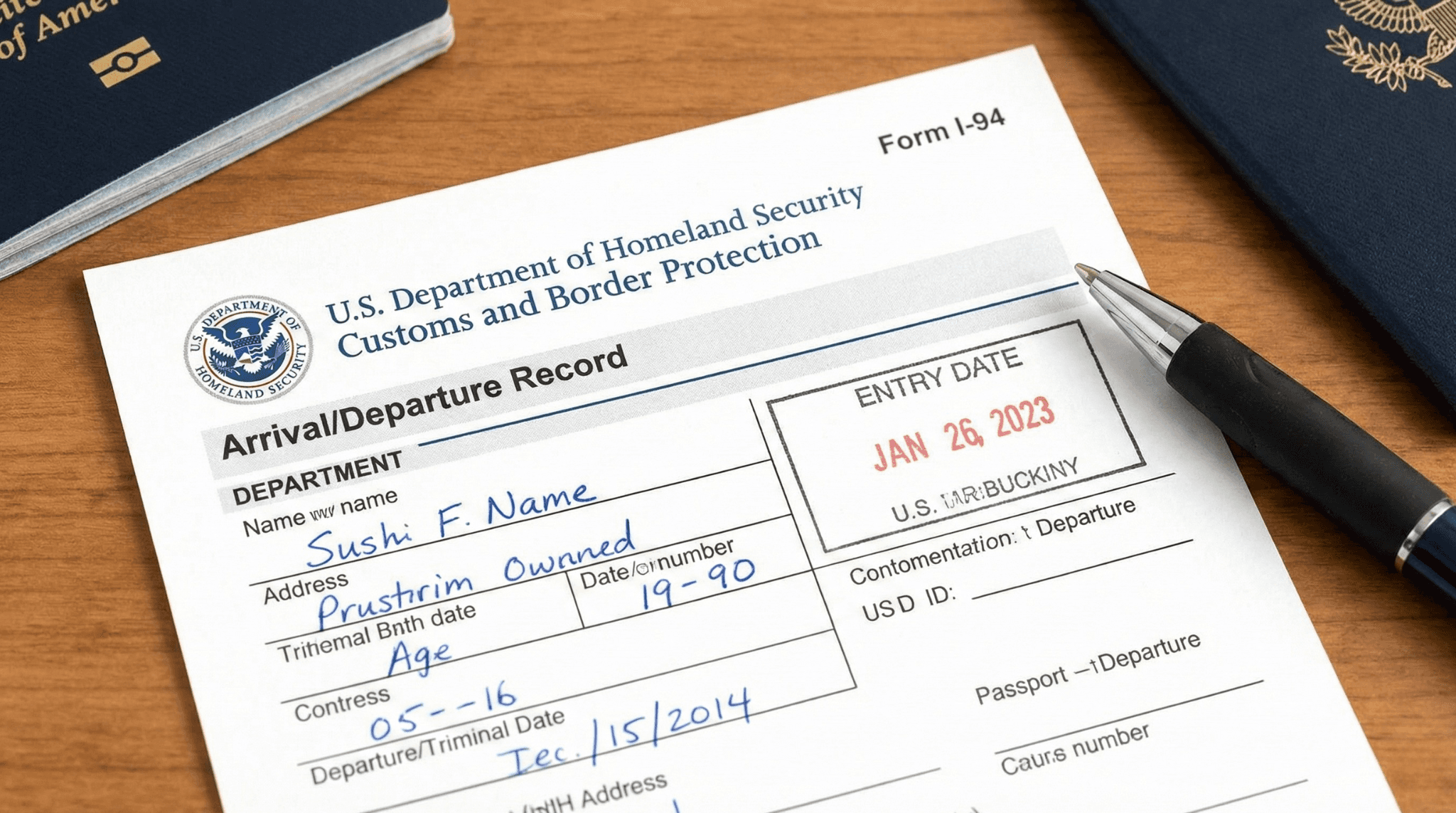
I-94 is electronic arrival/departure record created when you enter U.S. It shows your immigration status, authorized stay period, and admission date. Access it anytime at cbp.gov/i94 and print multiple copies. I-94 proves your legal status to employers, schools, DMV, and USCIS. It's more important than visa stamp for proving status within U.S. Print it after every international trip.
Key Takeaways
I-94 created automatically when entering U.S. by air/sea
Access and print anytime at cbp.gov/i94 (free)
Shows your status, admit date, and authorized stay period
Paper I-94 still issued at land borders (Canada, Mexico)
Print multiple copies for employment, DMV, school enrollment
Check I-94 after every entry for errors and report immediately
Table of Content
What Is I-94
I-94 (Arrival/Departure Record) is electronic record created by CBP (Customs and Border Protection) when you enter U.S. It contains passport number, admission date, class of admission (B-2, F-1, H-1B, etc.), and admit until date (how long you can stay).
For most visa types entering by air or sea, I-94 is completely electronic - no physical document. For land border entries (Canada/Mexico), you still receive paper I-94 stapled in passport.
What I-94 shows:
Name (as in passport)
Date of birth
Passport number
Country of citizenship
Visa type/Class of admission (H1B, F1, B2, etc.)
Admission date
Admit until date (or "D/S" for duration of status)
Accessing Your I-94
Visit cbp.gov/i94 and enter passport number, birth date, and admission date. System retrieves your I-94 instantly. Print PDF or screenshot for your records.
When to access I-94:
Immediately after every international trip
When starting new job (employer needs copy)
When enrolling in school
When applying for driver's license
When filing USCIS applications
Anytime you need to prove legal status
I-94 is free. Never pay third-party websites charging fees for I-94 retrieval.
Duration of Status (D/S)
Most work and student visas show "D/S" (Duration of Status) instead of specific date in "admit until" field. This means you can stay as long as you maintain valid status.
D/S visas:
F-1 (student): Valid until program completion plus grace period
H-1B (work): Valid until I-797 approval notice expiration
J-1 (exchange): Valid until program end on DS-2019
L-1 (transfer): Valid until I-797 expiration
Even with D/S, your status has expiration date determined by approval notice (I-797, I-20, DS-2019), not I-94.
I-94 vs Visa Stamp
People confuse these frequently. Visa stamp in passport allows entering U.S. It's like entry ticket. I-94 proves legal status while in U.S. It's like attendance record.
Document
Purpose
Where You Get It
Expiration Meaning
Visa stamp
Permission to enter U.S.
U.S. consulate abroad
Cannot enter if expired
I-94
Proof of legal status in U.S.
CBP at border
Must leave U.S. by this date
You can have expired visa stamp but valid I-94 - you're legal in U.S. but cannot travel and return. You can have valid visa stamp but no I-94 - you haven't entered U.S. yet.
Why I-94 Matters More Than Visa
Within U.S., I-94 is king. Employers verify work authorization using I-94 and I-797, not visa stamp. DMV issues driver's licenses based on I-94 validity. USCIS processes applications based on I-94 entry records. Schools verify student status using I-94 and I-20.
Your visa stamp can be expired for years, but as long as I-94/status is valid, you're legal. This confuses many immigrants who think expired visa stamp means illegal status.
Common I-94 Errors
Errors happen frequently. CBP officer may enter wrong information. Check immediately after every entry.
Common errors:
Name spelling mistakes
Wrong class of admission (entered as B-2 when you have H-1B)
Wrong passport number
Wrong admit until date
Missing entry (especially rare but happens)
Report errors immediately to CBP Deferred Inspection site or file online correction request. Don't assume it will fix itself - errors complicate employment verification and future applications.
Paper I-94 at Land Borders
Land border crossings from Canada and Mexico still issue paper I-94 cards. Officers staple white or green card into passport. This is your I-94 - keep it safe.
Paper I-94 rules:
Keep it stapled in passport or in safe place
Submit when departing if returning by land
Get new one each entry
Same information as electronic I-94
Losing it requires replacement filing ($445 Form I-102)
I-94 for Employment Verification
Employers use Form I-9 to verify work authorization. For most non-citizens, this requires I-94. Employer examines I-94 showing valid status (F-1 with OPT, H-1B, etc.) plus work authorization document (EAD, I-797, etc.).
Print I-94 before first day of work. Give copy to employer for I-9 completion. Keep copy for your records.
Travel Record and I-94
I-94 maintains complete entry/exit history. When you leave U.S., exit is recorded electronically (airlines transmit passenger manifest to CBP). When you return, new I-94 is created.
Access travel history at cbp.gov/i94 - shows all entries and exits. Useful for proving physical presence for citizenship, tracking time abroad for green card abandonment concerns, or documenting continuous residence.
When I-94 Gets Complicated
Adjustment of status applicants (I-485 pending) don't always have clear I-94 because status change happens within U.S. Advance parole travel creates new I-94 as "parolee." Some statuses have automatic extensions (Cap-Gap, H-4 EAD) not reflected in I-94 requiring additional documentation.
For complex situations, consult immigration attorney about proving status.
Visit cbp.gov/i94, enter passport number and birth date. System retrieves your record instantly. Print PDF for your records.
My I-94 has error, how to fix?
File correction request online at cbp.gov or visit CBP Deferred Inspection site at nearest international airport with supporting documents.
Do I need I-94 if visa is valid?
Yes. Visa allows entry, I-94 proves legal status in U.S. Both serve different purposes. Employers need I-94, not visa stamp.
What if I-94 shows wrong admission date?
Correct it immediately with CBP. Wrong dates affect future applications and benefit calculations for green cards/citizenship.
Can I-94 be extended?
Not directly. File for extension of underlying status (H-1B extension, F-1 program extension). New approval notice extends your authorized stay, and new I-94 created on next entry.