Greenlit on the Merits: An EB-1A Approval
Greenlit on the Merits: An EB-1A Approval
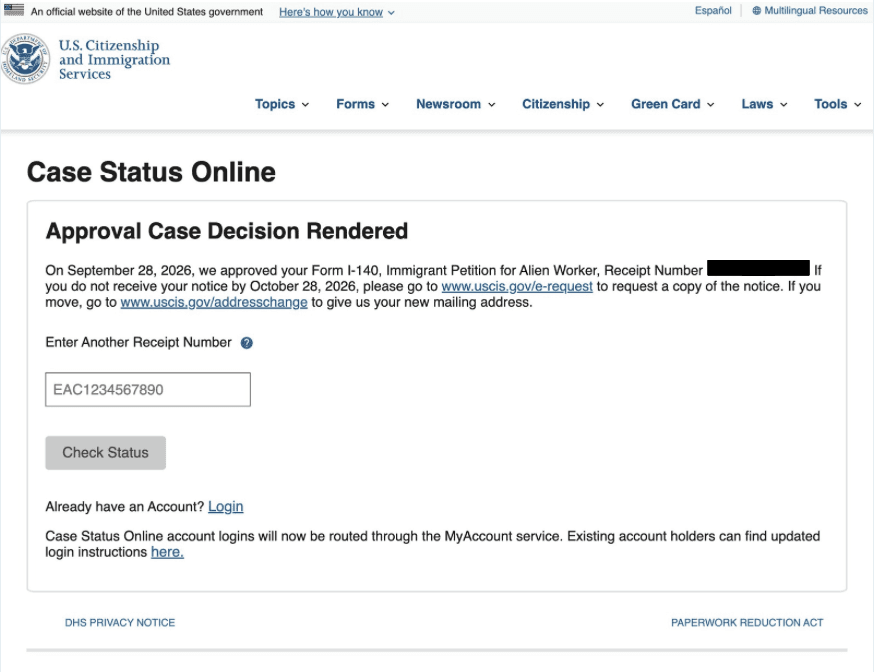
An EB-1A green card approval for a technology leader in satellite positioning and advanced sensor systems, recognized as an individual of extraordinary ability. The EB-1A is the highest bar in employment-based immigration, and he cleared it after a demanding Request for Evidence. He has been greened, meaning he now holds the path to permanent residence in the United States.
An EB-1A green card approval for a technology leader in satellite positioning and advanced sensor systems, recognized as an individual of extraordinary ability. The EB-1A is the highest bar in employment-based immigration, and he cleared it after a demanding Request for Evidence. He has been greened, meaning he now holds the path to permanent residence in the United States.
September 28, 2026
September 28, 2026
Petition Type | Route | Processing | RFE | Status |
EB-1A Extraordinary Ability | Self-Petition | Premium | Issued and Overcome | Approved |
Case Background
Case Background
This is a self-petitioned EB-1A, which means the applicant sponsored himself on the strength of his own record, with no employer behind the filing. Client details have been anonymized, but the facts are real. Here is who he is:
A technology leader with more than fifteen years in satellite positioning and navigation systems and, more recently, advanced sensor technology
The creator of a simulation and validation platform that changed how his industry tests a category of mission-critical positioning receivers, work that produced foundational intellectual property and was adopted by major players in automotive and autonomous driving
Now a senior commercial leader taking a new class of sensor technology to market across energy, industrial safety, and defense, at a heavily funded company
A repeat invited judge of his peers' work, a published author in his field, a subject of trade and general media coverage, and a senior member of a leading professional body
Field: Technology
This is a self-petitioned EB-1A, which means the applicant sponsored himself on the strength of his own record, with no employer behind the filing. Client details have been anonymized, but the facts are real. Here is who he is:
A technology leader with more than fifteen years in satellite positioning and navigation systems and, more recently, advanced sensor technology
The creator of a simulation and validation platform that changed how his industry tests a category of mission-critical positioning receivers, work that produced foundational intellectual property and was adopted by major players in automotive and autonomous driving
Now a senior commercial leader taking a new class of sensor technology to market across energy, industrial safety, and defense, at a heavily funded company
A repeat invited judge of his peers' work, a published author in his field, a subject of trade and general media coverage, and a senior member of a leading professional body
Field: Technology
Why the EB-1A Is the Hardest Standard
Why the EB-1A Is the Hardest Standard
The EB-1A is not a bigger O-1A. It is a different and higher test, and it is a green card, permanent residence, which raises both the stakes and the scrutiny.
It works in two steps. First, you must satisfy at least three of ten regulatory criteria, things like authorship, judging, a leading or critical role, and original contributions of major significance. Meeting three is only the entry ticket. Second, and this is where many strong cases fail, USCIS applies a final merits determination: it steps back and weighs all of the evidence together to decide whether the person has truly risen to the small percentage at the very top of the field, with sustained national or international acclaim.
So an EB-1A can check the boxes and still be denied, because the officer is not counting criteria at the end. They are judging a career as a whole. A winning petition has to satisfy the criteria and tell one coherent story of a person at the top of their field. That is the case we set out to build.
The EB-1A is not a bigger O-1A. It is a different and higher test, and it is a green card, permanent residence, which raises both the stakes and the scrutiny.
It works in two steps. First, you must satisfy at least three of ten regulatory criteria, things like authorship, judging, a leading or critical role, and original contributions of major significance. Meeting three is only the entry ticket. Second, and this is where many strong cases fail, USCIS applies a final merits determination: it steps back and weighs all of the evidence together to decide whether the person has truly risen to the small percentage at the very top of the field, with sustained national or international acclaim.
So an EB-1A can check the boxes and still be denied, because the officer is not counting criteria at the end. They are judging a career as a whole. A winning petition has to satisfy the criteria and tell one coherent story of a person at the top of their field. That is the case we set out to build.
How We Built the Case
How We Built the Case
As an aside worth noting: he had applied once before, roughly two years earlier, with a different preparer, and that attempt had not succeeded. We did not adapt the old petition. A case that has already failed usually fails for structural reasons rather than cosmetic ones, so we started over, reassessed his entire record, and rebuilt the petition around the evidence that would actually carry the EB-1A standard.
We framed his record around the strongest proof of top-of-field standing: the platform he originated that changed an industry practice, the intellectual property behind it, its adoption by major companies, his repeated selection to judge others, his authorship, and his media recognition. Where the profile had gaps, we strengthened it before refiling rather than hoping an officer would overlook them. We filed under premium processing, and USCIS responded with a detailed Request for Evidence.
As an aside worth noting: he had applied once before, roughly two years earlier, with a different preparer, and that attempt had not succeeded. We did not adapt the old petition. A case that has already failed usually fails for structural reasons rather than cosmetic ones, so we started over, reassessed his entire record, and rebuilt the petition around the evidence that would actually carry the EB-1A standard.
We framed his record around the strongest proof of top-of-field standing: the platform he originated that changed an industry practice, the intellectual property behind it, its adoption by major companies, his repeated selection to judge others, his authorship, and his media recognition. Where the profile had gaps, we strengthened it before refiling rather than hoping an officer would overlook them. We filed under premium processing, and USCIS responded with a detailed Request for Evidence.
The RFE and How We Answered It
The RFE and How We Answered It
The RFE was serious. It conceded two criteria outright, judging and original contributions of major significance, and challenged the rest. Two criteria are not enough. The EB-1A requires three, so we had to secure at least one more from the contested pile, and then win the final merits argument. We secured two more, and built the totality case on top.
The authorship criterion: correcting a misapplication
This was the pivotal point. The RFE rejected authorship because, it said, the record did not show his articles were widely and frequently cited or that they had become of major significance in the field. That is the wrong test. The authorship criterion asks three things only: that he authored work in the field, that the work is scholarly, and that it appeared in a qualifying professional or major-trade publication. Citation counts and major significance belong to a different criterion, original contributions, which USCIS had already conceded. We showed, criterion by criterion, that the officer had imported a requirement the regulation does not contain, and that on the correct test his authorship plainly qualified. We did not argue louder. We corrected the standard.
The leading or critical role criterion
The RFE accepted that he held senior roles but said the record did not separate his contribution from that of any other employee. So we did exactly that. We documented what turned on him specifically: the outcomes he was directly responsible for, the decisions that were his to make, and the concrete results in the areas he led, showing his role was critical to the organization rather than merely senior within it.
The high salary criterion
The RFE asked for tax records and a better peer comparison on salary. We supplied the tax documents in good faith to be fully responsive, but we did not rest the case on this criterion. We told USCIS plainly that his eligibility stood on the other criteria and the totality, so the case did not depend on winning a benchmarking argument. Choosing which ground to fight on is part of the craft.
The final merits argument
With four criteria established, one more than required, we made the totality case: taken as a whole, the record shows a person who changed an industry practice, is repeatedly asked to judge his peers, publishes in his field, and is recognized in the media, which is exactly the sustained acclaim the final merits determination looks for. We did not just clear the threshold. We showed the officer the whole picture the standard actually asks about.
The RFE was serious. It conceded two criteria outright, judging and original contributions of major significance, and challenged the rest. Two criteria are not enough. The EB-1A requires three, so we had to secure at least one more from the contested pile, and then win the final merits argument. We secured two more, and built the totality case on top.
The authorship criterion: correcting a misapplication
This was the pivotal point. The RFE rejected authorship because, it said, the record did not show his articles were widely and frequently cited or that they had become of major significance in the field. That is the wrong test. The authorship criterion asks three things only: that he authored work in the field, that the work is scholarly, and that it appeared in a qualifying professional or major-trade publication. Citation counts and major significance belong to a different criterion, original contributions, which USCIS had already conceded. We showed, criterion by criterion, that the officer had imported a requirement the regulation does not contain, and that on the correct test his authorship plainly qualified. We did not argue louder. We corrected the standard.
The leading or critical role criterion
The RFE accepted that he held senior roles but said the record did not separate his contribution from that of any other employee. So we did exactly that. We documented what turned on him specifically: the outcomes he was directly responsible for, the decisions that were his to make, and the concrete results in the areas he led, showing his role was critical to the organization rather than merely senior within it.
The high salary criterion
The RFE asked for tax records and a better peer comparison on salary. We supplied the tax documents in good faith to be fully responsive, but we did not rest the case on this criterion. We told USCIS plainly that his eligibility stood on the other criteria and the totality, so the case did not depend on winning a benchmarking argument. Choosing which ground to fight on is part of the craft.
The final merits argument
With four criteria established, one more than required, we made the totality case: taken as a whole, the record shows a person who changed an industry practice, is repeatedly asked to judge his peers, publishes in his field, and is recognized in the media, which is exactly the sustained acclaim the final merits determination looks for. We did not just clear the threshold. We showed the officer the whole picture the standard actually asks about.
The Outcome
The Outcome
APPROVED | GREEN CARD | RFE OVERCOME | FOUR CRITERIA |
EB-1A Extraordinary Ability | Path to permanent residence | All challenges answered | One more than the three required |
The EB-1A was approved. He was recognized, on the merits, as an individual of extraordinary ability, and now holds the path to permanent residence in the United States. In short, he got greened.
The strongest EB-1A petitions do not just meet the criteria. They make an officer see a career at the very top of its field, and answer every question before it becomes a doubt.
APPROVED | GREEN CARD | RFE OVERCOME | FOUR CRITERIA |
EB-1A Extraordinary Ability | Path to permanent residence | All challenges answered | One more than the three required |
The EB-1A was approved. He was recognized, on the merits, as an individual of extraordinary ability, and now holds the path to permanent residence in the United States. In short, he got greened.
The strongest EB-1A petitions do not just meet the criteria. They make an officer see a career at the very top of its field, and answer every question before it becomes a doubt.
Key Success Factors
Key Success Factors
1. We built it as one story, not a checklist
Because the EB-1A ends in a final merits determination, we built the case to show sustained acclaim as a whole, not merely to satisfy three criteria. That is what turns a qualifying record into an approval.
2. We corrected the law where the RFE got it wrong
The decisive move was showing that the officer had applied the wrong test to the authorship criterion, importing a citation-impact requirement that lives in a different criterion. On the correct standard, the criterion was met. Precision on the regulation beat volume of evidence.
3. We made his role unmistakably his
For the leading or critical role criterion, we separated his contribution from everyone else's, documenting the outcomes that turned on him specifically rather than the seniority of his title.
4. We chose our ground
We answered every request, but we did not stake the case on the weakest criterion. We were responsive on salary while resting eligibility on stronger criteria and the totality, so no single contested point could sink the petition.
5. We built from solid ground, not a quick fix
Rather than lightly editing an earlier attempt, we reassessed the whole record and strengthened the profile before refiling, so the petition stood on its own from the first page.
1. We built it as one story, not a checklist
Because the EB-1A ends in a final merits determination, we built the case to show sustained acclaim as a whole, not merely to satisfy three criteria. That is what turns a qualifying record into an approval.
2. We corrected the law where the RFE got it wrong
The decisive move was showing that the officer had applied the wrong test to the authorship criterion, importing a citation-impact requirement that lives in a different criterion. On the correct standard, the criterion was met. Precision on the regulation beat volume of evidence.
3. We made his role unmistakably his
For the leading or critical role criterion, we separated his contribution from everyone else's, documenting the outcomes that turned on him specifically rather than the seniority of his title.
4. We chose our ground
We answered every request, but we did not stake the case on the weakest criterion. We were responsive on salary while resting eligibility on stronger criteria and the totality, so no single contested point could sink the petition.
5. We built from solid ground, not a quick fix
Rather than lightly editing an earlier attempt, we reassessed the whole record and strengthened the profile before refiling, so the petition stood on its own from the first page.
Why Extraordinary Professionals Trust OpenSphere
Why Extraordinary Professionals Trust OpenSphere
OpenSphere prepares EB-1A and other extraordinary ability cases for founders, engineers, scientists, and technology leaders, including complex self-petitions and difficult refilings.
Command of the two-step EB-1A standard, from the individual criteria to the final merits determination that decides the case
A proven approach to hard RFEs, including notices that apply the wrong legal test and have to be corrected, not just answered
Experience building self-petitions that rest entirely on the strength of the applicant's own record
Whether you are filing for the first time or building a stronger case than before, OpenSphere can help you build a petition that stands on its own.
Get your free visa evaluation at opensphere.ai
Note: Client details have been anonymized to protect confidentiality while preserving the essential facts of the case.
OpenSphere prepares EB-1A and other extraordinary ability cases for founders, engineers, scientists, and technology leaders, including complex self-petitions and difficult refilings.
Command of the two-step EB-1A standard, from the individual criteria to the final merits determination that decides the case
A proven approach to hard RFEs, including notices that apply the wrong legal test and have to be corrected, not just answered
Experience building self-petitions that rest entirely on the strength of the applicant's own record
Whether you are filing for the first time or building a stronger case than before, OpenSphere can help you build a petition that stands on its own.
Get your free visa evaluation at opensphere.ai
Note: Client details have been anonymized to protect confidentiality while preserving the essential facts of the case.