Academic Immigration Roadmap: From PhD to Tenured Professor
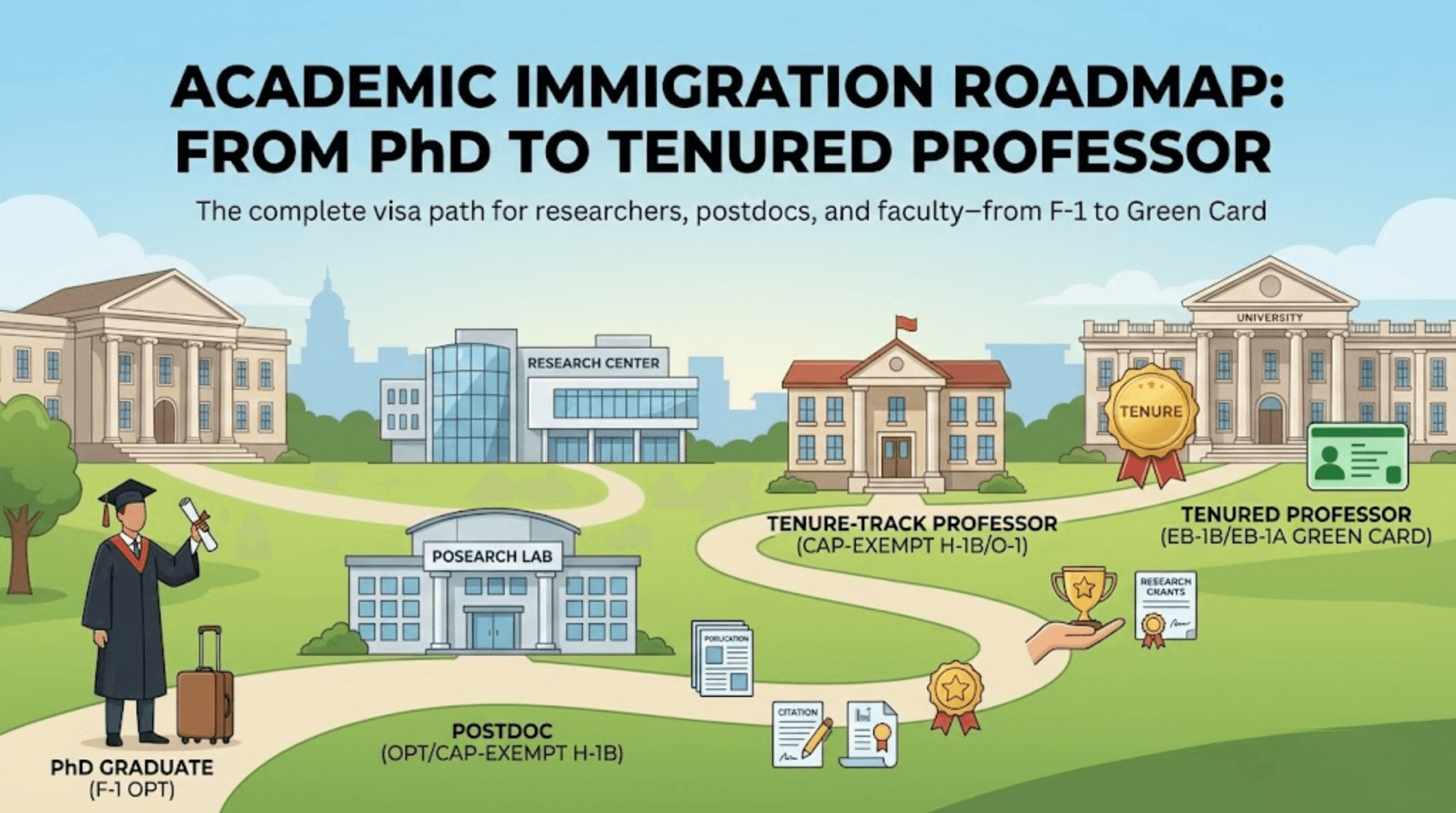
The academic career path creates natural immigration opportunities - F-1 during PhD, OPT for postdocs, O-1 or H-1B for faculty positions, and EB-1B or EB-1A for tenure-track roles. Here's the complete academic immigration roadmap.
The academic career path creates natural immigration opportunities - F-1 during PhD, OPT for postdocs, O-1 or H-1B for faculty positions, and EB-1B or EB-1A for tenure-track roles. Here's the complete academic immigration roadmap.
Academic careers offer strong immigration paths: F-1 during PhD generates evidence (publications, teaching, awards), postdoc positions on OPT or cap-exempt H-1B avoid lottery, and tenure-track positions enable EB-1B (outstanding researcher) green card with no backlog. Faculty at universities can file for cap-exempt H-1B anytime without lottery.
The key advantage: academic achievements naturally satisfy O-1 and EB-1 criteria, and universities are experienced immigration sponsors.
Key Takeaways
PhD work builds evidence:
Publications, teaching awards, and research naturally satisfy visa criteria.
Cap-exempt H-1B for universities:
Faculty and researchers at universities skip H-1B lottery.
Postdoc on OPT works:
STEM PhD OPT extension provides 3 years for postdoc work.
EB-1B is designed for academics:
Outstanding researcher green card has no backlog for most countries (India/China have 2-4 year waits).
Tenure-track timing matters:
Start green card process before tenure clock runs out.
Multiple pathways exist:
O-1, H-1B, EB-1B, or EB-1A depending on profile.
Table of Content
The Academic Immigration Timeline
Years 1-5: PhD on F-1
Status: F-1 student visa
Focus:
Complete dissertation
Publish papers
Present at conferences
Build teaching experience
Network in field
Immigration preparation:
Document all achievements
Collect recommendation letters
Build citation profile
Join professional associations
Years 5-8: Postdoc
Status options:
OPT (12 months + 24 STEM extension)
Cap-exempt H-1B at university
J-1 (if from abroad, though has 2-year requirement)
Career focus:
Publish more papers
Develop independent research program
Apply for grants
Build citation profile
Prepare faculty applications
Immigration advantage:
OPT provides 3 years without visa costs
Universities can sponsor cap-exempt H-1B anytime
Build evidence toward O-1/EB-1
Years 8+: Faculty Position
Status options:
Cap-exempt H-1B (most common)
O-1 (if strong evidence)
Already have H-1B from postdoc
Career focus:
Teaching
Research program
Tenure preparation
Grant applications
Green card timing:
File EB-1B early in tenure track
Or pursue EB-1A if sufficient evidence
Don't wait until tenure decision
Cap-Exempt H-1B for Academics
What is cap-exempt H-1B?
H-1B through employers exempt from annual cap:
Universities (public and private)
Nonprofit research organizations
Government research institutions
University-affiliated nonprofits
Huge advantages:
1. No lottery:
File anytime
No March registration
No 25% selection odds
2. Start immediately:
File with premium processing
Start work within weeks
No October 1 wait
3. Renewable indefinitely:
• Same 6-year maximum stay as regular H-1B (cap-exempt and cap-subject) • Extensions beyond 6 years are only possible if your green card process has started (PERM or I-140) and a visa number is not yet available
Who qualifies:
Faculty:
Assistant, Associate, Full Professors
Lecturers
Adjunct faculty
Visiting faculty
Researchers:
Postdoctoral researchers
Research scientists
Research associates
Lab managers with research duties
Staff (if directly supporting research/teaching):
Some IT roles
Some administrative roles
Must be related to educational/research mission
Process:
University HR handles petition
File I-129 with premium processing
15-day decision
Start work upon approval
Cost: Usually employer pays (standard for academic positions)
O-1 for Academic Positions
When O-1 makes sense:
You're joining university but:
Coming from industry (no cap-exempt H-1B history)
Want faster processing
Have strong evidence already
O-1 advantages over H-1B:
Same processing time with premium
No employer restrictions (can work for any university)
Strong positioning for future EB-1A
O-1 evidence from academic career:
Publications (authorship criterion)
Citations (original contributions)
Peer review (judging criterion)
Conference presentations (original contributions)
Awards and fellowships (awards criterion)
High salary (if applicable)
EB-1B: Outstanding Researcher Green Card
What is EB-1B?
Green card category specifically for researchers and professors with:
International recognition
At least 3 years research experience
Offer of tenure-track or comparable position
Requirements:
1. International recognition:
Meet 2 of 6 criteria:
Major prizes or awards
Membership in associations requiring outstanding achievements
Published material in professional publications about your work
Participation as judge of others' work
Original research contributions
Authorship of scholarly articles
Note: These are easier to meet than EB-1A's 3 of 10 criteria.
2. Three years of research experience:
PhD research counts
Postdoc counts
Teaching generally doesn't count unless research-focused
Most PhD graduates have 5+ years by graduation
3. Position offer:
Tenure-track faculty position, OR
Comparable research position expected to last indefinitely
University research scientist positions qualify
EB-1B vs EB-1A:
Factor
EB-1B
EB-1A
Employer required
Yes
No (self-petition)
Criteria
2 of 6
3 of 10
Experience requirement
3 years research
None specified
Job offer required
Yes (tenure-track or comparable)
No
Who pays
Employer typically
You (self-petition)
Backlog
None for most countries; 2-3 years (China); 3-4 years (India)
None for most countries; 2-3 years (China); 3-4 years (India)
When to choose EB-1B:
You have tenure-track offer
You meet 2 of 6 criteria easily
Employer will sponsor
Want employer support
When to choose EB-1A:
You meet 3 of 10 criteria
Want self-petition flexibility
Employer won't sponsor
Career may change
EB-1A for Academics
Academics often qualify for EB-1A, and academic achievements naturally satisfy criteria:
Criterion 1 (Awards):
Dissertation awards
Best paper awards
Fellowship awards (NSF GRFP, etc.)
Criterion 3 (Published material about you):
University press releases
Media coverage of research
Profiles in academic publications
Criterion 4 (Judging):
Peer review for journals
Conference program committees
Grant review panels
Criterion 5 (Original contributions):
Research papers
Citations to your work
Novel methodologies
Criterion 6 (Authorship):
Published papers
Conference proceedings
Book chapters
Criterion 7 (Exhibitions):
Research presented at conferences
Invited talks
Criterion 8 (Critical role):
Key research role at institution
Grant leadership
Lab management
Timing Green Card with Tenure
Critical timing issue:
Most tenure decisions: Year 6-7 of tenure track
If you wait until Year 5 to start green card:
PERM + I-140 + I-485: 3-4 years
Green card approved after tenure decision
If tenure denied, must leave university
Green card in jeopardy if lose job
Better strategy:
Start EB-1B or EB-1A in Year 1-2:
Earlier filing
Green card approved before tenure decision
Job flexibility if tenure denied
Peace of mind during tenure process
International Faculty Considerations
If you're abroad and offered faculty position:
Option 1: H-1B from abroad
University files cap-exempt H-1B
You interview at consulate
Enter U.S. on H-1B
Start teaching/research
Option 2: O-1 from abroad
Stronger evidence case
Same process—consular interview
Enter on O-1
Option 3: J-1 exchange visitor
Some universities prefer J-1 for visiting scholars
Be aware of 2-year home residency requirement
May complicate future green card
Recommendation: H-1B or O-1 generally better than J-1 for long-term plans.
How OpenSphere Helps Academics
Academic Career Stage Assessment:
Based on your stage (PhD, postdoc, faculty), recommend optimal visa path.
Evidence Evaluation:
Assess your publications, citations, and achievements against O-1 and EB-1 criteria.
Timeline Planning:
Map when to file green card relative to tenure timeline.
EB-1B vs EB-1A Comparison:
Determine which green card path is stronger for your profile.
Academic Immigration Paths
Career Stage
Recommended Visa
Green Card Option
Timeline
PhD student
F-1
Build evidence
4-6 years
Postdoc
OPT or cap-exempt H-1B
File EB-1B/EB-1A if ready
2-4 years
Tenure-track
Cap-exempt H-1B
EB-1B (employer) or EB-1A (self)
File Year 1-2
Tenured
H-1B or O-1
EB-1B or EB-1A
Anytime
In academia and planning your immigration path? Want to know when to file for green card relative to your tenure timeline?
Take the OpenSphere evaluation. You'll get academic-specific immigration roadmap.