Quick Answer

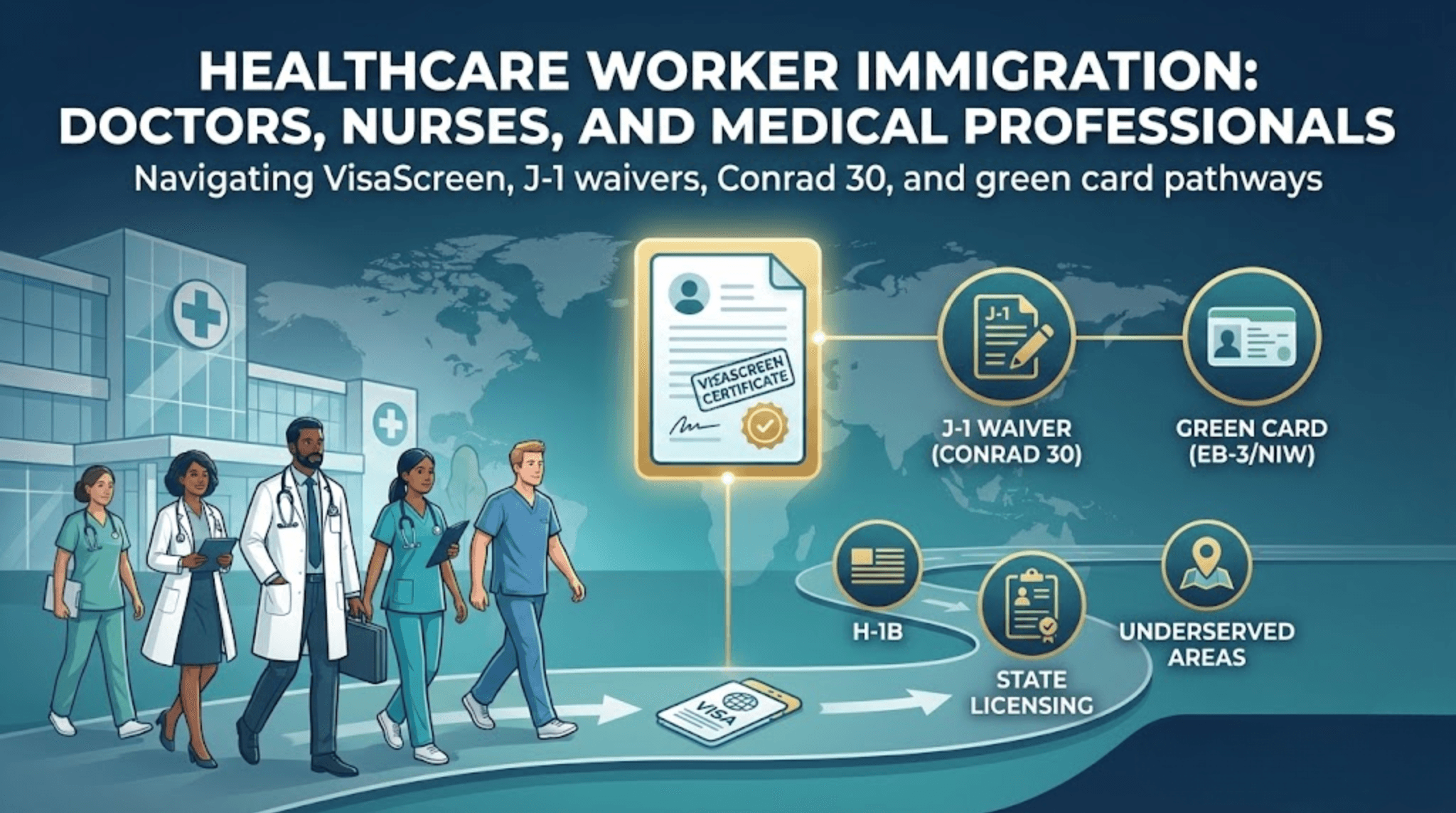
Healthcare workers have specialized immigration paths shaped by U.S. workforce needs and licensing requirements. Physicians on J-1 face two-year home residency requirements (waivable through Conrad 30 or other programs). Nurses can pursue H-1B or EB-3 with VisaScreen certification. Physical therapists, pharmacists, and other allied health professionals use H-1B. NIW (National Interest Waiver) is particularly accessible for healthcare workers in underserved areas. Timeline varies: nurses face 2-4 years for EB-3 green cards, physicians need 3-7 years depending on waiver and category.

Key Takeaways

  • VisaScreen is mandatory: Most healthcare workers need VisaScreen certificate before H-1B or green card.

  • J-1 physicians face two-year requirement: Must waive through Conrad 30, federal agency, or other programs.

  • Conrad 30 requires 3-year commitment: Work in underserved area for 3 years to waive J-1 requirement.

  • NIW is accessible for healthcare: Serving underserved populations strengthens NIW case significantly.

  • Nurses have direct EB-3 path: Can skip H-1B and go directly to green card in some cases.

  • State licensing complicates timing: Must coordinate immigration timing with licensing requirements.

Key Takeaways

  • VisaScreen is mandatory: Most healthcare workers need VisaScreen certificate before H-1B or green card.

  • J-1 physicians face two-year requirement: Must waive through Conrad 30, federal agency, or other programs.

  • Conrad 30 requires 3-year commitment: Work in underserved area for 3 years to waive J-1 requirement.

  • NIW is accessible for healthcare: Serving underserved populations strengthens NIW case significantly.

  • Nurses have direct EB-3 path: Can skip H-1B and go directly to green card in some cases.

  • State licensing complicates timing: Must coordinate immigration timing with licensing requirements.

Table of Content

VisaScreen Certification

What is VisaScreen?

Certificate issued by CGFNS (Commission on Graduates of Foreign Nursing Schools) verifying:

  • Education meets U.S. standards

  • Licenses are authentic and unencumbered

  • English proficiency (if applicable)

  • Passing NCLEX-RN (for nurses) or equivalent exams

Who needs VisaScreen:

  • Nurses (RN)

  • Physical therapists

  • Occupational therapists

  • Speech-language pathologists

  • Medical technologists/technicians

  • Physician assistants (for some visas)

Who does NOT need VisaScreen:

  • Physicians (different requirements)

  • Dentists (different process)

  • Healthcare administrators

  • Medical researchers without clinical duties

How to get VisaScreen:

Step 1: Educational credentials evaluation

  • Submit transcripts and diplomas

  • CGFNS evaluates equivalency to U.S. education

  • 8-12 weeks processing

Step 2: License verification

  • CGFNS contacts licensing authorities

  • Verifies licenses are valid and unrestricted

  • 4-8 weeks

Step 3: English proficiency (if needed)

  • TOEFL or IELTS scores

  • Certain countries exempt

  • Recent scores required

Step 4: Exam results

  • NCLEX-RN for nurses

  • Relevant exams for other professions

  • Must pass before certificate issued

Step 5: VisaScreen certificate issued

  • Valid for 5 years

  • Required for H-1B and green card applications

Cost: $500-$700 Timeline: 3-6 months total

Physician Immigration Paths

The J-1 Challenge:

Most international medical graduates come to U.S. on J-1 for residency/fellowship.

J-1 two-year home residency requirement applies when:

  • Government funded (U.S. or home country)

  • Graduate medical education (residency, fellowship)

  • Skills list (physicians typically on list)

Result: Must return to home country for 2 years before H-1B or green card (unless waived).

J-1 Waiver Options for Physicians:

Option 1: Conrad 30 Waiver (Most Common)

What it is:

  • State-sponsored waiver

  • Agree to work in Health Professional Shortage Area (HPSA)

  • 3 years full-time commitment

  • Each state sponsors up to 30 physicians per year

Process:

  1. Find job offer in underserved area (rural or urban shortage area)

  2. State health department sponsors your waiver

  3. Apply to USCIS for J-1 waiver

  4. Upon approval, change to H-1B

  5. Complete 3-year service commitment

Timeline: 4-6 months for waiver approval

After 3 years: Free to practice anywhere, pursue green card

Option 2: Federal Agency Waiver

What it is:

  • Federal agency (VA, NIH, CDC, etc.) sponsors waiver

  • Work for federal government

  • No geographic restriction

Requirements:

  • Job offer from qualifying federal agency

  • Agency certifies your work furthers their mission

  • Less common than Conrad 30

Option 3: Interested Government Agency (IGA)

What it is:

  • Similar to federal agency but broader

  • Department of State involvement

  • Work benefits U.S. government programs

Option 4: Exceptional Hardship Waiver

What it is:

  • Waiver based on hardship to U.S. citizen or permanent resident spouse/child

  • Must show exceptional (not just ordinary) hardship

Standard: Very high; rarely granted

Option 5: Persecution Waiver

What it is:

  • Fear of persecution if returning to home country

  • Similar to asylum standard

When it applies: Rare; specific country situations

Physician Visa Options After J-1 Waiver

H-1B (after waiver):

  • Cap-exempt if working at hospital, university, or nonprofit

  • Cap-subject if at private practice (lottery required)

  • 3 years renewable

O-1:

  • For exceptional physicians

  • Published research, awards, recognition

  • No annual cap

Green card options:

EB-1A:

  • Extraordinary ability

  • Published research, citations, awards

  • 2-3 years

EB-2 NIW:

  • National interest waiver

  • Working in underserved area strengthens case significantly

  • 2-3 years (non-backlog), 5+ years (India)

EB-2 PERM:

  • Employer-sponsored

  • Hospital or practice sponsors

  • 3-4 years (non-backlog)

Nurse Immigration Paths

Nursing roles that qualify:

Registered Nurses (RN):

  • H-1B visa option

  • EB-3 green card option (most common)

  • Must have U.S. RN license or eligibility

Advanced Practice Nurses:

  • Nurse Practitioners

  • Clinical Nurse Specialists

  • Nurse Anesthetists

  • Nurse Midwives

  • May qualify for higher categories

H-1B for Nurses:

Requirements:

  • VisaScreen certificate

  • RN license in state of employment

  • Employer sponsorship

  • Bachelor's degree in nursing (BSN) preferred

Process:

  1. Pass NCLEX-RN

  2. Obtain state RN license

  3. Get VisaScreen certificate

  4. Employer files H-1B

  5. Enter H-1B lottery (if cap-subject)

Challenge: Most hospitals are cap-exempt, but some nursing positions face lottery.

EB-3 Green Card for Nurses:

The direct path:

Many nurses skip H-1B entirely and go straight to green card.

Process:

  1. Employer files PERM labor certification

  2. I-140 immigrant petition

  3. I-485 adjustment of status (or consular processing)

Timeline:

  • PERM: 12-18 months

  • I-140: 6-12 months

  • I-485: 12-18 months

  • Total: 3-4 years

Requirements:

  • VisaScreen certificate

  • RN license or eligibility

  • Job offer from U.S. healthcare facility

  • Meet EB-3 education requirements

Advantage: No H-1B lottery needed

Allied Health Professionals

Physical Therapists:

Visa options:

  • H-1B (requires VisaScreen)

  • O-1 (if exceptional achievements)

  • EB-2 or EB-3 green card

Requirements:

  • U.S. equivalent of physical therapy degree

  • State licensure

  • VisaScreen certificate

Occupational Therapists:

Same as physical therapists:

  • H-1B with VisaScreen

  • EB-2 or EB-3

  • State licensure required

Pharmacists:

Visa options:

  • H-1B (no VisaScreen required for pharmacists)

  • O-1 (for exceptional)

  • EB-2 green card typically

Requirements:

  • Pharmacy degree (U.S. or evaluated foreign degree)

  • NAPLEX and MPJE exams

  • State pharmacist license

Medical Technologists:

Visa options:

  • H-1B (requires VisaScreen)

  • EB-2 or EB-3

Requirements:

  • Laboratory science degree

  • Clinical lab certifications

  • VisaScreen

NIW for Healthcare Workers

Why healthcare workers excel at NIW:

Dhanasar Prong 1 (Substantial Merit and National Importance):

  • Healthcare has obvious national importance

  • Addressing physician/nurse shortages benefits U.S.

  • Serving underserved populations critical

Dhanasar Prong 2 (Well Positioned):

  • Medical credentials and training

  • Clinical experience

  • Commitment to underserved areas

Dhanasar Prong 3 (Balance favors waiving job offer):

  • Healthcare workforce shortages make labor certification impractical

  • Urgent need for providers

  • Flexibility enables service where needed most

NIW strategy for healthcare workers:

Strengthen your case by:

  • Working in Health Professional Shortage Area

  • Serving Medicaid/Medicare populations

  • Providing care to vulnerable populations

  • Research on health disparities or public health

  • Teaching/training future healthcare providers

Evidence:

  • Letters from health departments

  • Data on shortage areas

  • Patient demographic information

  • Expert letters on healthcare needs

  • Publications on public health topics

State Licensing Coordination

Critical timing issue:

Most healthcare roles require state license to work.

The challenge:

  • Getting license often requires being in state

  • Getting visa may require having job

  • Having job may require having license

  • Circular dependency

Solutions:

For nurses:

  • Some states allow NCLEX passage before arrival

  • Temporary permits in some states

  • Work with immigration-experienced recruiters

For physicians:

  • Medical licenses vary by state

  • Some allow application before arrival

  • Hospital credentialing adds time

Best practice:

  • Research state requirements early

  • Work with employers familiar with immigration

  • Budget extra time for licensing process

How OpenSphere Helps Healthcare Workers

VisaScreen Readiness: Checklist of requirements and timeline for obtaining VisaScreen.

Waiver Assessment: For J-1 physicians, evaluate which waiver option best fits your situation.

Path Comparison: Compare H-1B, NIW, and employer-sponsored paths based on your credentials.

State Licensing Coordination: Guidance on coordinating visa timing with state licensing requirements.

Comparison Table: Healthcare Immigration Paths

Profession

Common Visa

Green Card Path

Special Requirement

Physician

J-1 then H-1B (post-waiver)

NIW or EB-2 PERM

J-1 waiver, medical license

Nurse (RN)

H-1B or direct to GC

EB-3

VisaScreen, NCLEX, RN license

Physical Therapist

H-1B

EB-2 or EB-3

VisaScreen, PT license

Pharmacist

H-1B

EB-2

NAPLEX, state license

Medical Technologist

H-1B

EB-3

VisaScreen, certifications

Healthcare professional planning U.S. immigration? Want to understand VisaScreen, licensing, and optimal visa path?

Take the OpenSphere evaluation. You'll get healthcare-specific immigration roadmap.

Get Healthcare Immigration Plan

VisaScreen Certification

What is VisaScreen?

Certificate issued by CGFNS (Commission on Graduates of Foreign Nursing Schools) verifying:

  • Education meets U.S. standards

  • Licenses are authentic and unencumbered

  • English proficiency (if applicable)

  • Passing NCLEX-RN (for nurses) or equivalent exams

Who needs VisaScreen:

  • Nurses (RN)

  • Physical therapists

  • Occupational therapists

  • Speech-language pathologists

  • Medical technologists/technicians

  • Physician assistants (for some visas)

Who does NOT need VisaScreen:

  • Physicians (different requirements)

  • Dentists (different process)

  • Healthcare administrators

  • Medical researchers without clinical duties

How to get VisaScreen:

Step 1: Educational credentials evaluation

  • Submit transcripts and diplomas

  • CGFNS evaluates equivalency to U.S. education

  • 8-12 weeks processing

Step 2: License verification

  • CGFNS contacts licensing authorities

  • Verifies licenses are valid and unrestricted

  • 4-8 weeks

Step 3: English proficiency (if needed)

  • TOEFL or IELTS scores

  • Certain countries exempt

  • Recent scores required

Step 4: Exam results

  • NCLEX-RN for nurses

  • Relevant exams for other professions

  • Must pass before certificate issued

Step 5: VisaScreen certificate issued

  • Valid for 5 years

  • Required for H-1B and green card applications

Cost: $500-$700 Timeline: 3-6 months total

Physician Immigration Paths

The J-1 Challenge:

Most international medical graduates come to U.S. on J-1 for residency/fellowship.

J-1 two-year home residency requirement applies when:

  • Government funded (U.S. or home country)

  • Graduate medical education (residency, fellowship)

  • Skills list (physicians typically on list)

Result: Must return to home country for 2 years before H-1B or green card (unless waived).

J-1 Waiver Options for Physicians:

Option 1: Conrad 30 Waiver (Most Common)

What it is:

  • State-sponsored waiver

  • Agree to work in Health Professional Shortage Area (HPSA)

  • 3 years full-time commitment

  • Each state sponsors up to 30 physicians per year

Process:

  1. Find job offer in underserved area (rural or urban shortage area)

  2. State health department sponsors your waiver

  3. Apply to USCIS for J-1 waiver

  4. Upon approval, change to H-1B

  5. Complete 3-year service commitment

Timeline: 4-6 months for waiver approval

After 3 years: Free to practice anywhere, pursue green card

Option 2: Federal Agency Waiver

What it is:

  • Federal agency (VA, NIH, CDC, etc.) sponsors waiver

  • Work for federal government

  • No geographic restriction

Requirements:

  • Job offer from qualifying federal agency

  • Agency certifies your work furthers their mission

  • Less common than Conrad 30

Option 3: Interested Government Agency (IGA)

What it is:

  • Similar to federal agency but broader

  • Department of State involvement

  • Work benefits U.S. government programs

Option 4: Exceptional Hardship Waiver

What it is:

  • Waiver based on hardship to U.S. citizen or permanent resident spouse/child

  • Must show exceptional (not just ordinary) hardship

Standard: Very high; rarely granted

Option 5: Persecution Waiver

What it is:

  • Fear of persecution if returning to home country

  • Similar to asylum standard

When it applies: Rare; specific country situations

Physician Visa Options After J-1 Waiver

H-1B (after waiver):

  • Cap-exempt if working at hospital, university, or nonprofit

  • Cap-subject if at private practice (lottery required)

  • 3 years renewable

O-1:

  • For exceptional physicians

  • Published research, awards, recognition

  • No annual cap

Green card options:

EB-1A:

  • Extraordinary ability

  • Published research, citations, awards

  • 2-3 years

EB-2 NIW:

  • National interest waiver

  • Working in underserved area strengthens case significantly

  • 2-3 years (non-backlog), 5+ years (India)

EB-2 PERM:

  • Employer-sponsored

  • Hospital or practice sponsors

  • 3-4 years (non-backlog)

Nurse Immigration Paths

Nursing roles that qualify:

Registered Nurses (RN):

  • H-1B visa option

  • EB-3 green card option (most common)

  • Must have U.S. RN license or eligibility

Advanced Practice Nurses:

  • Nurse Practitioners

  • Clinical Nurse Specialists

  • Nurse Anesthetists

  • Nurse Midwives

  • May qualify for higher categories

H-1B for Nurses:

Requirements:

  • VisaScreen certificate

  • RN license in state of employment

  • Employer sponsorship

  • Bachelor's degree in nursing (BSN) preferred

Process:

  1. Pass NCLEX-RN

  2. Obtain state RN license

  3. Get VisaScreen certificate

  4. Employer files H-1B

  5. Enter H-1B lottery (if cap-subject)

Challenge: Most hospitals are cap-exempt, but some nursing positions face lottery.

EB-3 Green Card for Nurses:

The direct path:

Many nurses skip H-1B entirely and go straight to green card.

Process:

  1. Employer files PERM labor certification

  2. I-140 immigrant petition

  3. I-485 adjustment of status (or consular processing)

Timeline:

  • PERM: 12-18 months

  • I-140: 6-12 months

  • I-485: 12-18 months

  • Total: 3-4 years

Requirements:

  • VisaScreen certificate

  • RN license or eligibility

  • Job offer from U.S. healthcare facility

  • Meet EB-3 education requirements

Advantage: No H-1B lottery needed

Allied Health Professionals

Physical Therapists:

Visa options:

  • H-1B (requires VisaScreen)

  • O-1 (if exceptional achievements)

  • EB-2 or EB-3 green card

Requirements:

  • U.S. equivalent of physical therapy degree

  • State licensure

  • VisaScreen certificate

Occupational Therapists:

Same as physical therapists:

  • H-1B with VisaScreen

  • EB-2 or EB-3

  • State licensure required

Pharmacists:

Visa options:

  • H-1B (no VisaScreen required for pharmacists)

  • O-1 (for exceptional)

  • EB-2 green card typically

Requirements:

  • Pharmacy degree (U.S. or evaluated foreign degree)

  • NAPLEX and MPJE exams

  • State pharmacist license

Medical Technologists:

Visa options:

  • H-1B (requires VisaScreen)

  • EB-2 or EB-3

Requirements:

  • Laboratory science degree

  • Clinical lab certifications

  • VisaScreen

NIW for Healthcare Workers

Why healthcare workers excel at NIW:

Dhanasar Prong 1 (Substantial Merit and National Importance):

  • Healthcare has obvious national importance

  • Addressing physician/nurse shortages benefits U.S.
  • Serving underserved populations critical

Dhanasar Prong 2 (Well Positioned):

  • Medical credentials and training

  • Clinical experience

  • Commitment to underserved areas

Dhanasar Prong 3 (Balance favors waiving job offer):

  • Healthcare workforce shortages make labor certification impractical

  • Urgent need for providers

  • Flexibility enables service where needed most

NIW strategy for healthcare workers:

Strengthen your case by:

  • Working in Health Professional Shortage Area

  • Serving Medicaid/Medicare populations

  • Providing care to vulnerable populations

  • Research on health disparities or public health

  • Teaching/training future healthcare providers

Evidence:

  • Letters from health departments

  • Data on shortage areas

  • Patient demographic information

  • Expert letters on healthcare needs

  • Publications on public health topics

State Licensing Coordination

Critical timing issue:

Most healthcare roles require state license to work.

The challenge:

  • Getting license often requires being in state

  • Getting visa may require having job

  • Having job may require having license

  • Circular dependency

Solutions:

For nurses:

  • Some states allow NCLEX passage before arrival

  • Temporary permits in some states

  • Work with immigration-experienced recruiters

For physicians:

  • Medical licenses vary by state

  • Some allow application before arrival

  • Hospital credentialing adds time

Best practice:

  • Research state requirements early

  • Work with employers familiar with immigration

  • Budget extra time for licensing process

How OpenSphere Helps Healthcare Workers

VisaScreen Readiness: Checklist of requirements and timeline for obtaining VisaScreen.

Waiver Assessment: For J-1 physicians, evaluate which waiver option best fits your situation.

Path Comparison: Compare H-1B, NIW, and employer-sponsored paths based on your credentials.

State Licensing Coordination: Guidance on coordinating visa timing with state licensing requirements.

Comparison Table: Healthcare Immigration Paths

Profession

Common Visa

Green Card Path

Special Requirement

Physician

J-1 then H-1B (post-waiver)

NIW or EB-2 PERM

J-1 waiver, medical license

Nurse (RN)

H-1B or direct to GC

EB-3

VisaScreen, NCLEX, RN license

Physical Therapist

H-1B

EB-2 or EB-3

VisaScreen, PT license

Pharmacist

H-1B

EB-2

NAPLEX, state license

Medical Technologist

H-1B

EB-3

VisaScreen, certifications

Healthcare professional planning U.S. immigration? Want to understand VisaScreen, licensing, and optimal visa path?

Take the OpenSphere evaluation. You'll get healthcare-specific immigration roadmap.

Get Healthcare Immigration Plan

Frequently Asked Questions

1. Do all nurses need VisaScreen?

Yes, for H-1B and green card. VisaScreen is mandatory for RNs seeking immigration benefits.

2. Can I practice while waiting for VisaScreen?

No. VisaScreen must be obtained before H-1B or green card filing. State license is separate.

3. How long does Conrad 30 waiver take?

4-6 months for waiver approval, then 3-year service commitment.

4. Can I get green card without J-1 waiver?

No. If subject to two-year requirement, must waive before green card.

5. Do physicians need VisaScreen?

No. Physicians have different requirements (USMLE, ECFMG certification).

6. Can nurses skip H-1B and go straight to green card?

Yes. Many nurses use direct EB-3 path without H-1B.

7. What if my nursing degree is 3 years (not 4)?

Credential evaluation will determine U.S. equivalency. May need additional coursework.

8. Can I work while EB-3 green card processes?

If in U.S., you can work on current visa. Once I-485 filed, can get EAD.

9. Does working in underserved area help my NIW case?

Significantly. Serving shortage areas is strong evidence for NIW approval.

10. Can I change specialties after Conrad 30?

After completing 3-year commitment, you're free to practice in any specialty and location.

Share post

Explore Topics

Icon

0%

Explore Topics

Icon

0%