Quick Answer

Finance and banking roles often struggle with H-1B requirements because USCIS scrutinizes whether positions are truly "specialty occupations" requiring bachelor's degrees. Traders, investment bankers, and financial analysts face particular challenges. O-1 visa may be better for senior professionals with track records. Green card strategies include EB-1A for exceptional achievers (published research, industry recognition) or employer-sponsored EB-2/EB-3. Financial services firms can sponsor visas but face compliance burdens including location restrictions and H-1B amendments for client site work.

Key Takeaways

  • H-1B scrutiny is high: USCIS questions whether finance roles require specialized degrees.

  • O-1 suits senior professionals: Track record in finance, published research, or industry recognition can qualify.

  • Regulatory compliance adds complexity: Financial services face additional oversight beyond immigration.

  • Client site work triggers amendments: H-1B requires amendments when changing work locations.

  • Green card options vary: EB-1A for top performers, employer-sponsored for others.

  • L-1 is common for international banks: Intracompany transfers work well for global financial institutions.

Key Takeaways

  • H-1B scrutiny is high: USCIS questions whether finance roles require specialized degrees.

  • O-1 suits senior professionals: Track record in finance, published research, or industry recognition can qualify.

  • Regulatory compliance adds complexity: Financial services face additional oversight beyond immigration.

  • Client site work triggers amendments: H-1B requires amendments when changing work locations.

  • Green card options vary: EB-1A for top performers, employer-sponsored for others.

  • L-1 is common for international banks: Intracompany transfers work well for global financial institutions.

Table of Content

The H-1B Challenge in Finance

Why finance struggles with H-1B:

USCIS scrutiny on "specialty occupation":

  • Must require bachelor's degree minimum

  • Degree must relate to position duties

  • Industry standard must require degree

Problematic roles:

  • Traders (USCIS argues experience matters more than degree)

  • Sales and trading associates (seen as sales, not specialty)

  • Junior investment bankers (questioned degree requirement)

  • Financial advisors (licensure vs degree confusion)

Roles that work better:

  • Quantitative analysts (clearly requires advanced math/stats)

  • Risk analysts (statistical modeling requires degree)

  • Financial engineers (technical degree required)

  • Data scientists in finance (clear specialty)

How to strengthen finance H-1B petitions:

1. Emphasize technical nature:

  • Financial modeling requirements

  • Statistical analysis duties

  • Programming and data analysis

  • Complex mathematical applications

2. Document industry standards:

  • Show similar positions require degrees

  • Professional organizations' standards

  • Job postings requiring degrees

3. Specify degree requirement:

  • Finance, economics, mathematics, statistics

  • Show how degree knowledge applies to role

4. Provide detailed job description:

  • Daily responsibilities

  • Projects requiring degree-level knowledge

  • Technical tools and methodologies

O-1 for Finance Professionals

O-1 may be better path for experienced finance professionals:

Who qualifies:

Senior professionals with:

  • Published research or analysis

  • Industry recognition (awards, rankings)

  • Media coverage

  • Speaking engagements

  • Advisory roles

  • Significant deals or transactions

Evidence examples:

Publications:

  • Research papers on financial topics

  • Articles in financial publications (WSJ, FT, Bloomberg)

  • White papers on market analysis

  • Book authorship

Recognition:

  • Industry awards (40 Under 40, Top Analyst rankings)

  • Institutional Investor rankings

  • Best Analyst awards

  • Media quotes and appearances

Critical role:

  • Key role at major financial institution

  • Revenue generation documentation

  • Client testimonials

  • Deal leadership

Judging:

  • Evaluating investment proposals

  • Due diligence committee membership

  • Award judging panels

  • Peer review for publications

L-1 for International Banks

L-1 works well for global financial institutions:

L-1A (Manager/Executive):

  • Managing trading desks

  • Leading investment banking teams

  • Country or regional leadership

  • Product line management

L-1B (Specialized Knowledge):

  • Proprietary trading strategies

  • Institution-specific systems

  • Specialized product expertise

  • Internal methodologies

Advantages for banks:

  • No lottery (vs H-1B)

  • Fast processing with premium

  • Path to EB-1C green card

Requirements:

  • 1 year at foreign affiliate

  • Transfer to U.S. office

  • Maintain manager/executive or specialized knowledge role

Green Card Strategies for Finance

Option 1: EB-1A (Extraordinary Ability)

For top performers with:

  • Published financial research

  • Top analyst rankings (Institutional Investor, etc.)

  • Media recognition

  • Significant deal experience

  • Industry awards

  • Advisory board roles

Evidence:

  • Research publications

  • Rankings and awards

  • Press coverage

  • Deal tombstones and documentation

  • Expert letters from industry leaders

Timeline: 2-3 years (no backlog)

Option 2: EB-2 NIW (National Interest Waiver)

For those whose work benefits U.S. economy:

  • Financial research advancing the field

  • Risk management innovations

  • Fintech development

  • Economic analysis benefiting policy

Dhanasar framework application:

  • Prong 1: Financial work has economic importance

  • Prong 2: Your expertise positions you to advance it

  • Prong 3: U.S. benefits from your work continuing

Timeline: 2-3 years (non-backlog countries), 5+ years (India/China)

Option 3: Employer-Sponsored (PERM)

Standard path for most finance professionals:

Process:

  • Employer files PERM labor certification

  • I-140 petition

  • I-485 adjustment of status

Timeline:

  • PERM: 12-18 months

  • I-140: 6-12 months

  • I-485: 12-24 months

  • Total: 3-4 years (non-backlog), 15+ years (India)

Challenges:

  • Must prove no qualified U.S. workers

  • Salary requirements

  • Job duties documentation

Compliance Considerations

Financial services face additional compliance:

1. Location restrictions:

  • H-1B tied to specific work locations

  • Client site work may require amendments

  • Remote work compliance

2. Salary requirements:

  • Prevailing wage determinations

  • Wall Street salaries often exceed minimums

  • Bonus structures and equity

3. Regulatory oversight:

  • FINRA registration requirements

  • SEC compliance

  • State licensing

4. H-1B amendments:

  • Changing work location

  • Material changes to duties

  • Client assignments

Sector-Specific Challenges

Investment Banking:

Challenges:

  • Long hours and travel

  • Client site work (amendment requirements)

  • Junior roles harder to justify as specialty

Strategy:

  • O-1 for VPs and above with track record

  • H-1B for technical roles (financial modeling, risk)

  • L-1 for international bank transfers

Trading:

Challenges:

  • USCIS questions degree requirement

  • Experience valued over education

  • High turnover industry

Strategy:

  • Quantitative trading (clear technical requirement)

  • O-1 for senior traders with track records

  • L-1 for proprietary strategies

Asset Management:

Challenges:

  • Research roles easier to support

  • Portfolio management scrutiny

  • Fund structure complications

Strategy:

  • Research analysts (H-1B or O-1 based on seniority)

  • EB-1A for published researchers

  • Employer PERM for others

Fintech:

Advantages:

  • Tech roles clearly specialty occupations

  • Innovation narrative supports NIW

  • Startup equity can demonstrate impact

Strategy:

  • H-1B for engineers and data scientists

  • O-1 for founders and senior tech leaders

  • EB-1A for those with product impact

How OpenSphere Helps Finance Professionals

Industry-Specific Assessment: Evaluate which visa type works best for your specific finance role.

H-1B Strength Analysis: Assess whether your position can overcome USCIS scrutiny.

O-1 Evidence Review: Determine if your track record qualifies for O-1.

Green Card Path Comparison: Compare EB-1A (if you qualify) vs employer sponsorship.

Comparison Table: Finance Immigration Options

Visa

Best For

Key Advantage

Challenge

H-1B

Technical roles, junior positions

Standard path

High RFE rates for some roles

O-1

Senior with track record

No lottery, stronger case

Requires significant evidence

L-1

International bank transfers

No lottery, EB-1C path

Requires foreign affiliate

EB-1A

Top performers

Fastest green card

High bar

PERM

Most professionals

Employer supported

Long timeline for Indians

Working in finance and planning your U.S. immigration? Want to know which visa fits your role and career stage?

Take the OpenSphere evaluation. You'll get finance-specific immigration strategy.

Get Finance Immigration Strategy

The H-1B Challenge in Finance

Why finance struggles with H-1B:

USCIS scrutiny on "specialty occupation":

  • Must require bachelor's degree minimum

  • Degree must relate to position duties

  • Industry standard must require degree

Problematic roles:

  • Traders (USCIS argues experience matters more than degree)

  • Sales and trading associates (seen as sales, not specialty)

  • Junior investment bankers (questioned degree requirement)

  • Financial advisors (licensure vs degree confusion)

Roles that work better:

  • Quantitative analysts (clearly requires advanced math/stats)

  • Risk analysts (statistical modeling requires degree)

  • Financial engineers (technical degree required)

  • Data scientists in finance (clear specialty)

How to strengthen finance H-1B petitions:

1. Emphasize technical nature:

  • Financial modeling requirements

  • Statistical analysis duties

  • Programming and data analysis

  • Complex mathematical applications

2. Document industry standards:

  • Show similar positions require degrees

  • Professional organizations' standards

  • Job postings requiring degrees

3. Specify degree requirement:

  • Finance, economics, mathematics, statistics

  • Show how degree knowledge applies to role

4. Provide detailed job description:

  • Daily responsibilities

  • Projects requiring degree-level knowledge

  • Technical tools and methodologies

O-1 for Finance Professionals

O-1 may be better path for experienced finance professionals:

Who qualifies:

Senior professionals with:

  • Published research or analysis

  • Industry recognition (awards, rankings)

  • Media coverage

  • Speaking engagements

  • Advisory roles

  • Significant deals or transactions

Evidence examples:

Publications:

  • Research papers on financial topics

  • Articles in financial publications (WSJ, FT, Bloomberg)

  • White papers on market analysis

  • Book authorship

Recognition:

  • Industry awards (40 Under 40, Top Analyst rankings)

  • Institutional Investor rankings

  • Best Analyst awards

  • Media quotes and appearances

Critical role:

  • Key role at major financial institution

  • Revenue generation documentation

  • Client testimonials

  • Deal leadership

Judging:

  • Evaluating investment proposals

  • Due diligence committee membership

  • Award judging panels

  • Peer review for publications

L-1 for International Banks

L-1 works well for global financial institutions:

L-1A (Manager/Executive):

  • Managing trading desks

  • Leading investment banking teams

  • Country or regional leadership

  • Product line management

L-1B (Specialized Knowledge):

  • Proprietary trading strategies

  • Institution-specific systems

  • Specialized product expertise

  • Internal methodologies

Advantages for banks:

  • No lottery (vs H-1B)

  • Fast processing with premium

  • Path to EB-1C green card

Requirements:

  • 1 year at foreign affiliate

  • Transfer to U.S. office

  • Maintain manager/executive or specialized knowledge role

Green Card Strategies for Finance

Option 1: EB-1A (Extraordinary Ability)

For top performers with:

  • Published financial research

  • Top analyst rankings (Institutional Investor, etc.)

  • Media recognition

  • Significant deal experience

  • Industry awards

  • Advisory board roles

Evidence:

  • Research publications

  • Rankings and awards

  • Press coverage

  • Deal tombstones and documentation

  • Expert letters from industry leaders

Timeline: 2-3 years (no backlog)

Option 2: EB-2 NIW (National Interest Waiver)

For those whose work benefits U.S. economy:

  • Financial research advancing the field

  • Risk management innovations

  • Fintech development

  • Economic analysis benefiting policy

Dhanasar framework application:

  • Prong 1: Financial work has economic importance

  • Prong 2: Your expertise positions you to advance it

  • Prong 3: U.S. benefits from your work continuing

Timeline: 2-3 years (non-backlog countries), 5+ years (India/China)

Option 3: Employer-Sponsored (PERM)

Standard path for most finance professionals:

Process:

  • Employer files PERM labor certification

  • I-140 petition

  • I-485 adjustment of status

Timeline:

  • PERM: 12-18 months

  • I-140: 6-12 months

  • I-485: 12-24 months

  • Total: 3-4 years (non-backlog), 15+ years (India)

Challenges:

  • Must prove no qualified U.S. workers

  • Salary requirements

  • Job duties documentation

Compliance Considerations

Financial services face additional compliance:

1. Location restrictions:

  • H-1B tied to specific work locations

  • Client site work may require amendments

  • Remote work compliance

2. Salary requirements:

  • Prevailing wage determinations

  • Wall Street salaries often exceed minimums

  • Bonus structures and equity

3. Regulatory oversight:

  • FINRA registration requirements

  • SEC compliance

  • State licensing

4. H-1B amendments:

  • Changing work location

  • Material changes to duties

  • Client assignments

Sector-Specific Challenges

Investment Banking:

Challenges:

  • Long hours and travel

  • Client site work (amendment requirements)

  • Junior roles harder to justify as specialty

Strategy:

  • O-1 for VPs and above with track record

  • H-1B for technical roles (financial modeling, risk)
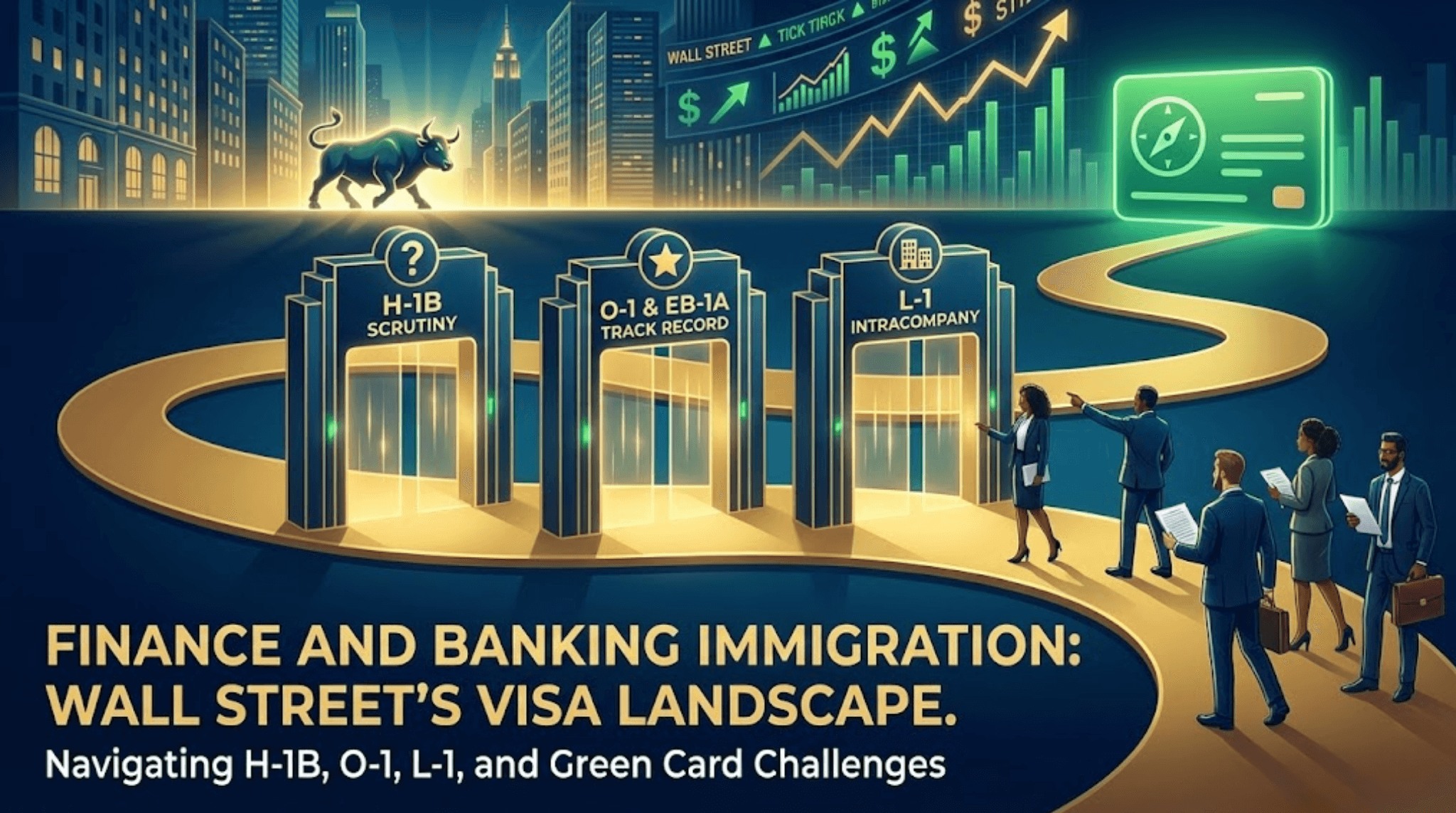
  • L-1 for international bank transfers

Trading:

Challenges:

  • USCIS questions degree requirement

  • Experience valued over education

  • High turnover industry

Strategy:

  • Quantitative trading (clear technical requirement)

  • O-1 for senior traders with track records

  • L-1 for proprietary strategies

Asset Management:

Challenges:

  • Research roles easier to support

  • Portfolio management scrutiny

  • Fund structure complications

Strategy:

  • Research analysts (H-1B or O-1 based on seniority)

  • EB-1A for published researchers

  • Employer PERM for others

Fintech:

Advantages:

  • Tech roles clearly specialty occupations

  • Innovation narrative supports NIW

  • Startup equity can demonstrate impact

Strategy:

  • H-1B for engineers and data scientists

  • O-1 for founders and senior tech leaders

  • EB-1A for those with product impact

How OpenSphere Helps Finance Professionals

Industry-Specific Assessment: Evaluate which visa type works best for your specific finance role.

H-1B Strength Analysis: Assess whether your position can overcome USCIS scrutiny.

O-1 Evidence Review: Determine if your track record qualifies for O-1.

Green Card Path Comparison: Compare EB-1A (if you qualify) vs employer sponsorship.

Comparison Table: Finance Immigration Options

Visa

Best For

Key Advantage

Challenge

H-1B

Technical roles, junior positions

Standard path

High RFE rates for some roles

O-1

Senior with track record

No lottery, stronger case

Requires significant evidence

L-1

International bank transfers

No lottery, EB-1C path

Requires foreign affiliate

EB-1A

Top performers

Fastest green card

High bar

PERM

Most professionals

Employer supported

Long timeline for Indians

Working in finance and planning your U.S. immigration? Want to know which visa fits your role and career stage?

Take the OpenSphere evaluation. You'll get finance-specific immigration strategy.

Get Finance Immigration Strategy

Frequently Asked Questions

1. Can traders get H-1B visas?

Difficult. USCIS questions whether trading requires degree. Quantitative traders have better chance.

2. Do I need a finance degree for H-1B in finance?

Related degree acceptable (economics, math, statistics). Degree must relate to job duties.

3. Can junior investment bankers get H-1B?

Challenging. Emphasize financial modeling, analysis, and technical aspects of role.

4. Does being a CFA charterholder help?

Shows expertise but doesn't replace visa requirements. Can support O-1 evidence of achievement.

5. Can I work at client sites on H-1B?

Yes, but may require H-1B amendment depending on duration and location change.

6. What if I'm in sales and trading?

If primarily sales: very difficult H-1B. If trading with technical analysis: stronger case.

7. Do Wall Street firms sponsor green cards?

Yes, major banks and investment firms sponsor. Process and willingness vary.

8. Can hedge fund managers get O-1?

If they have track record, published research, or industry recognition, potentially yes.

9. Does working at prestigious firm (Goldman, JPMorgan) help?

Firm prestige alone doesn't help. Your personal achievements and role duties matter.

10. What about fintech startups?

Tech roles in fintech have easier H-1B path than traditional finance roles.

Share post

Explore Topics

Icon

0%

Explore Topics

Icon

0%