Building Credit from Zero: How Immigrants Establish Financial Identity in the U.S.
Your foreign credit history means nothing in America. You're starting from scratch, which affects everything from apartment hunting to car loans to mortgages. Here's the systematic path from no credit to excellent credit in 12-24 months.
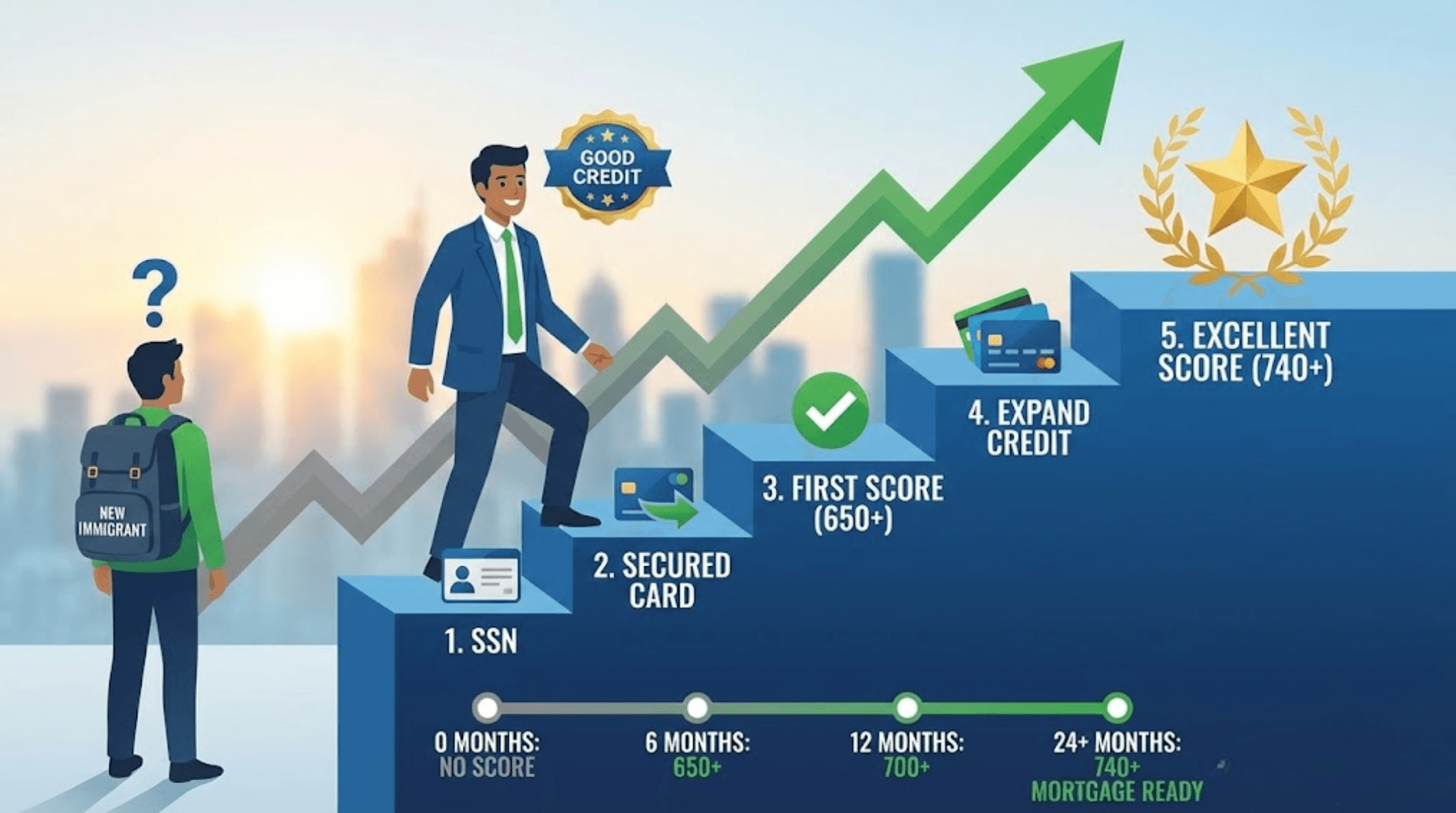
U.S. credit scores (300-850) measure your borrowing history and payment reliability. Immigrants start with no score (not bad credit, just invisible). The fastest path to good credit: secured credit card immediately after getting SSN, use it for small purchases monthly, pay in full every month, add authorized user on someone else's card (if possible), and consider credit builder loan after 6 months. Avoid: carrying balances, closing old accounts, or applying for too many cards at once. Timeline: 6 months to first score, 12-18 months to qualify for apartment/car loans, 24+ months for mortgage.
Key Takeaways
No credit is different from bad credit: You're invisible to the system, not penalized.
Secured credit card is your starting point: Put down $200-$1,000, get equal credit limit, build history.
Pay in full every month: Interest charges waste money. Use credit card like debit card.
6 months to first score: You need 6 months of credit activity before score appears.
30% utilization or less: Keep balance below 30% of limit, ideally below 10%.
Never miss payments: Even one missed payment drops score by 100+ points.
Key Takeaways
No credit is different from bad credit: You're invisible to the system, not penalized.
Secured credit card is your starting point: Put down $200-$1,000, get equal credit limit, build history.
Pay in full every month: Interest charges waste money. Use credit card like debit card.
6 months to first score: You need 6 months of credit activity before score appears.
30% utilization or less: Keep balance below 30% of limit, ideally below 10%.
Never miss payments: Even one missed payment drops score by 100+ points.
Table of Content
Quick Answer
U.S. credit scores (300-850) measure your borrowing history and payment reliability. Immigrants start with no score (not bad credit, just invisible). The fastest path to good credit: secured credit card immediately after getting SSN, use it for small purchases monthly, pay in full every month, add authorized user on someone else's card (if possible), and consider credit builder loan after 6 months. Avoid: carrying balances, closing old accounts, or applying for too many cards at once. Timeline: 6 months to first score, 12-18 months to qualify for apartment/car loans, 24+ months for mortgage.
Key Takeaways
No credit is different from bad credit: You're invisible to the system, not penalized.
Secured credit card is your starting point: Put down $200-$1,000, get equal credit limit, build history.
Pay in full every month: Interest charges waste money. Use credit card like debit card.
6 months to first score: You need 6 months of credit activity before score appears.
30% utilization or less: Keep balance below 30% of limit, ideally below 10%.
Never miss payments: Even one missed payment drops score by 100+ points.
Understanding the U.S. Credit System
What is a credit score?
A number (300-850) summarizing your creditworthiness based on:
Payment history (35% of score)
Credit utilization (30% of score)
Length of credit history (15% of score)
Credit mix (10% of score)
New credit inquiries (10% of score)
Credit score ranges:
300-579: Very Poor
580-669: Fair
670-739: Good
740-799: Very Good
800-850: Exceptional
Goal: 700+ within 18 months
Why credit matters:
Everything checks your credit:
Apartment applications (most require 650+)
Car loans (better rates with 700+)
Credit card approvals
Mortgage (need 620+, best rates at 760+)
Insurance rates (yes, car insurance checks credit)
You might have excellent credit in India, China, UK, or anywhere else. Doesn't matter in U.S.
Why:
Different credit bureaus
Different scoring systems
Different legal frameworks
No data sharing agreements
Result: You're starting completely fresh.
Month 1: Get Your Social Security Number
Why SSN comes first:
Credit bureaus track your credit using SSN. Without it, you can't build credit.
What to do:
Apply for SSN within 10 days of arriving in U.S.
Takes 2-3 weeks to receive card
Once you have it, start credit building immediately
Don't wait: Every month without credit history is a month lost.
Month 1-2: Open Secured Credit Card
What is a secured credit card?
You deposit money (say $500) with the bank. They give you credit card with $500 limit. Your deposit is held as security. After 6-12 months of on-time payments, you graduate to unsecured card and get deposit back.
This is not a debit card: It's a real credit card that reports to credit bureaus.
Best secured cards for immigrants:
Discover it Secured:
$200 minimum deposit
2% cash back at gas stations and restaurants
1% on everything else
Graduates to unsecured after 7-8 months typically
No annual fee
Capital One Platinum Secured:
$49, $99, or $200 deposit (based on approval)
Initial credit line of $200+
Graduates after as little as 6 months
No annual fee
Bank of America Secured:
$300-$5,000 deposit
If you bank with BofA, easier approval
Graduates after 12 months typically
Citi Secured Mastercard:
$200+ deposit
Reports to all 3 credit bureaus
Graduates after 18 months
How to use secured card strategically:
Rule 1: Small purchases only
$20-$100 per month
Gas, groceries, subscriptions
Don't max out your card
Rule 2: Pay in full every month
Set up autopay for full balance
Never carry a balance
Avoid interest charges completely
Rule 3: Keep utilization under 30%
If limit is $500, keep balance below $150
Ideally below 10% ($50)
Credit bureaus see low utilization as responsible
Rule 4: Use it regularly
At least one purchase per month
Shows active credit management
Dormant accounts don't build history as effectively
Month 3-6: Establish Banking Relationship
Why banking matters for credit:
Banks are more likely to approve you for credit products if you're their customer.
What to do:
Maintain checking account:
Keep positive balance
No overdrafts
Steady direct deposits
Add savings account:
Build emergency fund
Shows financial stability
Some banks consider this for credit approval
Consider credit builder loan:
Some banks/credit unions offer these
You "borrow" $500-$1,000
Money is held in savings
You make monthly payments for 12-24 months
Then you get money back
Builds installment loan history (not just credit card)
Cost: Small interest, but worth it for credit diversity
Month 6: Get Your First Credit Score
When scores appear:
After 6 months of credit card activity, you'll get first FICO score.
Check your score:
Free options:
Credit Karma (Vantage Score, not FICO, but gives idea)
Discover Credit Scorecard (free FICO even without Discover card)
Your bank's app (many offer free scores)
AnnualCreditReport.com (free report from all 3 bureaus once/year)
Expected first score: 650-700 if you've done everything right
The three credit bureaus:
Experian
Equifax
TransUnion
Each may have slightly different scores. That's normal.
Month 6-12: Expand Credit Mix
Once you have first score (650+):
Apply for unsecured credit card:
You may qualify for basic unsecured card
Keep secured card too (length of history matters)
This increases total credit available
Good starter unsecured cards:
Discover it Cash Back
Capital One QuicksilverOne
Petal Cash Back
Credit Union cards (if you're member)
Become authorized user (if possible):
If you have friend/spouse/family member with good credit and old credit card, they can add you as authorized user.
How this helps:
Their card's history appears on your report
Boosts your length of credit history
Immediate score increase
You don't even need physical card
Risks for primary cardholder:
If you overspend, it affects them
They're responsible for payments
Best practice: Only do this with someone you trust completely.
Don't close secured card yet:
Even after graduating to unsecured, keep secured card open:
Length of credit history matters
Oldest account has most value
Close it later after you have multiple cards for 2+ years
Month 12-18: Optimize Your Credit Profile
By now you should have:
700+ credit score
2-3 credit cards
12-18 months of perfect payment history
Low utilization (under 30%, ideally under 10%)
Strategies to boost score further:
Request credit limit increases:
After 6-12 months with card
Call and request increase
More available credit = lower utilization
Often approved if you've been responsible
Pay twice per month:
Even though bill is due monthly
Pay once mid-cycle, once at end
Keeps reported balance lower
Improves utilization ratio
Diversify credit mix:
Credit cards (revolving credit)
Car loan or credit builder loan (installment)
Mix of credit types slightly helps score
Monitor for errors:
Check credit reports every 4-6 months
Dispute any errors
Make sure all accounts are reported correctly
Month 18-24: Major Purchase Readiness
At 18-24 months with good behavior:
Your credit profile:
720-760 credit score
2-4 credit cards
2 years of payment history
Possibly installment loan
You can now qualify for:
Car loans:
720+: Best rates (5-7%)
Can get $20,000-$40,000 loan
36-60 month terms
Apartment:
Most require 650+, prefer 700+
You'll easily qualify
Lower security deposits
Premium credit cards:
Travel rewards cards
5% cash back categories
Sign-up bonuses
Not quite ready for:
Mortgage (need 2+ years for best rates, ideally 3-5)
Large personal loans
Business credit (that's separate)
What Hurts Your Credit
Payment mistakes:
Late payment (30+ days):
Score drops 60-110 points
Stays on report for 7 years
Single worst thing you can do
Missed payment:
Even worse than late
Score drops 100-150 points
Very hard to recover
Solution: Set up autopay for minimum payment (even if you pay more manually)
Utilization mistakes:
Maxing out cards:
Using 90-100% of limit
Looks desperate
Drops score 20-40 points
High utilization:
Even 60-70% hurts
Keep below 30%, ideally 10%
Application mistakes:
Applying for too many cards:
Each application = hard inquiry
Multiple inquiries in short time hurt score
Space applications 3-6 months apart
Closing old accounts:
Reduces length of credit history
Increases utilization (less total credit)
Keep old accounts open even if unused
Other mistakes:
Collections:
Medical bills or other debt sent to collections
Devastating to credit
Always pay bills, negotiate if needed
Judgments and liens:
Legal issues show on credit report
Avoid at all costs
Immigrant-Specific Credit Challenges
Challenge 1: No co-signer
Unlike Americans, you may not have family/friends with U.S. credit to co-sign.
Solution:
Secured cards don't need co-signers
Build independently from scratch
Challenge 2: High rent relative to income
Sending money home, supporting family abroad, means less available for U.S. expenses.
Solution:
Budget carefully
Keep credit utilization low
Build emergency fund to avoid credit card debt
Challenge 3: Temporary status anxiety
Worrying about visa status can lead to avoiding credit ("what if I have to leave?").
Solution:
Build credit anyway
If you leave, pay off balances
Credit history portable within U.S. if you return
Challenge 4: Cultural differences
Some cultures avoid all debt. But U.S. credit system requires using credit to prove you can manage it.
Solution:
Think of credit card as payment tool, not debt tool
Pay in full monthly (no debt carried)
Use system to your advantage
Credit Score Comparison: Years 1-3
Timeframe
Typical Score
What You Can Do
Month 0-6
No score
Secured card only, high apartment deposits
Month 6-12
650-700
Qualify for basic unsecured cards, some apartments
Month 12-18
700-740
Car loans at decent rates, most apartments, premium cards
Month 18-24
720-760
Excellent rates, wide access, ready for major purchases
Year 3+
740-800+
Best rates, mortgage ready, full credit access
How OpenSphere Helps Credit Building
Credit Timeline Planner: Personalized plan based on when you arrived and current credit status.
Product Recommendations: Which secured cards, credit builder loans, and strategies for your situation.
Progress Tracker: Monitor your credit journey and get alerts for next steps.
Error Detection: Help spotting credit report errors that hurt immigrant applicants.
New to the U.S. and starting credit journey? Want a personalized plan to reach 700+ credit score?
Take the OpenSphere evaluation. You'll get customized credit building roadmap.

U.S. credit scores (300-850) measure your borrowing history and payment reliability. Immigrants start with no score (not bad credit, just invisible). The fastest path to good credit: secured credit card immediately after getting SSN, use it for small purchases monthly, pay in full every month, add authorized user on someone else's card (if possible), and consider credit builder loan after 6 months. Avoid: carrying balances, closing old accounts, or applying for too many cards at once. Timeline: 6 months to first score, 12-18 months to qualify for apartment/car loans, 24+ months for mortgage.
Key Takeaways
No credit is different from bad credit: You're invisible to the system, not penalized.
Secured credit card is your starting point: Put down $200-$1,000, get equal credit limit, build history.
Pay in full every month: Interest charges waste money. Use credit card like debit card.
6 months to first score: You need 6 months of credit activity before score appears.
30% utilization or less: Keep balance below 30% of limit, ideally below 10%.
Never miss payments: Even one missed payment drops score by 100+ points.
Understanding the U.S. Credit System
What is a credit score?
A number (300-850) summarizing your creditworthiness based on:
Payment history (35% of score)
Credit utilization (30% of score)
Length of credit history (15% of score)
Credit mix (10% of score)
New credit inquiries (10% of score)
Credit score ranges:
300-579: Very Poor
580-669: Fair
670-739: Good
740-799: Very Good
800-850: Exceptional
Goal: 700+ within 18 months
Why credit matters:
Everything checks your credit:
Apartment applications (most require 650+)
Car loans (better rates with 700+)
Credit card approvals
Mortgage (need 620+, best rates at 760+)
Insurance rates (yes, car insurance checks credit)
You might have excellent credit in India, China, UK, or anywhere else. Doesn't matter in U.S.
Why:
Different credit bureaus
Different scoring systems
Different legal frameworks
No data sharing agreements
Result: You're starting completely fresh.
Month 1: Get Your Social Security Number
Why SSN comes first:
Credit bureaus track your credit using SSN. Without it, you can't build credit.
What to do:
Apply for SSN within 10 days of arriving in U.S.
Takes 2-3 weeks to receive card
Once you have it, start credit building immediately
Don't wait: Every month without credit history is a month lost.
Month 1-2: Open Secured Credit Card
What is a secured credit card?
You deposit money (say $500) with the bank. They give you credit card with $500 limit. Your deposit is held as security. After 6-12 months of on-time payments, you graduate to unsecured card and get deposit back.
This is not a debit card: It's a real credit card that reports to credit bureaus.
Best secured cards for immigrants:
Discover it Secured:
$200 minimum deposit
2% cash back at gas stations and restaurants
1% on everything else
Graduates to unsecured after 7-8 months typically
No annual fee
Capital One Platinum Secured:
$49, $99, or $200 deposit (based on approval)
Initial credit line of $200+
Graduates after as little as 6 months
No annual fee
Bank of America Secured:
$300-$5,000 deposit
If you bank with BofA, easier approval
Graduates after 12 months typically
Citi Secured Mastercard:
$200+ deposit
Reports to all 3 credit bureaus
Graduates after 18 months
How to use secured card strategically:
Rule 1: Small purchases only
$20-$100 per month
Gas, groceries, subscriptions
Don't max out your card
Rule 2: Pay in full every month
Set up autopay for full balance
Never carry a balance
Avoid interest charges completely
Rule 3: Keep utilization under 30%
If limit is $500, keep balance below $150
Ideally below 10% ($50)
Credit bureaus see low utilization as responsible
Rule 4: Use it regularly
At least one purchase per month
Shows active credit management
Dormant accounts don't build history as effectively
Month 3-6: Establish Banking Relationship
Why banking matters for credit:
Banks are more likely to approve you for credit products if you're their customer.
What to do:
Maintain checking account:
Keep positive balance
No overdrafts
Steady direct deposits
Add savings account:
Build emergency fund
Shows financial stability
Some banks consider this for credit approval
Consider credit builder loan:
Some banks/credit unions offer these
You "borrow" $500-$1,000
Money is held in savings
You make monthly payments for 12-24 months
Then you get money back
Builds installment loan history (not just credit card)
Cost: Small interest, but worth it for credit diversity
Month 6: Get Your First Credit Score
When scores appear:
After 6 months of credit card activity, you'll get first FICO score.
Check your score:
Free options:
Credit Karma (Vantage Score, not FICO, but gives idea)
Discover Credit Scorecard (free FICO even without Discover card)
Your bank's app (many offer free scores)
AnnualCreditReport.com (free report from all 3 bureaus once/year)
Expected first score: 650-700 if you've done everything right
The three credit bureaus:
Experian
Equifax
TransUnion
Each may have slightly different scores. That's normal.
Month 6-12: Expand Credit Mix
Once you have first score (650+):
Apply for unsecured credit card:
You may qualify for basic unsecured card
Keep secured card too (length of history matters)
This increases total credit available
Good starter unsecured cards:
Discover it Cash Back
Capital One QuicksilverOne
Petal Cash Back
Credit Union cards (if you're member)
Become authorized user (if possible):
If you have friend/spouse/family member with good credit and old credit card, they can add you as authorized user.
How this helps:
Their card's history appears on your report
Boosts your length of credit history
Immediate score increase
You don't even need physical card
Risks for primary cardholder:
If you overspend, it affects them
They're responsible for payments
Best practice: Only do this with someone you trust completely.
Don't close secured card yet:
Even after graduating to unsecured, keep secured card open:
Length of credit history matters
Oldest account has most value
Close it later after you have multiple cards for 2+ years
Month 12-18: Optimize Your Credit Profile
By now you should have:
700+ credit score
2-3 credit cards
12-18 months of perfect payment history
Low utilization (under 30%, ideally under 10%)
Strategies to boost score further:
Request credit limit increases:
After 6-12 months with card
Call and request increase
More available credit = lower utilization
Often approved if you've been responsible
Pay twice per month:
Even though bill is due monthly
Pay once mid-cycle, once at end
Keeps reported balance lower
Improves utilization ratio
Diversify credit mix:
Credit cards (revolving credit)
Car loan or credit builder loan (installment)
Mix of credit types slightly helps score
Monitor for errors:
Check credit reports every 4-6 months
Dispute any errors
Make sure all accounts are reported correctly
Month 18-24: Major Purchase Readiness
At 18-24 months with good behavior:
Your credit profile:
720-760 credit score
2-4 credit cards
2 years of payment history
Possibly installment loan
You can now qualify for:
Car loans:
720+: Best rates (5-7%)
Can get $20,000-$40,000 loan
36-60 month terms
Apartment:
Most require 650+, prefer 700+
You'll easily qualify
Lower security deposits
Premium credit cards:
Travel rewards cards
5% cash back categories
Sign-up bonuses
Not quite ready for:
Mortgage (need 2+ years for best rates, ideally 3-5)
Large personal loans
Business credit (that's separate)
What Hurts Your Credit
Payment mistakes:
Late payment (30+ days):
Score drops 60-110 points
Stays on report for 7 years
Single worst thing you can do
Missed payment:
Even worse than late
Score drops 100-150 points
Very hard to recover
Solution: Set up autopay for minimum payment (even if you pay more manually)
Utilization mistakes:
Maxing out cards:
Using 90-100% of limit
Looks desperate
Drops score 20-40 points
High utilization:
Even 60-70% hurts
Keep below 30%, ideally 10%
Application mistakes:
Applying for too many cards:
Each application = hard inquiry
Multiple inquiries in short time hurt score
Space applications 3-6 months apart
Closing old accounts:
Reduces length of credit history
Increases utilization (less total credit)
Keep old accounts open even if unused
Other mistakes:
Collections:
Medical bills or other debt sent to collections
Devastating to credit
Always pay bills, negotiate if needed
Judgments and liens:
Legal issues show on credit report
Avoid at all costs
Immigrant-Specific Credit Challenges
Challenge 1: No co-signer
Unlike Americans, you may not have family/friends with U.S. credit to co-sign.
Solution:
Secured cards don't need co-signers
Build independently from scratch
Challenge 2: High rent relative to income
Sending money home, supporting family abroad, means less available for U.S. expenses.
Solution:
Budget carefully
Keep credit utilization low
Build emergency fund to avoid credit card debt
Challenge 3: Temporary status anxiety
Worrying about visa status can lead to avoiding credit ("what if I have to leave?").
Solution:
Build credit anyway
If you leave, pay off balances
Credit history portable within U.S. if you return
Challenge 4: Cultural differences
Some cultures avoid all debt. But U.S. credit system requires using credit to prove you can manage it.
Solution:
Think of credit card as payment tool, not debt tool
Pay in full monthly (no debt carried)
Use system to your advantage
Credit Score Comparison: Years 1-3
Timeframe
Typical Score
What You Can Do
Month 0-6
No score
Secured card only, high apartment deposits
Month 6-12
650-700
Qualify for basic unsecured cards, some apartments
Month 12-18
700-740
Car loans at decent rates, most apartments, premium cards
Month 18-24
720-760
Excellent rates, wide access, ready for major purchases
Year 3+
740-800+
Best rates, mortgage ready, full credit access
How OpenSphere Helps Credit Building
Credit Timeline Planner: Personalized plan based on when you arrived and current credit status.
Product Recommendations: Which secured cards, credit builder loans, and strategies for your situation.
Progress Tracker: Monitor your credit journey and get alerts for next steps.
Error Detection: Help spotting credit report errors that hurt immigrant applicants.
New to the U.S. and starting credit journey? Want a personalized plan to reach 700+ credit score?
Take the OpenSphere evaluation. You'll get customized credit building roadmap.