The Immigrant's Guide to U.S. Healthcare: Insurance, Costs, and Navigating the System

U.S. healthcare is expensive, confusing, and nothing like other countries. From understanding insurance (premiums, deductibles, copays, networks) to navigating emergency vs urgent care to knowing when to see specialists, here's what immigrants need to know.

Quick Answer

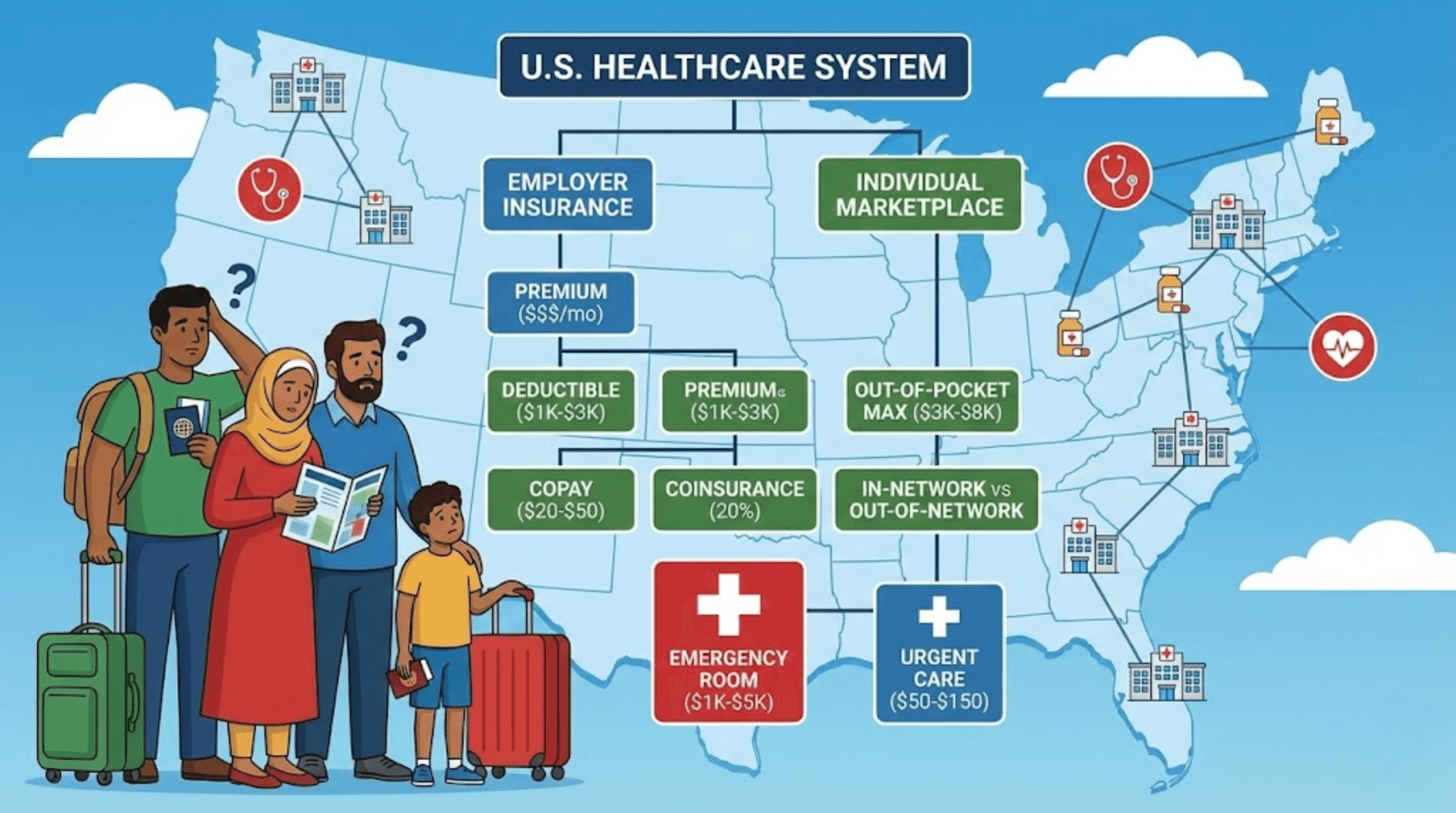
U.S. healthcare is employer-based: most working immigrants get insurance through their job. You pay monthly premium (your portion, employer pays rest), then when you need care you pay deductible (first $1,000-$3,000 of costs), then copays ($20-$50 per visit), until you hit out-of-pocket maximum ($3,000-$8,000/year). Stay "in network" to avoid massive bills. Emergency room costs $1,000-$5,000+ per visit. Prescriptions can be $5-$500/month. Without insurance, a single hospitalization can cost $50,000-$200,000. Get insurance immediately and understand your plan before you need care.

Key Takeaways

  • Insurance is mandatory practically: One serious illness without insurance can bankrupt you.

  • Employer insurance is cheapest: Individual plans cost $400-$700/month vs $100-$300/month through employer.

  • Understand your plan terms: Premium, deductible, copay, coinsurance, out-of-pocket max.

  • Stay in-network: Out-of-network can cost 2-3x more or not be covered at all.

  • Preventive care is free: Annual checkup, vaccines, screenings covered 100% by law.

  • Emergency room vs urgent care vs primary care: Using wrong one costs thousands unnecessarily.

Key Takeaways

  • Insurance is mandatory practically: One serious illness without insurance can bankrupt you.

  • Employer insurance is cheapest: Individual plans cost $400-$700/month vs $100-$300/month through employer.

  • Understand your plan terms: Premium, deductible, copay, coinsurance, out-of-pocket max.

  • Stay in-network: Out-of-network can cost 2-3x more or not be covered at all.

  • Preventive care is free: Annual checkup, vaccines, screenings covered 100% by law.

  • Emergency room vs urgent care vs primary care: Using wrong one costs thousands unnecessarily.

Table of Content

Understanding Health Insurance Basics

The key terms you must know:

Premium:

  • Amount you pay monthly for insurance

  • Whether you use healthcare or not

  • Example: $150/month

Deductible:

  • Amount you pay out-of-pocket before insurance starts paying

  • Example: $2,000 deductible means you pay first $2,000 of care each year

  • Resets every calendar year

Copay:

  • Fixed amount you pay for specific services

  • Example: $30 to see doctor, $50 for specialist

  • Paid at time of visit

Coinsurance:

  • Percentage you pay after meeting deductible

  • Example: 80/20 means insurance pays 80%, you pay 20%

  • Applies to bigger expenses (hospital, surgery)

Out-of-pocket maximum:

  • Most you'll pay in a year

  • After reaching this, insurance pays 100%

  • Example: $6,000 out-of-pocket max

  • Protects you from catastrophic costs

Example: How it works together

You have:

  • $200/month premium

  • $2,000 deductible

  • $30 copay for doctor

  • 80/20 coinsurance

  • $6,000 out-of-pocket max

Scenario: You break your leg

  1. Emergency room visit: $3,000

    • You pay: First $2,000 (deductible)

    • Then you pay 20% of remaining $1,000 = $200

    • Total you pay: $2,200

  2. Follow-up doctor visit: $200

    • You pay: $30 copay

    • Insurance pays rest

  3. Physical therapy: $1,500 over 3 months

    • You already met deductible

    • You pay: 20% = $300

    • Insurance pays: 80% = $1,200

Your total cost: $2,200 + $30 + $300 = $2,530 plus $2,400 in premiums ($200 x 12 months) = $4,930 for the year

Without insurance: Would have paid $4,700+ for medical care alone.

Getting Health Insurance

Option 1: Through Employer (Best for most)

How it works:

  • Employer offers insurance plan(s)

  • You enroll within 30 days of start date

  • Premium deducted from paycheck

  • Employer pays 50-80% of premium cost

Typical costs:

  • Employee-only coverage: $50-$200/month (your portion)

  • Employee + spouse: $200-$400/month

  • Family: $300-$600/month

Choosing a plan:

Most employers offer 2-4 options:

High Deductible Health Plan (HDHP):

  • Low premium ($50-$100/month)

  • High deductible ($3,000-$5,000)

  • Best if: You're young and healthy

  • Includes HSA (Health Savings Account) with tax benefits

PPO (Preferred Provider Organization):

  • Medium premium ($150-$250/month)

  • Medium deductible ($1,000-$2,000)

  • More flexibility in choosing doctors

  • Best if: You see doctors regularly

HMO (Health Maintenance Organization):

  • Low-medium premium ($100-$200/month)

  • Low deductible ($500-$1,500)

  • Must use specific network

  • Need referrals for specialists

  • Best if: You're okay with restricted network

Option 2: Through Healthcare.gov (If no employer insurance)

Who uses this:

  • Self-employed

  • Unemployed

  • Employer doesn't offer insurance

  • Part-time workers

How it works:

  • Shop plans on Healthcare.gov

  • Choose based on cost and coverage

  • May qualify for subsidies based on income

Costs without subsidy:

  • Individual: $400-$700/month

  • Family: $1,200-$2,000/month

Much more expensive than employer coverage

Option 3: Spouse's Insurance

If your spouse has employer insurance, you can join their plan.

Costs:

  • Adding spouse: $150-$300/month more

  • Usually cheaper than individual marketplace

Option 4: School Insurance (For students)

If you're on F-1 as student:

  • University offers student health plans

  • $1,500-$3,000 per year

  • Basic coverage, acceptable for student needs

Understanding Networks

In-network vs out-of-network:

In-network:

  • Doctors and hospitals contracted with your insurance

  • Insurance pays normal rates

  • You pay copays/coinsurance as expected

Out-of-network:

  • Providers not contracted with your insurance

  • Insurance pays little or nothing

  • You pay much more (often 2-3x)

  • Might not count toward deductible or out-of-pocket max

Critical importance:

Going out-of-network for surgery that would cost you $2,000 in-network might cost $10,000-$15,000 out-of-network.

How to stay in-network:

  • Use insurance website to find doctors

  • Call provider and verify they're in-network

  • Check hospital is in-network before procedures

  • In emergency, network doesn't matter (but try to get to in-network hospital if possible)

Types of Healthcare Providers

Primary Care Physician (PCP):

  • Your main doctor

  • Annual checkups

  • Common illnesses (flu, cold, minor injuries)

  • Manages referrals to specialists

  • Cost: $30-$50 copay per visit

When to see: Routine care, non-emergency issues

Specialist:

  • Doctors with specific expertise

  • Cardiologist, dermatologist, orthopedist, etc.

  • Usually need referral from PCP

  • Cost: $50-$100 copay per visit

When to see: Specific medical issues requiring expertise

Urgent Care:

  • Walk-in clinics for non-life-threatening issues

  • Open evenings and weekends

  • Faster than PCP for minor emergencies

  • Cost: $50-$150 copay

When to use:

  • Minor injuries (small cuts, sprains)

  • Mild infections

  • Rashes

  • Flu-like symptoms

Don't use for: Chest pain, severe bleeding, head injuries (go to ER)

Emergency Room (ER):

  • Hospital emergency department

  • For life-threatening conditions

  • Open 24/7

  • Cost: $500-$2,000 copay (plus additional costs)

When to use:

  • Chest pain

  • Severe bleeding

  • Head injuries

  • Broken bones

  • Difficulty breathing

  • Sudden severe pain

Avoid for: Cold, flu, minor cuts (use urgent care or PCP)

Why cost matters: ER visit for something urgent care could handle costs $1,000-$2,000 more.

Prescriptions

How prescription coverage works:

Tiers:

  • Tier 1 (Generic): $5-$15 copay

  • Tier 2 (Preferred brand): $25-$50 copay

  • Tier 3 (Non-preferred brand): $50-$100 copay

  • Tier 4 (Specialty drugs): $100-$500+ copay or percentage

Always ask for generic: Often identical to brand-name but 80% cheaper.

Where to fill prescriptions:

  • Pharmacy (CVS, Walgreens, Rite Aid)

  • Costco (cheapest, no membership needed for pharmacy)

  • Mail order (90-day supply, often cheaper)

  • GoodRx (discount app if uninsured)

Preventive Care (Free)

By law, these are 100% covered (no copay):

  • Annual physical exam

  • Vaccines (flu shot, etc.)

  • Cancer screenings

  • Blood pressure and cholesterol checks

  • Diabetes screening

  • Certain counseling services

Take advantage: Get annual checkup every year. It's free and catches problems early.

What Healthcare Actually Costs (Without Insurance)

To understand why insurance matters:

Service

Typical Cost Without Insurance

Doctor visit

$150-$300

Urgent care

$150-$400

Emergency room

$1,000-$5,000+

Hospital stay (per day)

$3,000-$5,000

MRI scan

$1,000-$3,000

CT scan

$500-$2,000

Ambulance ride

$500-$2,000

Surgery (minor)

$5,000-$15,000

Surgery (major)

$25,000-$100,000+

Having a baby

$10,000-$30,000

Heart attack treatment

$50,000-$150,000

A single serious illness can cost more than most people earn in a year.

Common Healthcare Mistakes Immigrants Make

Mistake 1: Skipping insurance to save money

Cost: One ER visit costs more than year of premiums.

Solution: Always have insurance. Cut other expenses if needed.

Mistake 2: Going to ER for non-emergencies

Cost: $1,000-$2,000 vs $50-$150 at urgent care.

Solution: Learn when ER is truly necessary.

Mistake 3: Not understanding their insurance plan

Cost: Surprise bills for out-of-network care.

Solution: Read your plan documents. Call insurance with questions.

Mistake 4: Avoiding care due to cost fears

Cost: Small problems become big problems.

Solution: Use preventive care (free). Address issues early when cheaper.

Mistake 5: Not getting annual checkup

Cost: Missed early detection of serious issues.

Solution: Annual physical is 100% free. Schedule it.

Mental Health Coverage

Mental health is covered:

By law, mental health must be covered like physical health.

Services covered:

  • Therapy/counseling sessions

  • Psychiatrist visits

  • Prescription medications for mental health

Finding provider:

  • Use insurance website to find in-network therapists

  • Ask PCP for referral

  • Many therapists offer teletherapy (video calls)

Cost:

  • Typically same copay as specialist ($50-$100)

  • Some plans cover certain number of sessions per year

Reducing stigma: Mental health care is normal and important. Use it if needed.

Dental and Vision Insurance

Usually separate from health insurance:

Dental:

  • Preventive (cleanings, checkups): Usually 100% covered

  • Basic (fillings, extractions): 70-80% covered

  • Major (crowns, root canals): 50% covered

  • Cost: $20-$50/month

Vision:

  • Exam: $10-$50 copay annually

  • Glasses/contacts: $100-$150 allowance annually

  • Cost: $10-$20/month

Worth it?

  • Dental: Yes, if you go to dentist regularly

  • Vision: Depends on whether you need glasses

Health Savings Account (HSA)

If you have high-deductible plan:

HSA benefits:

  • Contribute pre-tax money (saves 20-30% on taxes)

  • Money rolls over year to year

  • Use for medical expenses

  • Grows tax-free

  • Yours forever (even if you change jobs)

Contribution limits 2025:

  • Individual: $4,300

  • Family: $8,550

Strategy:

  • Max out HSA contributions if possible

  • Pay medical expenses from pocket if you can

  • Let HSA grow for retirement (can use for any expense after 65)

This is one of best tax advantages available

Navigating Medical Bills

Understanding bills:

You'll receive:

  • Bill from doctor/hospital

  • Explanation of Benefits (EOB) from insurance

  • EOB is NOT a bill (shows what insurance paid)

  • Actual bill shows what you owe

Always verify:

  • Compare bill to EOB

  • Make sure services were actually rendered

  • Check that provider was in-network

  • Look for errors (very common)

If you can't pay:

  • Call billing department immediately

  • Ask for payment plan

  • Ask for charity care (if low income)

  • Negotiate bill (hospitals often accept 20-50% less)

Don't ignore bills: Medical debt can go to collections and hurt credit.

Healthcare Comparison: U.S. vs Other Countries

Factor

U.S.

Most Other Countries

System

Private, employer-based

Public, government-run

Cost to patient

High (insurance + copays)

Low (taxes cover it)

Wait times

Short for most care

Longer for non-urgent

Choice of doctor

Wide (if in-network)

Sometimes limited

Bankruptcy from medical bills

Common

Almost never

The reality: U.S. healthcare is more expensive but accessible if you have good insurance.

How OpenSphere Helps with Healthcare

Plan Comparison Tool: Understand which employer plan option makes sense for your situation.

Cost Calculator: Estimate annual healthcare costs based on your expected usage.

Network Finder: Locate in-network doctors and hospitals in your area.

Dictionary: Decode insurance jargon and understand your benefits.

Confused about U.S. healthcare and insurance options? Want help choosing the right plan?

Take the OpenSphere evaluation. You'll get personalized healthcare guidance.

Understand Your Healthcare Options

Understanding Health Insurance Basics

The key terms you must know:

Premium:

  • Amount you pay monthly for insurance

  • Whether you use healthcare or not

  • Example: $150/month

Deductible:

  • Amount you pay out-of-pocket before insurance starts paying

  • Example: $2,000 deductible means you pay first $2,000 of care each year

  • Resets every calendar year

Copay:

  • Fixed amount you pay for specific services

  • Example: $30 to see doctor, $50 for specialist

  • Paid at time of visit

Coinsurance:

  • Percentage you pay after meeting deductible

  • Example: 80/20 means insurance pays 80%, you pay 20%

  • Applies to bigger expenses (hospital, surgery)

Out-of-pocket maximum:

  • Most you'll pay in a year

  • After reaching this, insurance pays 100%

  • Example: $6,000 out-of-pocket max

  • Protects you from catastrophic costs

Example: How it works together

You have:

  • $200/month premium

  • $2,000 deductible

  • $30 copay for doctor

  • 80/20 coinsurance

  • $6,000 out-of-pocket max

Scenario: You break your leg

  1. Emergency room visit: $3,000

    • You pay: First $2,000 (deductible)

    • Then you pay 20% of remaining $1,000 = $200

    • Total you pay: $2,200

  2. Follow-up doctor visit: $200

    • You pay: $30 copay

    • Insurance pays rest

  3. Physical therapy: $1,500 over 3 months

    • You already met deductible

    • You pay: 20% = $300

    • Insurance pays: 80% = $1,200

Your total cost: $2,200 + $30 + $300 = $2,530 plus $2,400 in premiums ($200 x 12 months) = $4,930 for the year

Without insurance: Would have paid $4,700+ for medical care alone.

Getting Health Insurance

Option 1: Through Employer (Best for most)

How it works:

  • Employer offers insurance plan(s)

  • You enroll within 30 days of start date

  • Premium deducted from paycheck

  • Employer pays 50-80% of premium cost

Typical costs:

  • Employee-only coverage: $50-$200/month (your portion)

  • Employee + spouse: $200-$400/month

  • Family: $300-$600/month

Choosing a plan:

Most employers offer 2-4 options:

High Deductible Health Plan (HDHP):

  • Low premium ($50-$100/month)

  • High deductible ($3,000-$5,000)

  • Best if: You're young and healthy

  • Includes HSA (Health Savings Account) with tax benefits

PPO (Preferred Provider Organization):

  • Medium premium ($150-$250/month)

  • Medium deductible ($1,000-$2,000)

  • More flexibility in choosing doctors

  • Best if: You see doctors regularly

HMO (Health Maintenance Organization):

  • Low-medium premium ($100-$200/month)

  • Low deductible ($500-$1,500)

  • Must use specific network

  • Need referrals for specialists

  • Best if: You're okay with restricted network

Option 2: Through Healthcare.gov (If no employer insurance)

Who uses this:

  • Self-employed

  • Unemployed

  • Employer doesn't offer insurance

  • Part-time workers

How it works:

  • Shop plans on Healthcare.gov

  • Choose based on cost and coverage

  • May qualify for subsidies based on income

Costs without subsidy:

  • Individual: $400-$700/month

  • Family: $1,200-$2,000/month

Much more expensive than employer coverage

Option 3: Spouse's Insurance

If your spouse has employer insurance, you can join their plan.

Costs:

  • Adding spouse: $150-$300/month more

  • Usually cheaper than individual marketplace

Option 4: School Insurance (For students)

If you're on F-1 as student:

  • University offers student health plans

  • $1,500-$3,000 per year

  • Basic coverage, acceptable for student needs

Understanding Networks

In-network vs out-of-network:

In-network:

  • Doctors and hospitals contracted with your insurance

  • Insurance pays normal rates

  • You pay copays/coinsurance as expected

Out-of-network:

  • Providers not contracted with your insurance

  • Insurance pays little or nothing

  • You pay much more (often 2-3x)

  • Might not count toward deductible or out-of-pocket max

Critical importance:

Going out-of-network for surgery that would cost you $2,000 in-network might cost $10,000-$15,000 out-of-network.

How to stay in-network:

  • Use insurance website to find doctors

  • Call provider and verify they're in-network

  • Check hospital is in-network before procedures

  • In emergency, network doesn't matter (but try to get to in-network hospital if possible)

Types of Healthcare Providers

Primary Care Physician (PCP):

  • Your main doctor

  • Annual checkups

  • Common illnesses (flu, cold, minor injuries)

  • Manages referrals to specialists

  • Cost: $30-$50 copay per visit

When to see: Routine care, non-emergency issues

Specialist:

  • Doctors with specific expertise

  • Cardiologist, dermatologist, orthopedist, etc.

  • Usually need referral from PCP

  • Cost: $50-$100 copay per visit

When to see: Specific medical issues requiring expertise

Urgent Care:

  • Walk-in clinics for non-life-threatening issues

  • Open evenings and weekends

  • Faster than PCP for minor emergencies

  • Cost: $50-$150 copay

When to use:

  • Minor injuries (small cuts, sprains)

  • Mild infections

  • Rashes

  • Flu-like symptoms

Don't use for: Chest pain, severe bleeding, head injuries (go to ER)

Emergency Room (ER):

  • Hospital emergency department

  • For life-threatening conditions

  • Open 24/7

  • Cost: $500-$2,000 copay (plus additional costs)

When to use:

  • Chest pain

  • Severe bleeding

  • Head injuries

  • Broken bones

  • Difficulty breathing

  • Sudden severe pain

Avoid for: Cold, flu, minor cuts (use urgent care or PCP)

Why cost matters: ER visit for something urgent care could handle costs $1,000-$2,000 more.

Prescriptions

How prescription coverage works:

Tiers:

  • Tier 1 (Generic): $5-$15 copay

  • Tier 2 (Preferred brand): $25-$50 copay

  • Tier 3 (Non-preferred brand): $50-$100 copay

  • Tier 4 (Specialty drugs): $100-$500+ copay or percentage

Always ask for generic: Often identical to brand-name but 80% cheaper.

Where to fill prescriptions:

  • Pharmacy (CVS, Walgreens, Rite Aid)

  • Costco (cheapest, no membership needed for pharmacy)

  • Mail order (90-day supply, often cheaper)

  • GoodRx (discount app if uninsured)

Preventive Care (Free)

By law, these are 100% covered (no copay):

  • Annual physical exam

  • Vaccines (flu shot, etc.)

  • Cancer screenings

  • Blood pressure and cholesterol checks

  • Diabetes screening

  • Certain counseling services

Take advantage: Get annual checkup every year. It's free and catches problems early.

What Healthcare Actually Costs (Without Insurance)

To understand why insurance matters:

Service

Typical Cost Without Insurance

Doctor visit

$150-$300

Urgent care

$150-$400

Emergency room

$1,000-$5,000+

Hospital stay (per day)

$3,000-$5,000

MRI scan

$1,000-$3,000

CT scan

$500-$2,000

Ambulance ride

$500-$2,000

Surgery (minor)

$5,000-$15,000

Surgery (major)

$25,000-$100,000+

Having a baby

$10,000-$30,000

Heart attack treatment

$50,000-$150,000

A single serious illness can cost more than most people earn in a year.

Common Healthcare Mistakes Immigrants Make

Mistake 1: Skipping insurance to save money

Cost: One ER visit costs more than year of premiums.

Solution: Always have insurance. Cut other expenses if needed.

Mistake 2: Going to ER for non-emergencies

Cost: $1,000-$2,000 vs $50-$150 at urgent care.

Solution: Learn when ER is truly necessary.

Mistake 3: Not understanding their insurance plan

Cost: Surprise bills for out-of-network care.

Solution: Read your plan documents. Call insurance with questions.

Mistake 4: Avoiding care due to cost fears

Cost: Small problems become big problems.

Solution: Use preventive care (free). Address issues early when cheaper.

Mistake 5: Not getting annual checkup

Cost: Missed early detection of serious issues.

Solution: Annual physical is 100% free. Schedule it.

Mental Health Coverage

Mental health is covered:

By law, mental health must be covered like physical health.

Services covered:

  • Therapy/counseling sessions

  • Psychiatrist visits

  • Prescription medications for mental health

Finding provider:

  • Use insurance website to find in-network therapists

  • Ask PCP for referral

  • Many therapists offer teletherapy (video calls)

Cost:

  • Typically same copay as specialist ($50-$100)

  • Some plans cover certain number of sessions per year

Reducing stigma: Mental health care is normal and important. Use it if needed.

Dental and Vision Insurance

Usually separate from health insurance:

Dental:

  • Preventive (cleanings, checkups): Usually 100% covered

  • Basic (fillings, extractions): 70-80% covered

  • Major (crowns, root canals): 50% covered

  • Cost: $20-$50/month

Vision:

  • Exam: $10-$50 copay annually

  • Glasses/contacts: $100-$150 allowance annually

  • Cost: $10-$20/month

Worth it?

  • Dental: Yes, if you go to dentist regularly

  • Vision: Depends on whether you need glasses

Health Savings Account (HSA)

If you have high-deductible plan:

HSA benefits:

  • Contribute pre-tax money (saves 20-30% on taxes)

  • Money rolls over year to year

  • Use for medical expenses

  • Grows tax-free

  • Yours forever (even if you change jobs)

Contribution limits 2025:

  • Individual: $4,300

  • Family: $8,550

Strategy:

  • Max out HSA contributions if possible

  • Pay medical expenses from pocket if you can

  • Let HSA grow for retirement (can use for any expense after 65)

This is one of best tax advantages available

Navigating Medical Bills

Understanding bills:

You'll receive:

  • Bill from doctor/hospital

  • Explanation of Benefits (EOB) from insurance

  • EOB is NOT a bill (shows what insurance paid)

  • Actual bill shows what you owe

Always verify:

  • Compare bill to EOB

  • Make sure services were actually rendered

  • Check that provider was in-network

  • Look for errors (very common)

If you can't pay:

  • Call billing department immediately

  • Ask for payment plan

  • Ask for charity care (if low income)

  • Negotiate bill (hospitals often accept 20-50% less)

Don't ignore bills: Medical debt can go to collections and hurt credit.

Healthcare Comparison: U.S. vs Other Countries

Factor

U.S.

Most Other Countries

System

Private, employer-based

Public, government-run

Cost to patient

High (insurance + copays)

Low (taxes cover it)

Wait times

Short for most care

Longer for non-urgent

Choice of doctor

Wide (if in-network)

Sometimes limited

Bankruptcy from medical bills

Common

Almost never

The reality: U.S. healthcare is more expensive but accessible if you have good insurance.

How OpenSphere Helps with Healthcare

Plan Comparison Tool: Understand which employer plan option makes sense for your situation.

Cost Calculator: Estimate annual healthcare costs based on your expected usage.

Network Finder: Locate in-network doctors and hospitals in your area.

Dictionary: Decode insurance jargon and understand your benefits.

Confused about U.S. healthcare and insurance options? Want help choosing the right plan?

Take the OpenSphere evaluation. You'll get personalized healthcare guidance.

Understand Your Healthcare Options
Frequently Asked Questions

1. Do I have to get health insurance?

No legal requirement federally (was under Obamacare, no longer), but going without is financial risk.

2. Can I use doctors from my home country online?

For prescriptions and some care, difficult. U.S. pharmacies need U.S. prescriptions.

3. What if I can't afford insurance?

Check Healthcare.gov for subsidies. You may qualify for help based on income.

4. Is dental included in health insurance?

Usually separate. Employer may offer dental plan as add-on.

5. Can I go to any hospital?

Check if it's in-network first. Out-of-network can cost much more.

6. What if I get sick while visiting home country?

U.S. insurance usually doesn't cover care abroad. Buy travel insurance if concerned.

7. How do I find a good doctor?

Ask colleagues for recommendations, check insurance website for in-network options, read online reviews.

8. What's a Health Savings Account?

Tax-advantaged account for medical expenses if you have high-deductible plan.

9. Do I need to see PCP before specialist?

Depends on plan. HMO requires referral, PPO usually doesn't.

10. What if I disagree with insurance denial?

File an appeal with your insurance company. They have formal appeals process.

Share post

Explore Topics

Icon

0%

Explore Topics

Icon

0%