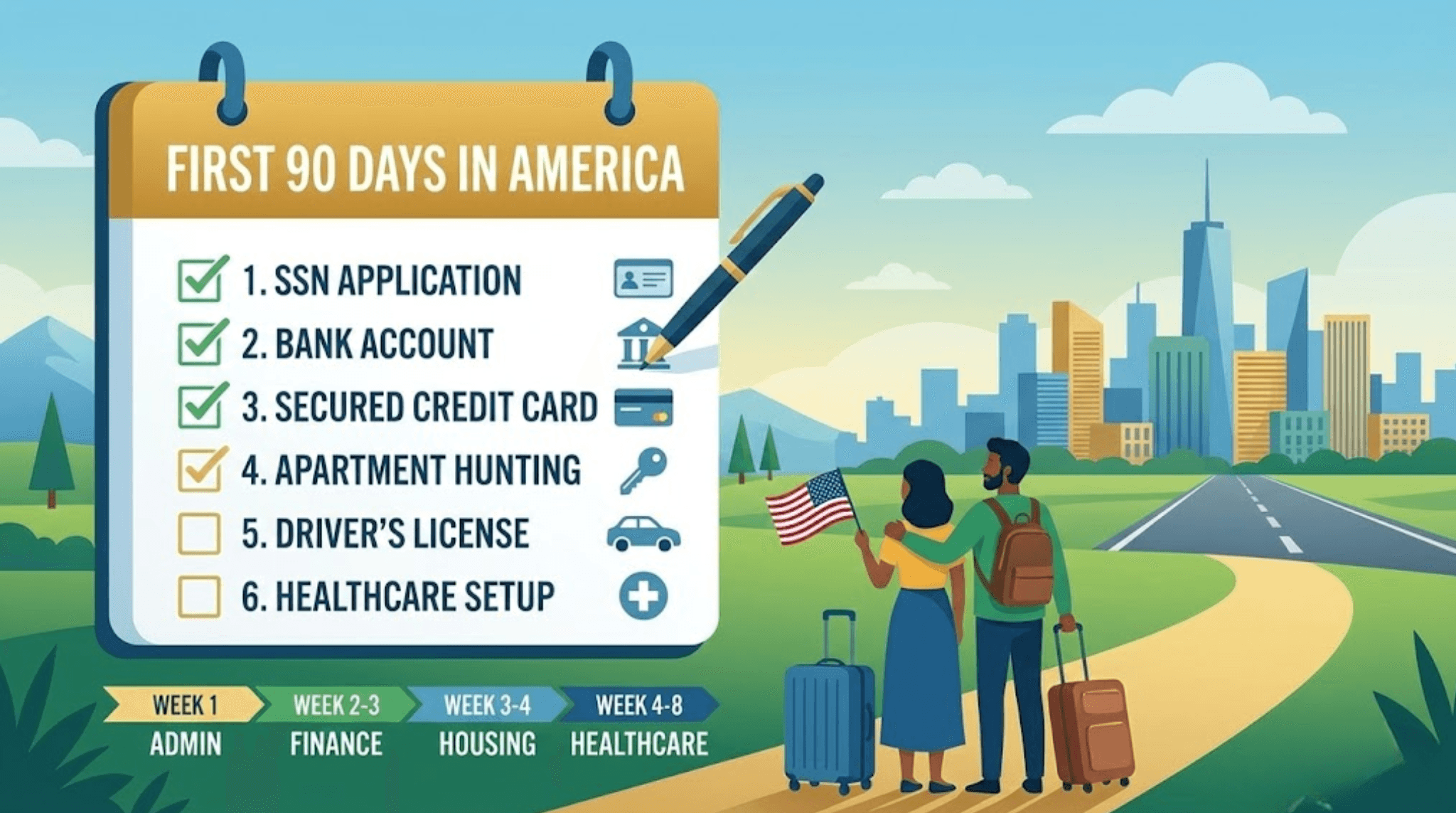
Week 1: Critical Administrative Tasks Day 1-3: Get Temporary Housing
Why temporary first:
Can't sign apartment lease without credit/references
Need U.S. address for SSN application
Need time to explore neighborhoods
Avoid rushed, bad rental decisions
Options:
Airbnb (easiest, 2-4 weeks)
Extended stay hotel
Corporate housing (if employer provides)
Friend's couch (cheapest but not ideal)
Cost: $1,500-$4,000 for 2-4 weeks
Day 3-5: Apply for Social Security Number
Why this is priority #1:
Everything requires SSN:
Bank accounts
Credit cards
Employment payroll
Apartment applications
Utilities
Phone plans
How to apply:
Wait 10 days after entry (SSN system needs to sync with immigration)
Visit local Social Security Administration office
Bring: Passport, I-94, visa, job offer letter
Fill out SS-5 form
Free application
Timeline:
Application: 30 minutes
Receive card: 2-3 weeks by mail
Critical: Apply immediately. This is your longest-lead-time item.
Day 5-7: Open Bank Account
What you need:
Passport (with visa)
I-94 (print from cbp.gov/i94)
U.S. address (even temporary)
Initial deposit ($25-$100)
Some banks: SSN (though some will open without if you're waiting)
Best banks for new immigrants:
Chase (branches everywhere, good for newcomers)
Bank of America (immigrant-friendly)
Citibank (global banking if you have account back home)
Capital One (online, good early credit products)
What to open:
Checking account (for direct deposit and bills)
Savings account (start emergency fund)
Avoid:
Banks requiring SSN immediately (wait for yours)
Banks with high fees
Banks without many branches/ATMs
Cost: Usually free with minimum balance
Day 7-10: Get Phone Number
Why you need it:
Apartment applications require U.S. phone
Banking and security
Job communication
Everything requires 2FA these days
Options:
Postpaid (best if you can):
Verizon, AT&T, T-Mobile
Requires SSN and credit check
$50-$80/month
May require deposit without credit history
Prepaid (if no SSN yet):
Same carriers, prepaid plans
No credit check
$40-$50/month
Can switch to postpaid later
MVNO (cheap option):
Mint Mobile, Visible, Cricket
Use major carrier networks
$25-$40/month
Good for first few months
Recommendation: Get prepaid immediately, switch to postpaid once you have SSN and want to build credit with phone payments.
Week 2-3: Financial Foundation Get Secured Credit Card
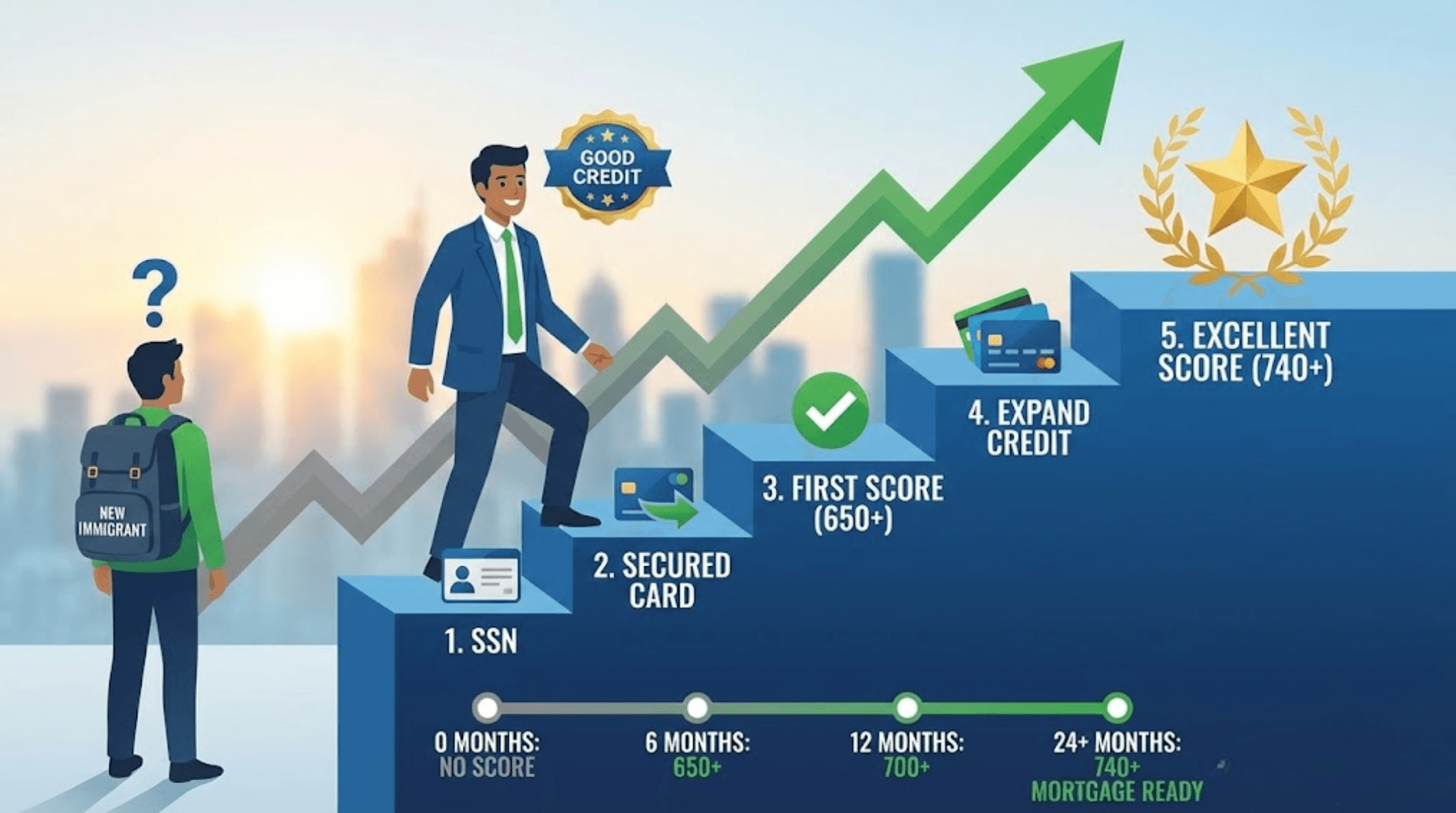
Why this is critical:
U.S. credit system penalizes having no credit history. Starting immediately matters.
How secured cards work:
You deposit $200-$1,000
That becomes your credit limit
Use card and pay in full each month
After 6-12 months, graduate to unsecured card
Deposit refunded
Best secured cards for immigrants:
Discover it Secured (good rewards, graduates quickly)
Capital One Platinum Secured (low deposit option)
Bank of America Secured (if you bank there)
Strategy:
Apply as soon as you have SSN
Make small purchases ($20-$50/month)
Pay in full every month (never carry balance)
After 6 months, you'll have credit score
This is not optional: Without U.S. credit history, you'll face:
Higher apartment deposits
Difficulty getting car loans
Higher insurance rates
Can't get mortgage later
Set Up Direct Deposit
With employer:
Provide bank account routing and account number
First paycheck may still be paper check (bank can deposit)
Verify deposit timing (weekly, biweekly, monthly)
Understand Your Paycheck
Deductions you'll see:
Federal income tax (20-30% typically)
State income tax (0-13% depending on state)
Social Security (6.2%)
Medicare (1.45%)
Health insurance premium
401(k) contribution (if you enrolled)
Your take-home: Roughly 65-75% of gross salary
Shock factor: If offered $100K, expect $5,400-6,200 per month take-home.
Week 3-4: Housing and Transportation Apartment Hunting
What landlords want:
Proof of income (3x rent in gross income)
Credit report (you won't have yet)
Background check
References
First month + last month + security deposit
How to overcome no credit:
Offer 2-3 months rent upfront
Get letter from employer verifying income
Offer larger security deposit
Use international credit report (if available)
Consider corporate housing/sublease for first 6 months
Where to search:
Apartments.com, Zillow, Trulia
Craigslist (careful of scams)
Facebook housing groups
Walk around desired neighborhoods
Cost: Expect to pay 3x first month's rent upfront
Example: $2,000/month apartment = $6,000 upfront
Furniture and Setup
Budget options:
IKEA (affordable, easy to assemble)
Facebook Marketplace (used furniture cheap)
Amazon (everything delivered)
Thrift stores (Goodwill, Salvation Army)
Essentials first 30 days:
Bed and mattress ($300-$1,000)
Kitchen basics ($200-$400)
Cleaning supplies ($50-$100)
Bathroom items ($100-$200)
Skip initially:
Living room furniture (use floor cushions temporarily)
Dining table (use kitchen counter)
Decorative items
Total furniture budget: $1,500-$3,000 for basics
Transportation
First 30 days:
Uber/Lyft (expensive but flexible)
Public transit (learn the system)
Walking/biking (explore neighborhood)
Month 2-3 decisions:
Buy a car if:
Living in car-dependent area (most of U.S.)
Public transit inadequate
Can afford $300-$500/month (payment, insurance, gas)
Skip car if:
Living in NYC, SF, DC, Chicago, Boston (good transit)
Work from home
Everything walkable
Getting driver's license:
Requirements vary by state
Usually: Written test + driving test
Some states require SSN, some don't
Some states accept foreign licenses, some don't
Cost: $30-$100
Timeline: 2-6 weeks depending on state
Week 4-8: Healthcare and Additional Setup Health Insurance
Through employer:
Enroll within 30 days of start date
Choose plan based on expected usage
Understand: Premium, deductible, copay, out-of-pocket max
If employer doesn't offer:
Healthcare.gov (marketplace)
Private insurance
Very expensive without employer subsidy
Find doctors:
Primary care physician (annual checkup)
Dentist (dental separate from health insurance)
Specialists as needed
Understand before you go:
What's covered
What's your copay
Is doctor in-network
Utilities and Services
Set up:
Electricity/gas (usually bundled)
Internet (Comcast/Xfinity, Verizon Fios, AT&T)
Water (sometimes included in rent)
Trash (sometimes included)
Cost expectations:
Internet: $50-$100/month
Electricity/gas: $80-$150/month (varies by season/size)
Water: $30-$60/month (if separate)
Connect with Community
Find your people:
Meetup.com (professional and social groups)
Facebook groups for your nationality in your city
Alumni networks (university alumni groups)
Religious/cultural organizations
Work colleagues
Why this matters:
Loneliness is real challenge
Practical advice from those who've done it
Job opportunities come from networks
Emotional support during adjustment
Week 8-12: Optimization and Long-Term Setup Optimize Banking
Once you have credit score (6+ months):
Apply for rewards credit card (2-5% cash back)
Open high-yield savings account (4-5% APY)
Consider investment account
File W-4 Correctly
Review tax withholding:
Too much withheld: You're giving government interest-free loan
Too little: You'll owe at tax time
Adjust based on your situation
Set Up Retirement
401(k) through employer:
Contribute at least enough to get employer match
Employer match is free money
Tax-advantaged savings
IRA (Individual):
Additional retirement savings
Roth IRA if eligible
$7,000/year limit (2025)
Understand Your Benefits
Review everything:
Health insurance details
Life insurance (if offered)
Disability insurance
FSA/HSA (health savings)
Stock options (if tech company)
Paid time off policy
Common First 90 Days Mistakes Mistake 1: Not applying for SSN immediately
Every day of delay pushes back everything else.
Solution: Apply within first week after 10-day wait period.
Mistake 2: Signing long apartment lease too quickly
You don't know neighborhoods yet. Rushed decisions lead to regrets.
Solution: Temporary housing first. Take 3-4 weeks to explore and decide.
Mistake 3: Not starting credit building
Waiting even 6 months means 6 months less credit history.
Solution: Secured credit card as soon as you have SSN.
Mistake 4: Overspending on furniture
Tempting to furnish entire apartment immediately.
Solution: Buy essentials only. Add gradually over 6-12 months.
Mistake 5: Not budgeting for double costs
First 90 days have overlapping expenses (temporary + permanent housing, etc.).
Solution: Expect to spend 2-3x normal monthly expenses in first 90 days.
Budget Breakdown: First 90 Days Expense
Amount
Timing
Temporary housing
$2,000-$4,000
Week 1-4
Apartment move-in
$4,000-$8,000
Week 3-4
Furniture/basics
$2,000-$4,000
Week 4-8
Transportation
$500-$1,500
Month 1-3
Food/groceries
$1,000-$2,000
Month 1-3
Phone/utilities setup
$300-$600
Week 1-2
Miscellaneous
$1,000-$2,000
Ongoing
Total
$10,000-$22,000
First 90 days
Note: This is beyond your regular monthly expenses. You'll need this upfront while waiting for first paycheck.
How OpenSphere Helps New Arrivals Personalized Checklist:
Based on your visa type, location, and situation, get customized task list.
Timeline Planner:
Sequence tasks optimally based on dependencies.
Resource Database:
Find SSN office, immigrant-friendly banks, housing, community groups in your city.
Cost Calculator:
Estimate first 90-day expenses based on your destination city.
Just arrived or arriving soon in the U.S.? Want a personalized checklist and timeline for your first 90 days?
Take the OpenSphere evaluation. You'll get location-specific guidance for settling in.
Get Your First 90 Days Plan