Quick Answer
If you want true dependent status (TD, O-3, or E-2 dependent) and you're not a Canadian citizen, you will need a U.S. consular visa interview at least once. If you're already in the U.S. in valid status (such as B-2 visitor with a visa, F-1 student, or your own work visa), you may be able to change to dependent status through USCIS though you'll eventually need the visa stamp if you ever leave and want to re-enter as a dependent.
Important: If you entered on the Visa Waiver Program (ESTA), you generally cannot change to another nonimmigrant status this is a legal prohibition, not just a risk.
Key Takeaways
✓ Non-Canadian spouses CAN qualify for dependent status - the spouse's citizenship doesn't block eligibility for TD, O-3, or E-2 dependent
✓ Consular interview is usually required - if you're outside the U.S. and want to enter as a dependent, you'll need a visa stamp from a U.S. embassy or consulate
✓ VWP/ESTA entrants CANNOT change status - if you entered on the Visa Waiver Program, you are legally prohibited from changing to TD, O-3, or E-2 status (with very limited exceptions)
✓ Canadian spouses of O-1 holders can enter at the border - but only after the O-1 petition is approved by USCIS (unlike TN which is fully border-adjudicated)
✓ E-2 spouses can work with E-2S designation - since January 2022, E-2 spouses receive "E-2S" on their I-94, allowing work without a separate EAD
✓ Processing times vary significantly - I-539 change of status currently takes 3-12+ months, with some categories experiencing delays up to 19 months
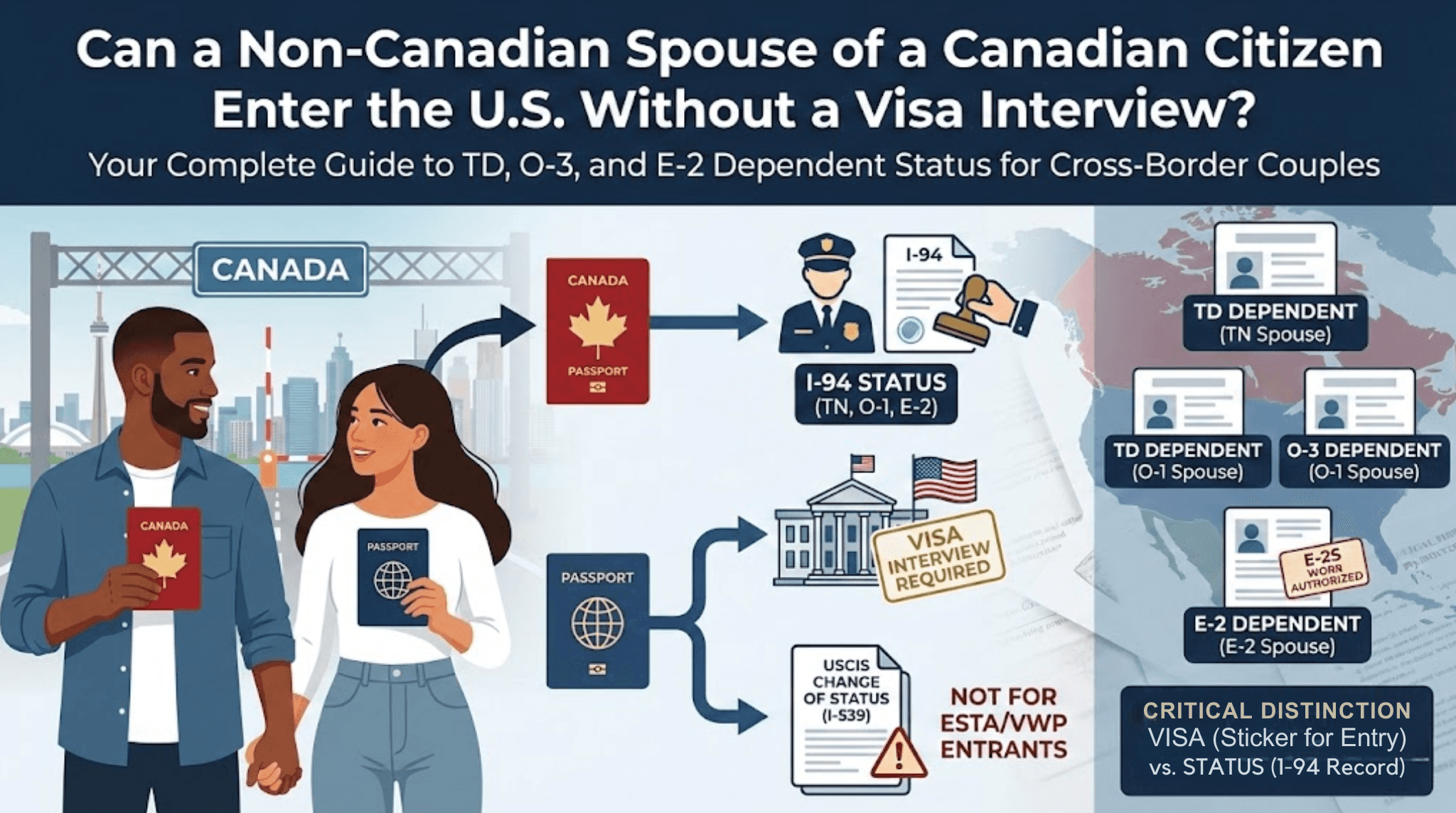
The Critical Distinction: Status vs. Visa
Before diving into the options, you need to understand a fundamental distinction in U.S. immigration:
Visa = A sticker in your passport that lets you ask to enter the U.S. at the border
Status = What you hold inside the U.S. (TN, TD, O-1, O-3, E-2, etc.), shown on your I-94 record
This distinction is crucial because if you're outside the U.S. and not Canadian, you generally need a visa from a U.S. consulate to enter in most work and dependent categories. Once you're inside the U.S. in certain qualifying statuses, you can sometimes change status through USCIS without going to a consulate.
What the Law Says: Dependent Visas by Category
TN / TD (USMCA Professionals & Dependents)
TN status is for certain professionals who are citizens of Canada or Mexico under the USMCA trade agreement. TD status is for their spouse and unmarried children under 21.
Key points:
The spouse doesn't have to be Canadian or Mexican to qualify for TD status
However, the U.S. government is explicit: non-Canadian spouses must apply for TD nonimmigrant visas at a U.S. embassy or consulate
TD spouses cannot work in the U.S.
Bottom line: If the principal is a Canadian TN worker and the spouse is not Canadian, a consular visa interview is normally required for the spouse to enter as TD.
O-1 / O-3 (Extraordinary Ability & Dependents)
O-1 status is for individuals with "extraordinary ability" in sciences, arts, business, athletics, etc. O-3 status is for the spouse and unmarried children under 21 of O-1/O-2 holders.
Key points:
The spouse's citizenship does not matter for eligibility
Canadian citizens can apply for O-3 admission directly at a U.S. port of entry—but only after the O-1 petition has been approved by USCIS (this differs from TN border processing)
Non-Canadian spouses outside the U.S. typically must get an O-3 visa at a consulate
O-3 spouses cannot work in the U.S.
E-2 / E-2 Dependent (Treaty Investor & Family)
E-2 status is for treaty investors and certain employees from treaty countries (including Canada). E-2 dependent status is for the spouse and unmarried children under 21.
Key points:
The spouse's citizenship doesn't have to match the principal
Huge benefit: E-2 spouses are work-authorized "incident to status"
Since January 31, 2022, E-2 spouses receive an I-94 with "E-2S" designation, which serves as evidence of work authorization for Form I-9 purposes—no separate EAD required
If the spouse is outside the U.S. and not Canadian, they will generally need an E-2 dependent visa from a consulate
Even Canadian principals applying for E-2 usually need to go through a U.S. consulate in Canada—this category is not adjudicated at the border
Options to Avoid a Consulate (At Least Temporarily)
⚠️ CRITICAL WARNING: VWP/ESTA Entrants
If you entered the U.S. on the Visa Waiver Program (VWP/ESTA), you generally cannot change to another nonimmigrant status like TD, O-3, or E-2. This is a legal prohibition under INA §217, not just a risk.
The only exceptions are:
Immediate relatives of U.S. citizens adjusting to permanent residence
Certain emergency situations
VWP entrants also cannot extend their stay beyond 90 days except in emergencies.
If you need dependent status and entered on ESTA, you must leave the U.S. and apply for a visa at a consulate.
Option 1: Enter in Another Status, Then Change Status Inside the U.S.
If the non-Canadian spouse can lawfully enter the U.S. in a qualifying status other than VWP, they may be able to change status:
Step 1: Enter in a different status that allows change of status:
B-2 visitor with a visa (NOT Visa Waiver/ESTA)
F-1 student
Their own work visa (H-1B, L-1, etc.)
Step 2: Once inside the U.S., file a change of status (Form I-539) to TD, O-3, or E-2 dependent.
Current Processing Times: Form I-539 processing currently takes 3 to 12+ months, with some categories experiencing delays of up to 19 months. Premium processing (30 days) is available only for F, M, and J visa categories—not for dependent status changes like TD, O-3, or E-2.
Critical Limitations:
The moment they leave the U.S. and want to re-enter as a dependent, they'll need to get the actual visa stamp at a consulate abroad
If they entered originally as a visitor but their real intent was to move in and change status, that can raise misrepresentation issues — intent at entry matters
This route should be handled very carefully with legal advice
Option 2: Enter as a Visitor for Short Trips Only
If the non-Canadian spouse holds a passport from a Visa Waiver Program country (e.g., many EU countries, Japan, UK, Australia), they can enter as a visitor for short, clearly temporary stays.
This works for:
Short trips to see the Canadian spouse working in the U.S.
Occasional visits rather than long-term living together
This does NOT work for:
Living in the U.S. long-term with your spouse
Working in the U.S.
Changing to dependent status (VWP entrants are legally prohibited from doing so)
Warning: CBP can refuse entry if it looks like you're effectively trying to move rather than visit. You must maintain genuine temporary visit intent.
Does Being "Based in Canada" Change Anything?
A very common situation: Canadian citizen is working in the U.S. on TN, O-1, or E-2, while their non-Canadian spouse is living in Canada, possibly commuting or visiting.
For the non-Canadian spouse:
To live in the U.S. as a dependent: They will almost always need a TD / O-3 / E-2 dependent visa from a U.S. consulate in Canada
To stay in Canada and just visit occasionally: They may enter the U.S. as a visitor (if eligible) without ever getting dependent status—but remember, if they use ESTA, they cannot later change status
What "based in Canada" really affects is logistics, not eligibility:
Visa interviews are usually done at U.S. consulates in Canada (Toronto, Vancouver, Montreal, Calgary, etc.)
Documentation needed: marriage certificate, proof of genuine relationship, proof the principal is maintaining TN/O-1/E-2 status
Strategy Comparison by Visa Type
Factor | TN + TD | O-1 + O-3 | E-2 + E-2 Dependent |
Principal processing | Border-adjudicated for Canadians | USCIS petition required first | Consular processing (even for Canadians) |
Spouse work authorization | ❌ No | ❌ No | ✅ Yes (E-2S designation) |
Canadian spouse border entry | Yes, at border | Yes, after USCIS approval | No, consular required |
Non-Canadian spouse consular req. | Yes, for entry | Yes, for entry | Yes, for entry |
Best for | Straightforward professional roles | Top-tier talent with extraordinary ability evidence | Investors or employees of treaty businesses |
When Does It Make Sense to Avoid the Consulate?
Avoiding a consulate can make short-term sense if:
The spouse is already in the U.S. in a qualifying status that allows change of status (NOT VWP/ESTA), and:
Wants to change status to TD/O-3/E-2
Is okay not traveling outside the U.S. for a while (potentially months or years)
But for long-term plans like:
Moving in together in the U.S.
Enrolling kids in school
Spouse working in the U.S. (E-2 only)
Any international travel
A consular visa appointment is usually unavoidable at some point.
Ready to Map Your Cross-Border Strategy?
These cross-border scenarios are rarely "one-size-fits-all." The right strategy depends on the spouse's citizenship, their current location and status, whether the goal is short visits or full relocation, timeline for getting the family together, and whether the spouse needs work authorization.
Get your personalized visa pathway assessment:https://evaluation.opensphere.ai/best-visa-for-you
1. Can my non-Canadian spouse get TD status if I'm a Canadian TN worker?
Yes, absolutely. TD status eligibility is based on your relationship to the TN principal, not your citizenship. The spouse doesn't need to be Canadian or Mexican. However, non-Canadian spouses must obtain a TD visa at a U.S. consulate before entering the U.S. in TD status—they cannot simply present documents at the border like a Canadian spouse could.
2. Can I enter on ESTA/VWP and then change to TD/O-3/E-2 status?
No. Under INA §217, Visa Waiver Program entrants are legally prohibited from changing to other nonimmigrant statuses—this is not just risky, it's not permitted. The only exception is for immediate relatives of U.S. citizens adjusting to permanent residence. If you need dependent status, you must enter on a visa that allows change of status (such as a B-2 visitor visa, not ESTA).
3. Can my Canadian spouse enter as O-3 at the border like TD?
Yes, but with an important difference. Canadian citizens can apply for O-3 admission at a U.S. port of entry after the O-1 petition has been approved by USCIS. Unlike TN (which is fully border-adjudicated), O-1 requires a USCIS petition approval first. The Canadian O-3 applicant brings the I-797 approval notice, passport, marriage/birth certificate, and evidence of the O-1 holder's status to the border.
4. How long does a change of status to TD/O-3/E-2 take?
USCIS processing times for Form I-539 (change of status) currently range from 3 to 12+ months, with some categories experiencing delays of up to 19 months. Premium processing is not available for dependent status changes like TD, O-3, or E-2 (only for F, M, and J categories). During this time, the applicant must remain in the U.S. and maintain valid status.
5. Can my spouse work in the U.S. on TD or O-3 status?
No. TD and O-3 status do not include work authorization. Spouses in these categories cannot work unless they independently qualify for their own work visa (like H-1B) or obtain an Employment Authorization Document through another avenue (such as a pending green card application). This is a significant limitation compared to E-2 dependent status.
6. How does work authorization work for E-2 spouses now?
Since January 31, 2022, E-2 spouses receive an I-94 with the "E-2S" designation, which serves as evidence of work authorization for Form I-9 purposes. They no longer need to apply for a separate EAD. E-2 spouses who entered before this date and want work authorization should either travel internationally to receive a new I-94 with the E-2S designation, contact a CBP Deferred Inspection Site, or file for extension through USCIS.
7. What's the difference between changing status and getting a visa?
Changing status (Form I-539 with USCIS) switches your immigration category while you're inside the U.S.—you never leave the country. Getting a visa requires appearing at a U.S. consulate abroad for an interview and having a visa stamp placed in your passport. You need the visa stamp to enter the U.S. in that status; you need the status change to remain in the U.S. in a different category.
8. What happens if my change of status is denied?
If your change of status is denied, you typically must leave the U.S. promptly to avoid accruing unlawful presence. This is especially critical for those who entered on VWP/ESTA, as they generally have no appeal rights and very limited options. Those who entered with a visa may have more flexibility. This is why consulting with an immigration attorney before pursuing the change-of-status route is strongly recommended.
9. Why can Canadian spouses avoid consular processing but not other nationalities?
Canadian citizens have a special arrangement under U.S. immigration law. They are generally visa-exempt for most nonimmigrant categories including TN, TD, and many others. This means Canadians can apply for status directly at the U.S. port of entry without first obtaining a visa stamp. This privilege doesn't extend to non-Canadian spouses, even if they're married to a Canadian and living in Canada.
10. Can we go to a consulate in a third country, or must it be Canada?
Generally, you should apply at a U.S. consulate in your country of residence or citizenship. If the non-Canadian spouse is living in Canada, they would typically apply at a U.S. consulate in Canada (Toronto, Vancouver, Montreal, Calgary, etc.). Applying in a third country is sometimes possible but may result in additional scrutiny or delays. Consult with an immigration attorney about the best location for your specific situation.