Top 10 Memberships to Strengthen Your O-1A Visa Profile
Strategic Guide to Meeting USCIS Membership Criteria Through Selective Professional Associations
Strategic Guide to Meeting USCIS Membership Criteria Through Selective Professional Associations

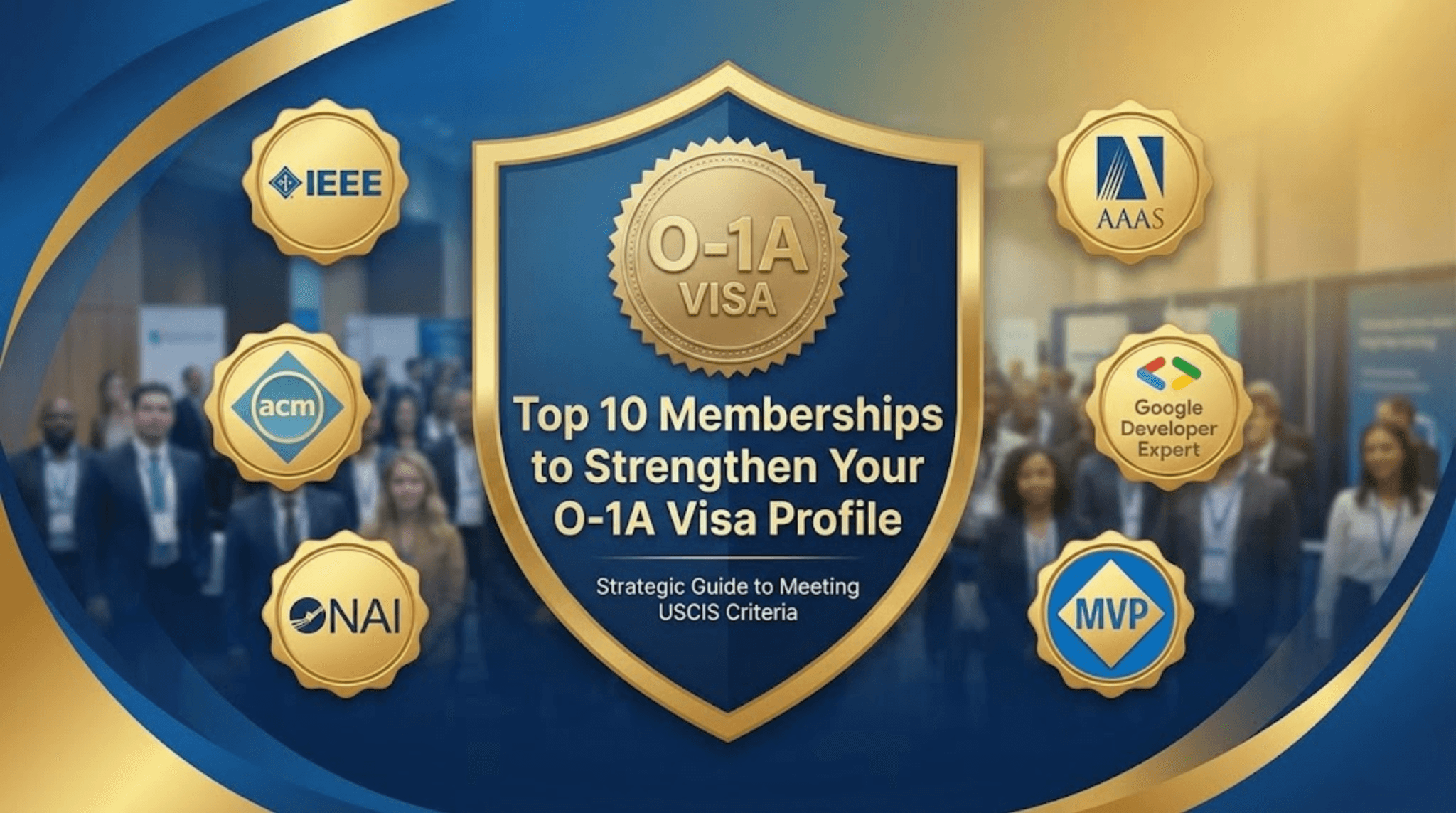
The O-1A membership criterion requires associations that demand outstanding achievements judged by recognized experts not just dues or credentials. Top qualifying memberships include IEEE Senior Member/Fellow, ACM Fellow, NAI Fellow, AAAS Fellow, Google Developer Expert, and Microsoft MVP. Avoid pay-to-play organizations where anyone can join by paying a fee.
✓ Selectivity matters most: USCIS looks for acceptance rates under 5% and expert-judged selection processes
✓ Fellow-level beats standard membership: IEEE Fellow (invitation-only) is stronger than IEEE Member (open enrollment)
✓ Accelerators have limitations: Y Combinator/Techstars alone may not satisfy membership criterion under current USCIS interpretation
✓ Documentation is essential: Collect bylaws, acceptance rates, and expert committee information to prove exclusivity
✓ Quality over quantity: One elite membership outweighs multiple generic professional associations
The O-1A membership criterion requires documentation of membership in associations that require outstanding achievements of their members, as judged by recognized national or international experts. This language is precise and demanding. Simply paying dues or holding credentials like a degree or license does not qualify.
For a membership to count, USCIS looks for three key elements:
Achievement-based admission (not credentials, experience, or payment alone)
Selection by recognized experts through peer review, nomination, or evaluation committees
Low acceptance rates demonstrating genuine selectivity (ideally under 5%)
1. IEEE Senior Member & IEEE Fellow
Senior Member is the highest grade you can apply for, requiring 10 years of professional practice and 5 years of significant performance, plus three references from existing Senior Members or Fellows. Fellow is invitation-only, recognizing "unusual distinction" with rigorous peer review. IEEE Fellow is among the strongest memberships for O-1A.
Website: https://www.ieee.org/membership/senior
Why it works: Requires documented achievements, expert references, and has clear selectivity criteria that USCIS recognizes.
2. ACM Fellow & Distinguished Member
ACM Fellow represents the top 1% of ACM membership, requiring nomination and demonstrating "lasting impact on the field of computing." Distinguished Member recognizes the top 10%. Both require 5+ years of professional membership and nomination by peers—not self-application.
Website: https://awards.acm.org/fellows
Why it works: Explicit percentage caps (top 1% for Fellow) make selectivity undeniable to USCIS adjudicators.
3. National Academy of Inventors (NAI) Fellow
NAI Fellow is the highest distinction for academic inventors, requiring nomination, USPTO patents, and selection by an expert committee. The median NAI Fellow holds 20+ U.S. patents. Self-nomination is not permitted.
Website: https://academyofinventors.org/
Why it works: Objective patent requirements combined with peer nomination create strong evidence of achievement-based selection.
4. AAAS Fellow (American Association for the Advancement of Science)
AAAS Fellows are elected annually by the AAAS Council for "scientifically or socially distinguished" contributions. Requires nomination by three existing Fellows and continuous membership for four years. Section quotas limit selections to approximately 0.4% of membership.
Website: https://www.aaas.org/fellows
Why it works: 150-year tradition, rigorous nomination process, and explicit quota system demonstrate genuine exclusivity.
5. Google Developer Expert (GDE)
GDE status recognizes expertise in Google technologies through referral by Google employees or existing GDEs. Requires demonstrated community contributions (speaking, writing, mentoring) and passes through interview evaluation. Approximately 1,000 GDEs exist worldwide.
Website: https://developers.google.com/community/experts
Why it works: Referral-only access, interview process, and global recognition by a major technology company establish credibility.
6. Microsoft Most Valuable Professional (MVP)
Microsoft MVPs are recognized annually for community contributions to Microsoft technologies. Selection requires nomination by Microsoft employees or existing MVPs, with approximately 4,000 MVPs worldwide. Award must be renewed yearly based on continued contributions.
Website: https://mvp.microsoft.com/
Why it works: Annual renewal requirement proves ongoing excellence, and nomination-only process demonstrates selectivity.
7. Y Combinator & Techstars (With Important Caveats)
⚠️ Important: Under current USCIS interpretation, accelerator acceptance alone may not satisfy the membership criterion. However, these programs can strengthen Critical Role and Original Contributions criteria. Y Combinator accepts roughly 1-2% of applicants; Techstars approximately 1%. Combine with traditional professional memberships for stronger evidence.
Why the caveat: USCIS has questioned whether accelerators constitute "associations" in the traditional sense, and whether acceptance reflects individual achievement versus startup potential.
Strategic use: Present accelerator acceptance as supporting evidence for other criteria while pursuing traditional memberships for the membership criterion specifically.
8. Field-Specific Honorary Societies
National Academy of Sciences, National Academy of Engineering, and National Academy of Medicine represent the highest recognition in their fields. Other examples include the Royal Society (UK), American Physical Society Fellows, and Association for Computational Linguistics Fellows. All require nomination and expert evaluation.
Why they work: These represent the pinnacle of professional recognition in their respective fields, with nomination-only processes and extremely low acceptance rates.
9. AWS Heroes, Salesforce MVPs & Similar Tech Recognition Programs
Major technology companies maintain expert recognition programs with selective nomination processes. AWS Heroes, Salesforce MVPs, and GitHub Stars require demonstrated expertise and community impact. Document selection criteria carefully as these programs evolve.
Why they work: Global tech companies have reputations to protect, making their recognition programs genuinely selective. However, document the specific criteria as these are newer programs.
10. IEEE Computer Society Membership
The IEEE Computer Society offers membership specifically for computing professionals, with Senior Member and Distinguished Contributor designations requiring demonstrated achievements and peer endorsement.
Website: https://www.computer.org/membership
Why it works: Field-specific focus combined with achievement requirements makes this relevant for technology professionals.
LIKELY TO QUALIFY ✓ | UNLIKELY TO QUALIFY ✗ |
IEEE Fellow/Senior Member | Standard IEEE/ACM membership |
ACM Fellow/Distinguished Member | Forbes Councils (pay-to-play) |
NAI Fellow | State Bar/CPA associations |
AAAS Fellow | Alumni associations |
Google Developer Expert | Open-enrollment professional groups |
Microsoft MVP | Local tech meetup memberships |
National Academy members | US-RSE (open membership) |
Field-specific Fellows | Newsweek Expert Forum |
Pay-to-Play Organizations
Forbes Business Council, Entrepreneur Leadership Network, Newsweek Expert Forum: These organizations charge $2,000-$8,000+ annually and accept most applicants who meet basic revenue thresholds. While they offer publishing opportunities, USCIS recognizes that admission is based primarily on ability to pay, not expert evaluation of achievements.
Open-Enrollment Professional Associations
US-RSE (US Research Software Engineer Association): While valuable for networking, membership is "easy and free" with no achievement requirements. Similarly, basic-tier memberships in IEEE, ACM, or other professional societies that anyone can join by paying dues do not satisfy the criterion.
Credential-Based Memberships
State Bar Associations, CPA Societies: These require passing exams and maintaining credentials but don't evaluate "outstanding achievements" beyond baseline competency. USCIS has specifically rejected these as evidence of extraordinary ability.
How to Document Your Membership for Maximum Impact
Strong documentation makes the difference between a membership that strengthens your case and one that gets dismissed. Include:
Letter from organization leadership describing the evaluation process you underwent
Official membership certificate or letter confirming your status and admission date
Organization bylaws or constitution showing membership criteria
Website excerpts describing the selection process and requirements
Acceptance rate statistics (if available) or evidence of selectivity
Selection committee composition showing expert credentials
Comparison to general membership if you hold a higher tier (e.g., Senior vs. standard)
Ready to Evaluate Your O-1A Eligibility?
Understanding which memberships strengthen your profile is just one piece of the O-1A puzzle. OpenSphere's evidence-based evaluation tool analyzes your complete profile against all eight USCIS criteria to identify your strongest evidence and gaps.
Get your personalized visa pathway assessment:https://evaluation.opensphere.ai/best-visa-for-you
1. Does IEEE Senior membership definitely satisfy the O-1A membership criterion?
IEEE Senior membership requires documented achievements and expert references, making it a strong candidate. However, USCIS evaluates the totality of evidence, so you should document the selection criteria, acceptance process, and your qualifications that led to selection. Some adjudicators have questioned whether the 10-year experience requirement alone constitutes "outstanding achievement." Pairing Senior membership with committee leadership or reviewer roles strengthens this criterion.
2. Are Forbes Business Council and similar paid memberships useful for O-1A?
Pay-to-play memberships are generally weak evidence because USCIS recognizes that admission is based primarily on ability to pay, not expert evaluation of achievements. While Forbes Councils claim a "selection committee," the acceptance rate and criteria suggest these are primarily revenue-driven. Focus instead on memberships with genuine selectivity.
3. Can Y Combinator or Techstars acceptance satisfy the membership criterion?
Under current USCIS interpretation, accelerator acceptance alone is unlikely to satisfy membership criterion. However, these programs are excellent evidence for Critical Role (CR) and Original Contributions (OC) criteria. The extremely low acceptance rates (1-2%) can still support your overall "totality of evidence" argument.
4. How do I document that my membership is selective?
Gather: (1) Organization bylaws describing membership criteria, (2) website/promotional materials explaining selection process, (3) acceptance rate statistics, (4) composition of selection committee showing expert credentials, (5) a letter from the organization describing the evaluation process. The stronger your documentation of selectivity, the more weight USCIS gives your membership.
5. Do I need multiple memberships to satisfy this criterion?
No. One genuinely selective membership with strong documentation can satisfy the criterion. USCIS evaluates quality, not quantity. Multiple weak memberships (like several pay-to-play councils) may actually harm your case by suggesting you're padding evidence rather than demonstrating genuine recognition.
6. What if my membership is in a less well-known organization?
Lesser-known organizations can still qualify if you thoroughly document: (1) the organization's reputation in your field, (2) the rigor of member selection, (3) the credentials of experts who evaluate applicants, and (4) acceptance statistics. International or industry-specific organizations are often overlooked but can be compelling evidence.
7. How long do I need to hold the membership?
USCIS has removed time-based requirements for membership evaluation. Recent memberships count just as much as longstanding ones. What matters is whether the membership required demonstrated outstanding achievement at the time of admission, not how long you've held it.
8. Can serving on a membership committee help my case?
Yes. Serving as a reviewer on membership selection committees (like IEEE Senior Member reviewer) can help satisfy the "judging" criterion while also demonstrating your standing in the field. This dual benefit makes committee service particularly valuable for O-1A profile building.
9. What's the difference between membership and awards for O-1A purposes?
Membership refers to ongoing association status based on achievement (IEEE Fellow, ACM Distinguished Member). Awards are one-time recognitions (Forbes 30 Under 30, TechCrunch Disrupt winner). Both satisfy different O-1A criteria. Some recognitions like IEEE Fellow status blur the line, functioning as both prestigious membership and an honor for achievements.
10. How should I prioritize which memberships to pursue?
Focus on memberships that: (1) directly align with your claimed field of expertise, (2) have clearly documented selective criteria, (3) you genuinely qualify for based on achievements you can document. Don't pursue memberships you can't legitimately earn—USCIS officers are experienced at identifying credential inflation.