Quick answer
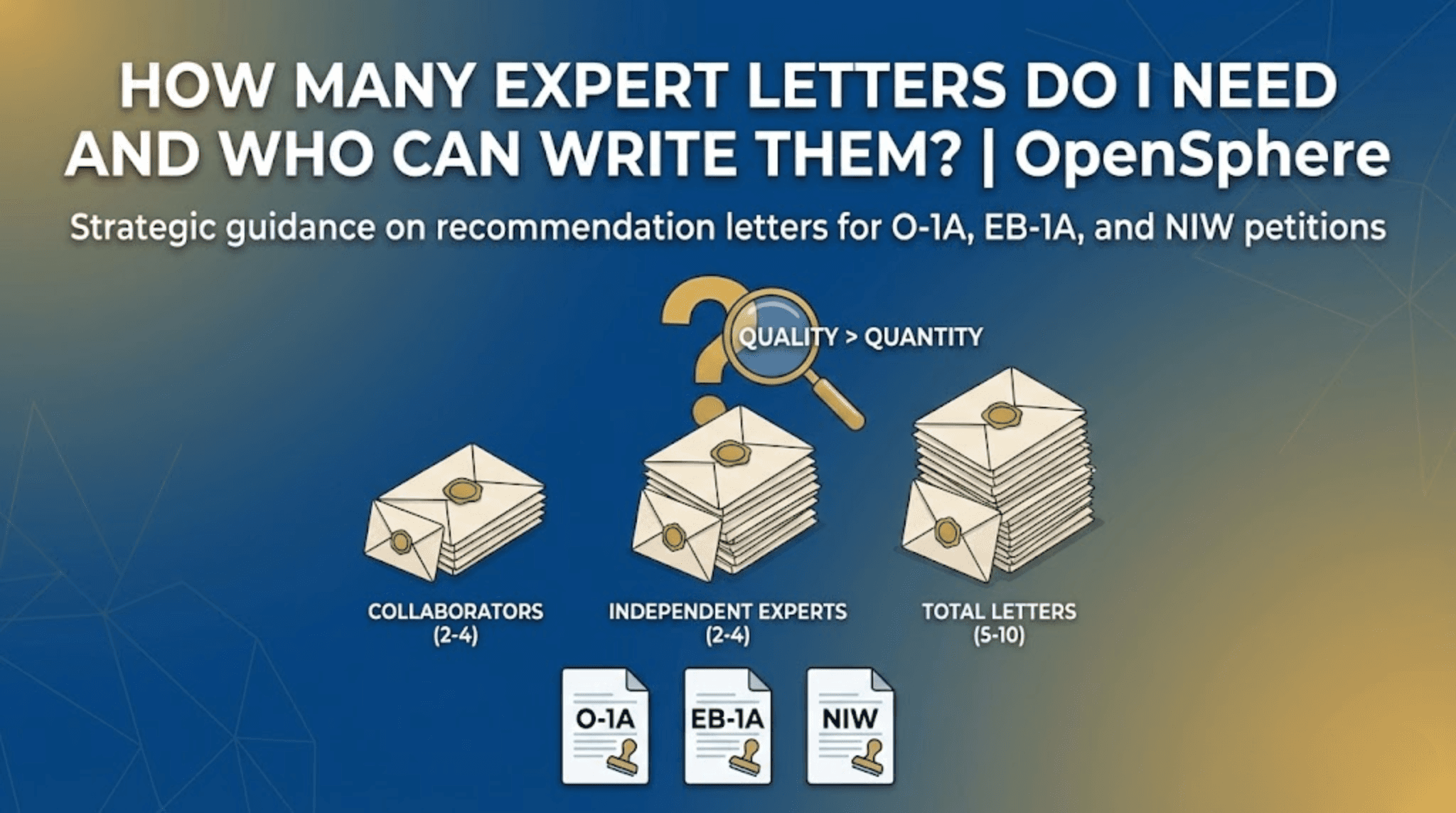
For EB-1A and O-1A petitions, 5–10 strong letters typically constitute a solid package, with a mix of independent experts (who know you by reputation) and collaborators (who know your work directly). For NIW, 2–4 targeted letters usually suffice. Quality matters enormously more than quantity—a few excellent letters outperform many generic ones. The best letters come from recognized experts who can articulate specifically why your contributions matter to the field.
Key takeaways
• Quality over quantity: Detailed, specific letters from credible experts beat numerous generic endorsements.
• Independent voices carry more weight: USCIS gives special attention to letters from experts who know you by reputation rather than personal collaboration.
• Mix of perspectives helps: Combine letters from collaborators (who know details) with independent experts (who provide objective validation).
• Letters must be specific: Vague praise fails. Letters should explain exactly what you contributed and why it matters.
• Credentials of writers matter: Distinguished experts' endorsements carry more weight than unknown individuals.
• Geographic diversity strengthens cases: International recognition is demonstrated by letters from experts in multiple countries.
How many letters do you need?
There is no regulatory minimum, and more is not always better. Guidance based on petition type:
EB-1A (Extraordinary Ability): 5–10 letters is typical for strong cases. This provides enough voices to validate multiple criteria while avoiding redundancy.
O-1A (Extraordinary Ability): Similar to EB-1A—aim for 5–10 letters that speak to your sustained national or international acclaim.
NIW (National Interest Waiver): 2–4 letters often suffice, focused specifically on the three Dhanasar prongs.
EB-1B (Outstanding Researcher): 1–2 letters may be sufficient given the more structured requirements of this category.
The right number depends on your case. Someone with extremely strong documentary evidence might need fewer letters; someone whose achievements require more explanation might need more voices to establish context.
Who should write your letters?
Independent experts (most valuable):
These are people who know your work and reputation but have never collaborated with you directly. They might know you from:
Reading and citing your publications
Seeing your presentations at conferences
Hearing about your work through industry reputation
Evaluating your work in their role as editors, reviewers, or judges
Independent letters carry particular weight because the writer has no personal stake in your success. When someone who has never worked with you testifies that you are among the top in your field, USCIS takes notice.
Collaborators and colleagues:
Letters from direct collaborators, supervisors, and colleagues are valuable for providing detailed knowledge of your specific contributions. These writers can explain:
Your specific role in joint projects
The significance of contributions others might not see
Day-to-day evidence of your expertise
However, letters only from collaborators may suggest your reputation does not extend beyond your immediate circle.
Ideal mix:
A strong petition includes both types:
2–4 independent experts who validate your broader reputation
2–4 collaborators who provide detailed knowledge of specific contributions
At least some writers from outside your current institution
Writers from multiple countries if claiming international recognition
Who makes a strong letter writer?
Strong credentials matter. The most impactful letters come from:
Recognized leaders in your field (professors at top universities, senior researchers, executives at major companies)
People with their own documented achievements (awards, publications, leadership roles)
Experts whose credentials can be easily verified
Writers who can speak to your specific contributions (not just general endorsements)
Less effective writers include:
Unknown individuals without documented expertise
People who obviously share financial interest in your success (though investors can be useful for specific criteria)
Writers who can only speak generically about your field, not your contributions
Anyone who appears to be writing solely as a favor without genuine knowledge
What makes a letter effective?
Effective letters share common characteristics:
Specific, not generic:
Bad: "Dr. Chen is an excellent researcher who does important work."
Good: "Dr. Chen's development of the X algorithm, published in Nature in 2021, fundamentally changed how our field approaches protein folding prediction. My lab now uses this methodology, and it has reduced our computational requirements by 40%."
Addresses criteria directly:
The best letters explicitly address the regulatory criteria you are claiming. If you claim "original contribution of major significance," the letter should explain why your contribution is original and why it has major significance to the field.
Explains the writer's credibility:
The letter should briefly establish why the writer is qualified to opine. This might include their position, publications, awards, or experience in the field.
Provides independent validation:
For independent experts, the letter should explain how they know of your work and why it stands out among the many contributions in the field.
Avoids personal qualities:
USCIS cares about your professional achievements, not that you are "a pleasure to work with" or "highly ethical." Focus letters on contributions and recognition, not personality.
What letters should not do
Common letter problems that undermine petitions:
Template language: Letters that sound identical suggest they were written by the applicant and merely signed. Each letter should reflect the writer's voice and perspective.
Hyperbole without evidence: Calling someone "the greatest in the field" without explaining why damages credibility. Specific, verifiable claims beat superlatives.
Discussing potential rather than achievement: USCIS evaluates what you have done, not what you might do. Letters should focus on accomplished contributions, not future promise.
Inaccuracies or exaggerations: If USCIS can verify claims and finds discrepancies, it damages your entire case. Ensure all facts in letters are accurate.
Rehashing your CV: Letters that simply list your credentials add nothing beyond what USCIS can read in your resume. Letters should provide context and evaluation that documents cannot.
Practical tips for obtaining letters
Start early: Requesting and obtaining letters takes time. Give potential writers 4–6 weeks minimum.
Provide context: Give writers information about O-1A/EB-1A/NIW criteria and what USCIS looks for. They may not understand immigration law nuances.
Draft thoughtfully: You may provide draft language, but ensure writers genuinely review and modify to reflect their actual views. Letters should not be carbon copies.
Use letterhead: Official letterhead adds credibility. Include the writer's full contact information.
Include CVs: Attach the writer's brief resume or biographical summary to establish their credentials.
Follow up: Busy experts need reminders. Build in time for follow-up communications.
OpenSphere's evidence evaluation
Understanding how your expert letters fit into your overall petition strategy is essential. OpenSphere evaluates your profile and helps identify what evidence—including letters—will strengthen your case.
Start your evaluation: https://evaluation.opensphere.ai/best-visa-for-you
Q: Is there a minimum number of letters required?
A: No regulatory minimum exists. The right number depends on how much independent validation your achievements need. Most strong cases have 5–10 letters.
Q: Can letters be from family members or friends?
A: Letters should be from professional contacts who can speak to your work. Family and personal friends generally cannot provide credible expert validation.
Q: Should letters be on company letterhead?
A: Yes, official letterhead from the writer's institution adds credibility and verifiability.
Q: Can I write letters for experts to sign?
A: You can provide drafts, but writers should genuinely review, modify, and take ownership of the content. Identical-sounding letters damage credibility.
Q: How important are international letters?
A: For claims of international recognition, letters from experts in multiple countries directly support that claim. Aim for geographic diversity.
Q: What if I cannot get independent experts?
A: While collaborator letters are acceptable, cases with only letters from people you worked with directly are weaker. Expand your network to find experts who know your work by reputation.
Q: Should letters mention immigration at all?
A: Letters typically state they are written to support your petition, but the focus should be on your contributions and standing, not immigration arguments.
Q: How recent should letters be?
A: Current letters are preferred. Letters more than 1–2 years old may raise questions about whether your recognition is sustained and current.
Q: Can letters be from competitors?
A: Letters from competitors or people at competing institutions can be powerful evidence of recognition—they have no incentive to praise you unless you genuinely deserve it.
Q: What if a writer's English is limited?
A: Letters can be written in other languages with certified English translations. However, if a writer can write in English, that is generally preferable.