Can I switch to H-1B or O-1A from F-1 later?
Understanding your pathways from student visa to work authorization
Understanding your pathways from student visa to work authorization

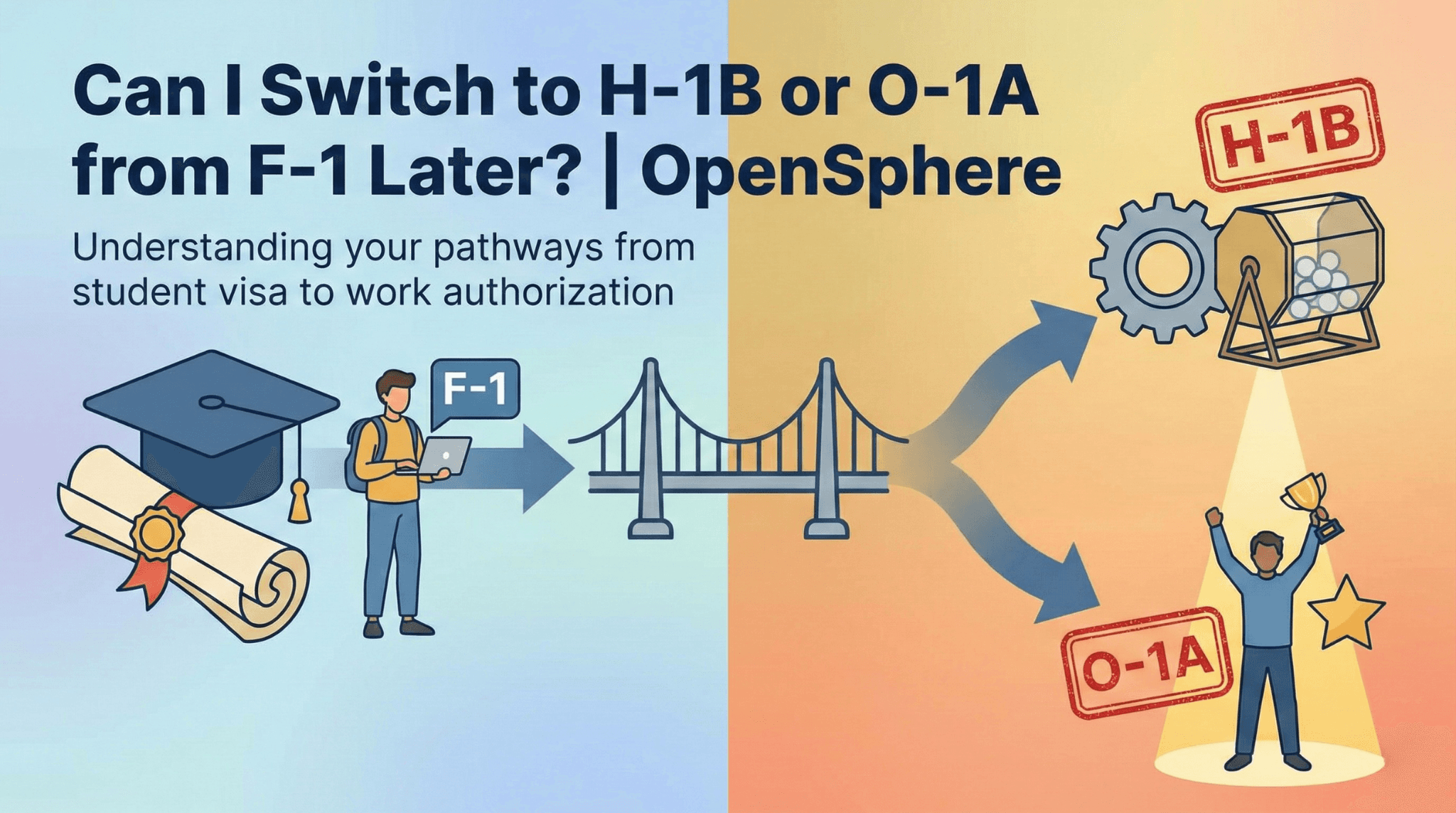
Yes, F-1 students can transition to H-1B or O-1A status, but through different mechanisms with different requirements. H-1B requires employer sponsorship, lottery selection (for cap-subject positions), and a specialty occupation. O-1A requires demonstrating extraordinary ability and can potentially bypass the lottery. Both involve either change of status while in the U.S. or consular processing abroad.
• OPT is your bridge: Optional Practical Training allows F-1 students to work while seeking longer-term visa options.
• H-1B has a lottery: Most H-1B positions are subject to an annual cap requiring lottery selection before your employer can file.
• O-1A has no cap: If you qualify as a person of extraordinary ability, you skip the lottery entirely.
• Timing matters critically: Transitions must be carefully timed to avoid gaps in status.
• Cap-gap extension protects you: If selected for H-1B, your F-1 status and OPT are automatically extended until October 1.
• STEM OPT provides extra time: Students with STEM degrees can get 24 additional months of OPT, extending the window for transition.
The H-1B visa is the most common work visa for F-1 students, but it is subject to an annual cap with far more applicants than available slots.
Timeline overview:
During studies: Focus on academics. You cannot work except for limited on-campus employment or Curricular Practical Training if program-required.
Post-graduation OPT: After completing your degree, you can apply for 12 months of Optional Practical Training, allowing you to work in your field. STEM degree holders can apply for an additional 24-month STEM OPT extension.
H-1B lottery: Each March, employers register employees for the H-1B lottery. If selected, employers file petitions in April. H-1B status begins October 1.
Cap-gap extension: If your F-1 status or OPT expires before October 1 but you have been selected for H-1B, your status is automatically extended until your H-1B begins.
Change of status: If you requested change of status with your H-1B petition, your status automatically converts to H-1B on October 1 if approved.
Key requirements:
You must have a bachelor's degree or higher
Your job must be a "specialty occupation" requiring that degree
Your employer must sponsor you and pay filing fees
You must be selected in the lottery (unless employer is cap-exempt)
You must maintain valid F-1 status until H-1B begins
O-1A offers significant advantages for students with exceptional achievements: no annual cap, no lottery, and the ability to self-petition through your own company.
Key differences from H-1B:
No lottery: O-1A visas are not subject to numerical limits. You can apply anytime with any employer.
Higher bar: You must demonstrate "extraordinary ability" through sustained national or international acclaim—a significantly higher standard than H-1B's degree requirements.
No degree requirement: Unlike H-1B, O-1A has no educational prerequisite. Your achievements matter, not your credentials.
Self-sponsorship possible: You can petition through your own U.S. company if you establish an employer-employee relationship.
How students qualify:
Some students build O-1A-qualifying credentials during their studies through:
Receiving nationally recognized academic awards or scholarships
Publishing significant research with substantial citations
Receiving major competitive grants or fellowships
Achieving recognition in entrepreneurship or business
Building a track record of achievements in arts, athletics, or other fields
Start building early: The best O-1A candidates begin documenting achievements during their academic programs—publications, awards, media coverage, judging roles—so they have a strong case by graduation.
When transitioning from F-1 to H-1B or O-1A, you choose between:
Change of status: You remain in the United States while your status changes. No interview required. If approved, your status automatically converts on the effective date.
Pros: No international travel required. No consular interview. Convenient if you are already in the U.S.
Cons: If you travel abroad before approval, you may need consular processing to re-enter. Some processing centers have backlogs.
Consular processing: You apply for a visa at a U.S. embassy abroad. Requires in-person interview and travel.
Pros: Faster at some posts. Results in a visa stamp for future travel. Required if you are outside the U.S.
Cons: Requires leaving the country. Interview can be denied. Subject to consular appointment availability.
For F-1 students already in the United States, change of status is typically preferred unless there are specific reasons to process at a consulate.
The most common mistake F-1 students make is failing to properly time their transition. Key considerations:
OPT expiration: If your OPT expires before your work visa is approved, you lose work authorization. Plan transitions with buffer time.
60-day grace period: After OPT ends, you have 60 days to either change status or depart. This is not work authorization—you cannot work during the grace period.
Cap-gap protection: Only applies if you are H-1B lottery selected with a pending change of status petition. Does not extend indefinitely—applies only until October 1 or your petition decision.
Continuous maintenance: Gaps in status can complicate future immigration applications. Maintain valid status throughout your transition.
Choose H-1B if:
You have a specialty occupation job offer
Your achievements do not yet rise to extraordinary ability
Your employer will sponsor you
You are willing to participate in the lottery
Choose O-1A if:
You have demonstrated extraordinary ability in your field
You want to avoid the H-1B lottery
You want flexibility to work for multiple employers or self-sponsor
Your achievements can be documented against O-1A criteria
Many students pursue both paths simultaneously—entering the H-1B lottery while also building an O-1A case as a backup or alternative.
Understanding which work visa fits your profile requires evaluating your achievements against specific criteria. OpenSphere's evaluation helps identify your strongest pathway.
Assess your options: https://evaluation.opensphere.ai/best-visa-for-you
Q: Can I switch employers during H-1B status?
A: Yes. H-1B allows portability—you can begin working for a new employer as soon as they file a new H-1B petition on your behalf.
Q: What happens if I am not selected in the H-1B lottery?
A: Without selection, your employer cannot file an H-1B petition. Options include STEM OPT extension (if eligible), O-1A (if qualifying), or considering cap-exempt employers.
Q: Can I work for my own startup on O-1A?
A: Yes, but the company must have a legitimate employer-employee relationship with at least one other employee who can direct your work.
Q: Does H-1B count toward my time on O-1A?
A: No, they are separate statuses. H-1B has a six-year limit; O-1A has no time limit and can be renewed indefinitely.
Q: What if my OPT ends before the H-1B lottery?
A: If you are lottery-selected and have a pending petition, the cap-gap extends your status. If not selected, your status ends when OPT expires.
Q: Can I apply for O-1A while on OPT?
A: Yes. There is no restriction on applying for O-1A while on F-1 status with OPT work authorization.
Q: What is STEM OPT extension?
A: Students with degrees in STEM fields can apply for 24 additional months of OPT beyond the initial 12 months, providing more time to transition to work visas.
Q: Does my employer have to pay for H-1B?
A: Yes. The employer must pay certain H-1B filing fees by law. They may pass some costs to the employee, but core fees are employer obligations.
Q: Can I switch from H-1B to O-1A?
A: Yes. If you develop qualifying achievements while on H-1B, you can apply for O-1A status. This removes the six-year H-1B limit.
Q: What happens if my change of status is denied?
A: You typically have a brief period to depart the United States or file an appeal. The specifics depend on your circumstances and remaining valid status.