Quick answer
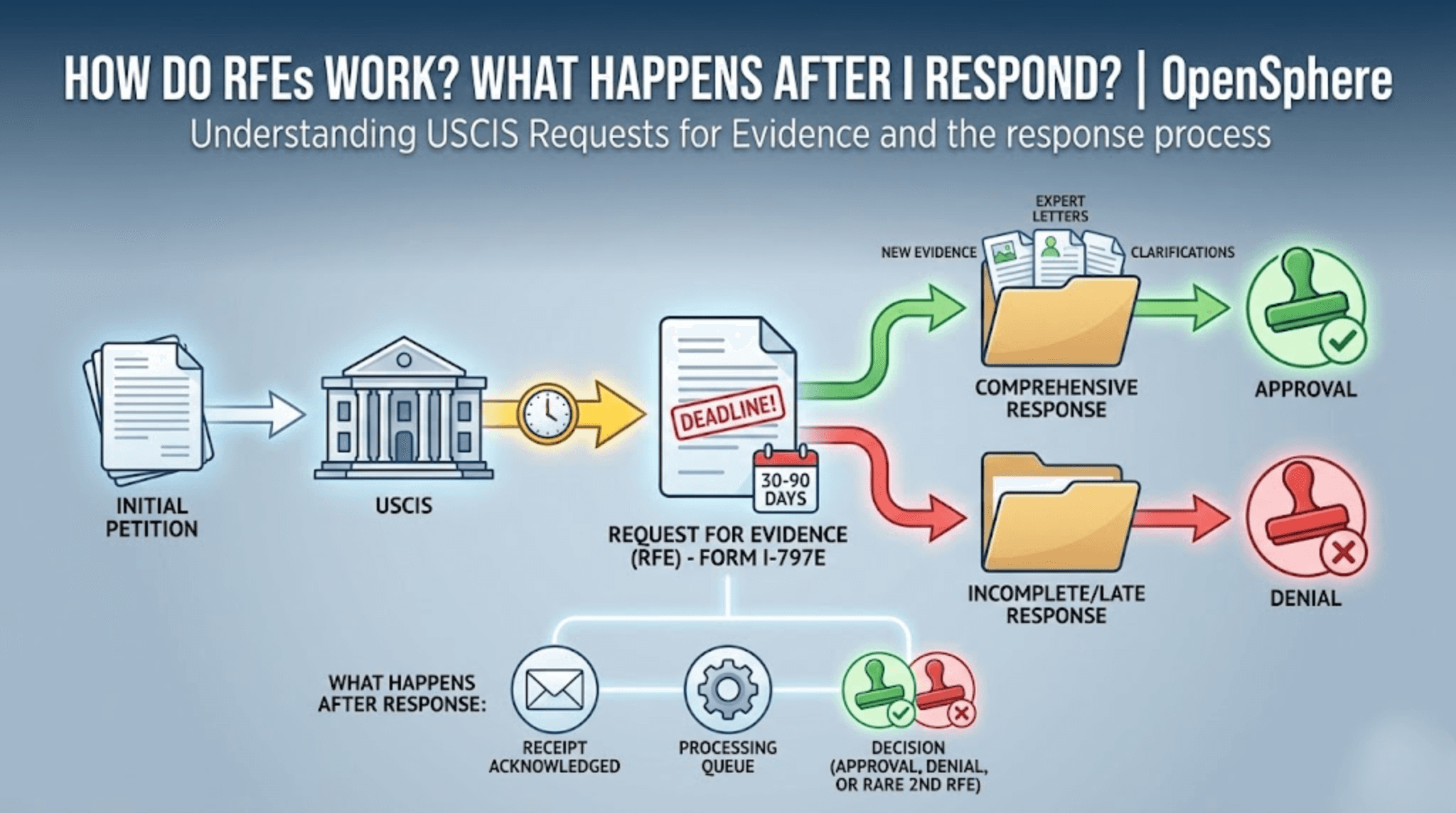
A Request for Evidence is USCIS's formal notice that your petition lacks sufficient evidence for approval. It is not a denial—it is an opportunity to supplement your case. After you respond, USCIS reviews your additional materials and issues either an approval, denial, or rarely, a second RFE. Response deadlines are strict, typically 30–90 days, with no extensions.
Key takeaways
• RFE is not denial: It means USCIS sees potential but needs more evidence to approve.
• Deadlines are absolute: Missing your response deadline results in denial. No extensions are granted.
• Respond comprehensively: Address every issue raised, even seemingly minor ones.
• New evidence helps: Adding documentation or letters strengthens your response more than re-arguing the same points.
• Consistency matters: Your response must align with your original petition. Contradictions create problems.
• Processing restarts: After your response, expect 60+ days for a decision unless you use premium processing.
What is a Request for Evidence?
When a USCIS officer reviews your petition and determines the evidence is insufficient to approve but potentially sufficient with additional documentation, they issue an RFE. This comes as Form I-797E, Notice of Action, sent to the address on file (typically your attorney's address if represented).
RFEs contain specific sections:
The facts: Basic case information—petition type, filing date, processing center.
The law: Citation of relevant regulations and legal requirements that apply to your case.
Evidence submitted: List of documents you provided. Review this carefully—sometimes evidence was received but not reviewed.
Evidence lacking: The critical section detailing what USCIS needs. This describes specific evidentiary gaps and may suggest alternative documentation.
Response deadline: The date by which USCIS must receive your response. This is non-negotiable.
Why you received an RFE
RFEs are issued when:
Missing initial evidence: Required documents were not included with your petition—degree certificates, translations, letters, or forms.
Insufficient documentation: Evidence was provided but did not adequately prove eligibility. For example, expert letters that were too vague or financial documents that were incomplete.
Unclear information: Something in your petition was confusing or inconsistent, requiring clarification.
Eligibility questions: USCIS is uncertain whether you meet specific criteria and wants additional proof.
RFEs are not issued randomly. Officers have specific guidance on when RFEs are appropriate, and each RFE represents identified deficiencies in your evidence.
How to respond effectively
Step 1: Read carefully
Understand exactly what USCIS is asking. RFEs can be dense with legal language, but the Evidence Lacking section specifies what you need. Highlight the specific requests.
Step 2: Address everything
Respond to every point raised, even if some seem minor or already addressed. Officers may have missed evidence, but your safest approach is to provide it again with clear organization.
Step 3: Provide new evidence
Simply re-arguing your original case rarely works. Add substantive new documentation:
Additional expert letters addressing the specific concerns raised
More detailed supporting documents
Clarifying statements with documentary backup
Evidence that was not included originally
Step 4: Maintain consistency
Your response cannot contradict your original petition. If your RFE response tells a different story, USCIS may question your credibility. Clarify and supplement, but do not contradict.
Step 5: Organize clearly
Use a cover letter addressing each RFE point in order. Label exhibits clearly. Make it easy for the officer to find what they requested.
Step 6: Submit before deadline
Allow mailing time. The deadline is when USCIS must receive your response, not when you send it. Submit at least 10–14 days early via tracked mail.
What happens after you respond
After receiving your response, USCIS:
Acknowledges receipt: Your case status should update to "Response received" within 1–2 weeks.
Returns to queue: Your case goes back into the processing queue for officer review.
Reviews complete file: The officer evaluates your original petition plus the new evidence.
Issues decision: USCIS issues one of three outcomes:
Approval: Your petition is approved and you receive an approval notice.
Denial: Your petition is denied. You receive a denial notice explaining the reasons, and in many cases, you can appeal.
Second RFE (rare): If additional issues emerge or your response was incomplete, USCIS may issue another RFE.
Processing time: Without premium processing, expect 60–90+ days after RFE response for a decision. With premium processing (where available), USCIS must take action within the premium timeframe after receiving your response.
If you cannot fully respond
Partial response: You can submit a partial response if you cannot obtain everything requested. This is treated as a request for decision on the record—essentially asking USCIS to decide with incomplete evidence. This rarely succeeds for substantive RFEs.
Extension request: USCIS does not grant extensions to RFE deadlines. If you cannot respond in time, your only option is a partial response or accepting denial and potentially refiling.
Unavailable evidence: If requested evidence genuinely does not exist (a document your country does not issue, for example), explain this in your response and provide alternative evidence that supports the same conclusion.
Preventing RFEs
The best strategy is avoiding RFEs through thorough initial applications:
Include all required documents in your original filing
Provide detailed, specific evidence rather than bare minimum
Ensure expert letters address all relevant criteria specifically
Review USCIS requirements for your visa category carefully
Consider legal review before filing
RFEs add months to processing times and create stress and uncertainty. Comprehensive initial petitions are worth the extra preparation.
OpenSphere helps you file strong
OpenSphere's evaluation identifies potential weaknesses in your profile before you file, helping you build stronger petitions that avoid RFE triggers.
Start your evaluation: https://evaluation.opensphere.ai/best-visa-for-you
Q: Does receiving an RFE mean I will be denied?
A: No. Many RFEs are resolved successfully. An RFE means USCIS needs more evidence to approve, not that they have decided to deny.
Q: How long do I have to respond?
A: Typically 30–90 days, as specified in your RFE notice. The deadline is when USCIS must receive your response.
Q: Can I get an extension?
A: No. USCIS does not extend RFE deadlines. Plan accordingly.
Q: Should I respond even if I think USCIS is wrong?
A: Yes. Address every point raised while respectfully clarifying any misunderstandings. Ignoring RFE points leads to denial.
Q: Can I add evidence that was not in my original petition?
A: Yes, and you should. RFEs invite additional evidence. Providing new documentation strengthens your response.
Q: What if I need to change something from my original petition?
A: Be very careful. Corrections are sometimes necessary, but contradictions damage credibility. Consult an attorney if you need to change material facts.
Q: How long after responding will I hear back?
A: Standard processing: 60–90+ days. Premium processing (where available): within the premium timeframe after USCIS receives your response.
Q: Can I use premium processing after receiving an RFE?
A: Yes, if your petition category qualifies for premium processing. You can upgrade after receiving an RFE.
Q: What happens if I miss the deadline?
A: USCIS will deny your petition based on the evidence they have. Missing deadlines is rarely survivable.
Q: Should I hire an attorney to respond to an RFE?
A: If the RFE identifies significant substantive weaknesses, professional help can be valuable. Simple documentation requests may be handleable independently.