How to prepare for the 30-second F-1 visa interview
Former consular officer insights on what really matters in your student visa interview
Former consular officer insights on what really matters in your student visa interview

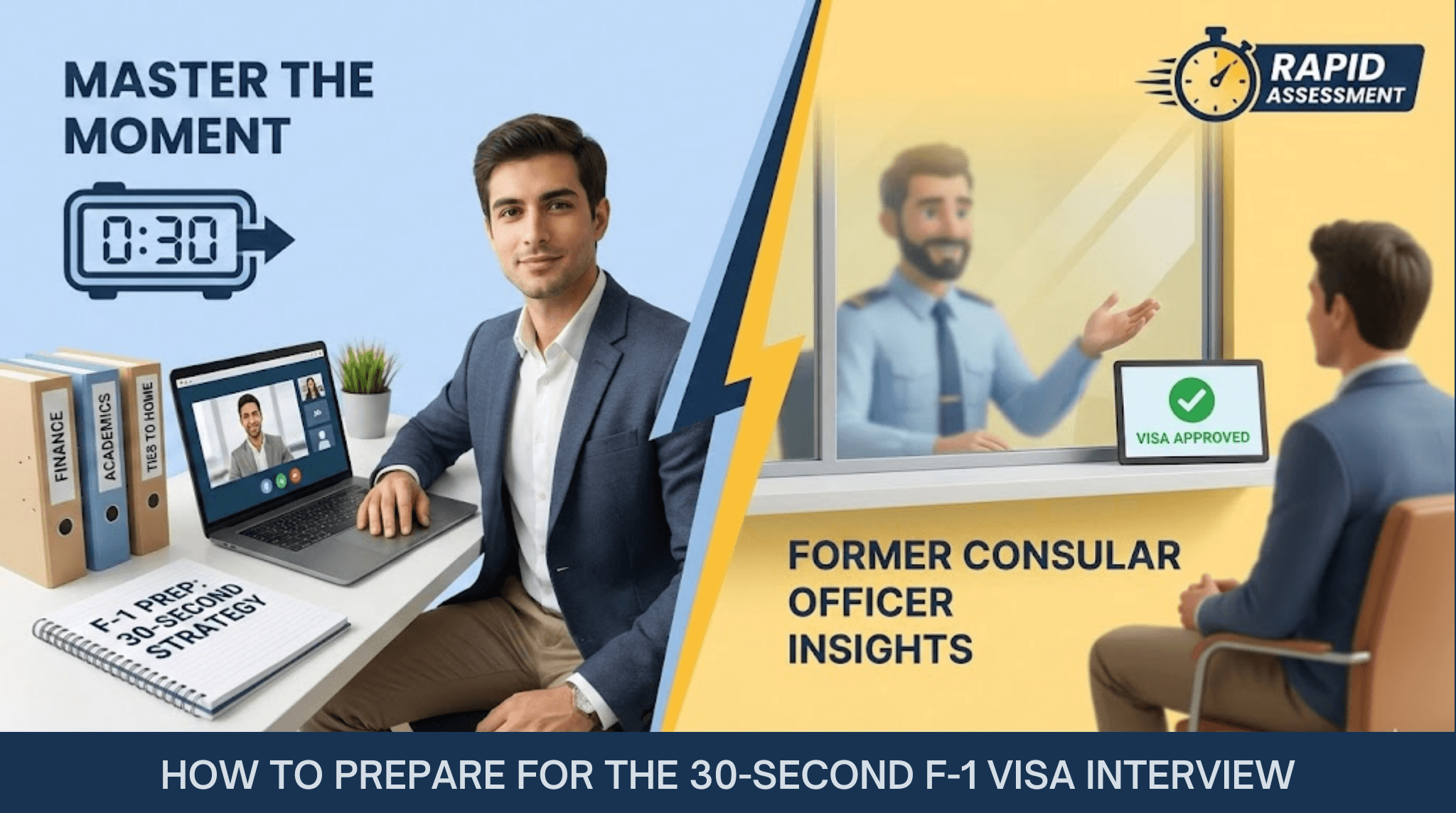
F-1 visa interviews are brief—often 30 seconds to three minutes—because consular officers are trained to make rapid eligibility assessments. Success requires demonstrating three things quickly and clearly: genuine intent to study, ability to pay for your education, and intent to return home after completing your studies. Preparation means having concise, authentic answers to predictable questions and organizing your documents for instant access.
• Brevity is expected: Most F-1 interviews last under three minutes. Officers are assessing credibility, not conducting extended conversations.
• The "why" questions matter most: Why this program, why this school, and why the United States are the questions officers use to gauge genuine student intent.
• Financial clarity is essential: You must clearly explain how you will fund your entire program, including sources and amounts.
• Ties to home country are critical: Officers need to believe you will return after studies. Evidence of connections to your home country helps.
• Documents support your story: Have everything organized and accessible, but remember the interview itself—not the paperwork—is what matters most.
• Authenticity beats rehearsal: Natural, confident answers are more convincing than memorized scripts.
The F-1 visa interview has one primary purpose: determining whether you are a legitimate student who will comply with visa terms. Officers evaluate four things:
Intent to study: Are you genuinely coming to pursue education, not to work illegally or immigrate? Officers assess this through your knowledge of your program and your educational motivation.
Academic qualification: Do you have the credentials and English ability to succeed in your program? Your acceptance letter demonstrates institutional confidence; the interview tests your ability to communicate.
Financial capacity: Can you pay for your education and living expenses for the entire duration? Vague or inconsistent answers about funding raise serious concerns.
Nonimmigrant intent: Will you return home after completing your studies? This does not mean you can never immigrate later—it means your current plan is to study and return.
"Why do you want to study in the United States?"
Do: Explain specific advantages of U.S. education for your goals. Mention program quality, research opportunities, or career relevance.
Do not: Give generic answers about "best education in the world" or express desire to stay and work in America.
Example:
"The United States has leading programs in computational biology. My university offers specialized research in protein engineering, which aligns directly with my career goal of working in biopharmaceutical development."
"Why this specific university?"
Do: Demonstrate that you researched multiple options and chose this school for specific reasons—faculty expertise, curriculum structure, research facilities, or academic reputation.
Do not: Admit you applied to only one school or give vague answers about "good reputation."
Example:
"I was accepted at three universities, but I chose Arizona State specifically because Professor Chen's lab works on the exact research area I want to pursue, and the program includes an industry internship component."
"How will you pay for your education?"
Do: Give a clear, specific answer identifying all funding sources with amounts. If family is paying, explain their income and savings briefly.
Do not: Be vague about amounts or sources, or appear uncertain about how education will be funded.
Example:
"My father will fund my education. He is a chartered accountant earning approximately $80,000 annually, and he has saved $120,000 specifically for my education. I have documents showing his bank statements and income."
"What will you do after completing your studies?"
Do: Describe concrete plans to return home and explain how your U.S. degree helps achieve those goals. Having job prospects or family business opportunities strengthens your answer.
Do not: Express uncertainty, mention hopes to stay in the United States, or discuss work visas or immigration.
Example:
"I plan to return to India and work in pharmaceutical research. My cousin runs a biotech startup in Hyderabad, and with my U.S. training in protein engineering, I can help develop their research division."
Required documents:
Valid passport
I-20 form issued by your school
SEVIS fee payment receipt
DS-160 confirmation page
Visa application fee receipt
Passport-size photos meeting specifications
Supporting documents:
Academic transcripts and diplomas
Standardized test scores (TOEFL, IELTS, GRE, SAT)
Financial documents proving ability to pay
Sponsor's employment and income verification
Bank statements showing sufficient funds
Proof of ties to home country (property, employment, family)
Organization tip: Use a folder with labeled sections. When officers ask for specific documents, you should be able to produce them in seconds, not minutes of searching.
Over-explaining: Keep answers to 30–45 seconds. Officers will ask follow-up questions if they want more detail.
Memorized scripts: Rehearsed answers sound robotic and raise suspicion. Understand your story; do not recite it.
Inconsistency with DS-160: Your verbal answers must match what you wrote on your application. Review your DS-160 before the interview.
Discussing work plans: Any mention of working in the United States (beyond OPT) or immigration plans undermines your nonimmigrant intent.
Bringing family to speak: Only the applicant is allowed in the interview area. Parents can accompany you to the embassy but cannot participate.
Nervousness about relatives in the U.S.: Having family in America is not disqualifying. If asked, be honest and explain the relationship. The officer already knows and is testing your honesty.
Denial is indicated by a white or yellow refusal slip. Common denial reasons include:
Section 214(b): You did not establish nonimmigrant intent
Insufficient financial documentation
Lack of ties to home country
Questions about academic qualifications
You can reapply, but you should address the reasons for denial. Simply reapplying with the same materials rarely succeeds. Determine what was weak about your case and gather stronger evidence before your next attempt.
While OpenSphere focuses primarily on work visas and green cards, understanding visa pathways—including student visas—is part of comprehensive immigration planning.
Explore your visa options: https://evaluation.opensphere.ai/best-visa-for-you
Q: Why are F-1 interviews so short?
A: Consular officers interview hundreds of applicants daily and are trained to assess eligibility efficiently. They can often determine credibility within the first few questions.
Q: What if the officer only asks me two questions?
A: Brief interviews are often approvals. If the officer is satisfied quickly, they may approve without extended questioning.
Q: Should I bring documents in English or my native language?
A: Bring original documents with certified English translations if originals are in another language.
Q: Can I appeal an F-1 denial?
A: There is no formal appeal process. You can reapply, but should address whatever weakness caused the denial.
Q: Does having relatives in the United States hurt my chances?
A: Not automatically. Be honest about family members, explain their status, and demonstrate that your educational plan is genuine and that you intend to return home.
Q: What if I am nervous and struggle to communicate clearly?
A: Take a breath before answering. Speaking slowly and clearly is better than rushing. Officers understand applicants may be nervous.
Q: Should I wear formal attire?
A: Business casual is recommended. You are requesting permission to enter another country—present yourself professionally, but do not overdress.
Q: How early should I arrive?
A: Arrive 30–45 minutes before your appointment time to allow for security checks and document processing.
Q: What happens if I am approved on the spot?
A: You will keep your passport for visa stamping and receive a colored slip indicating approval. The visa stamp is typically ready for pickup within a few days.
Q: Can I bring notes to the interview?
A: Do not read from notes during the interview. You can review notes beforehand, but referring to papers during questioning appears rehearsed and unprepared.