Quick answer
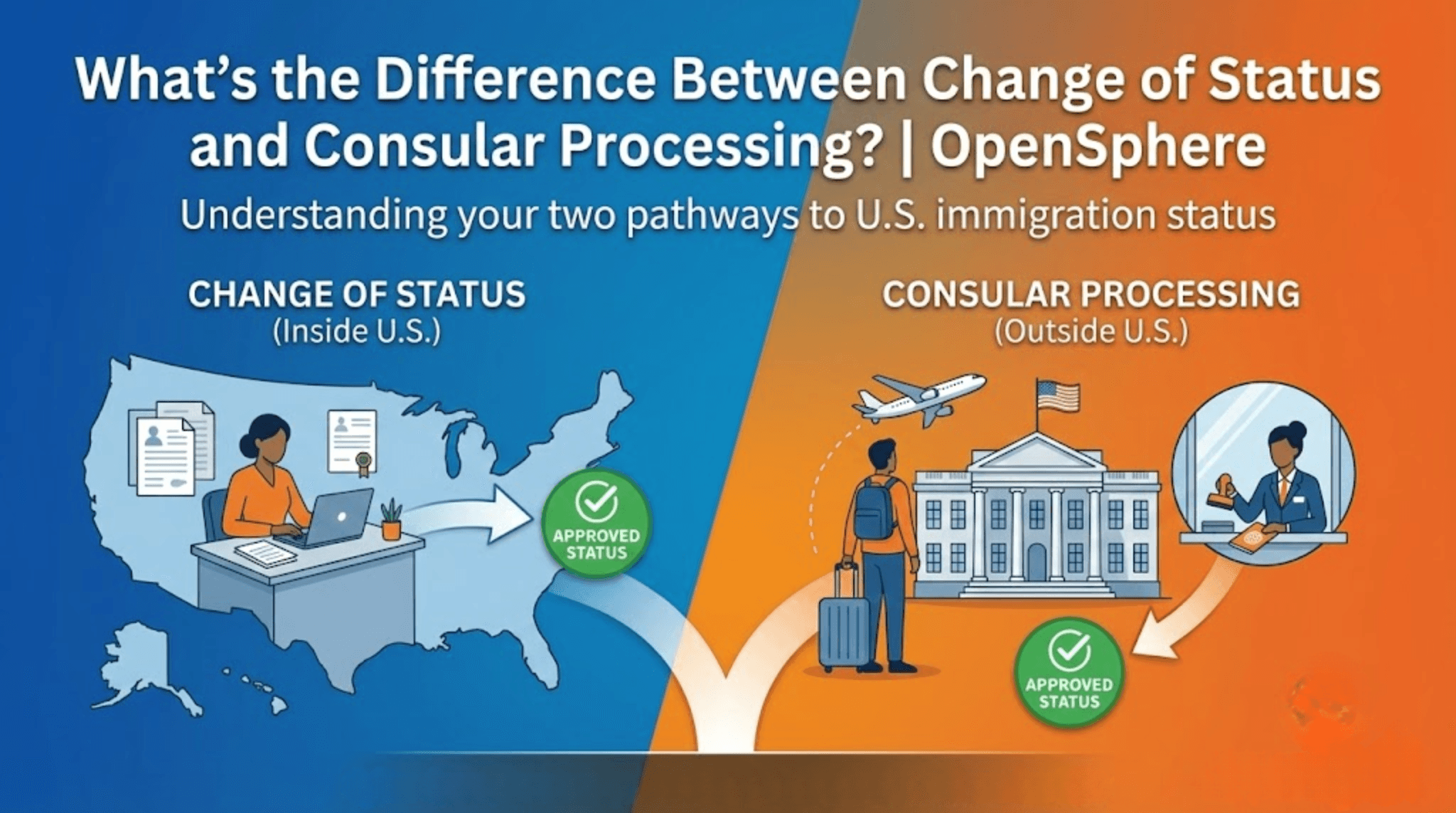
Change of status allows you to switch from one visa category to another while remaining in the United States—no travel or consular interview required. Consular processing requires you to apply for a visa at a U.S. embassy or consulate abroad, involving an in-person interview. The same underlying petition can be processed either way, but each method has distinct advantages, risks, and requirements.
Key takeaways
• Location is the key difference: Change of status happens inside the U.S.; consular processing happens outside.
• Both lead to the same outcome: Whether work visa or green card, both processes result in the same legal status if approved.
• No interview for change of status: USCIS adjudicates without in-person interview, unlike consular officers.
• Consular processing may be faster for green cards: Embassy interviews can sometimes be scheduled faster than USCIS processing.
• Travel restrictions differ: Pending change of status may be abandoned if you travel abroad. Consular processing requires travel.
• Risk profiles vary: Consular denials are generally non-appealable; USCIS denials can often be appealed.
Change of status explained
Change of status (COS) is the process of converting from one nonimmigrant status to another, or from nonimmigrant to immigrant status (adjustment of status), while physically present in the United States.
How it works:
You or your employer files the appropriate petition with USCIS (e.g., I-129 for work visas, I-485 for green cards)
Your petition indicates you are requesting change of status
USCIS adjudicates based on submitted documentation—no interview for most cases
If approved, your status automatically changes on the effective date
Eligibility requirements:
You must be physically present in the United States
You must be in valid legal status when filing (with limited exceptions)
You must have been admitted lawfully (inspected and admitted at a port of entry)
You must not be ineligible due to visa violations or other inadmissibility grounds
Key advantages:
No travel required
No consular interview
Maintain continuity of U.S. residence
Work authorization may continue or be obtained while pending (for green card cases)
Generally appealable if denied
Key disadvantages:
Cannot travel abroad while pending (or change of status may be abandoned)
USCIS processing backlogs can be lengthy
No visa stamp—you will need to obtain one if traveling internationally later
Some applicants are ineligible (e.g., VWP/ESTA entrants generally cannot change status)
Consular processing explained
Consular processing means applying for a visa at a U.S. embassy or consulate abroad, requiring in-person interview and issuance of a visa stamp in your passport.
How it works:
Underlying petition is filed with USCIS (I-129 for work visas, I-130 or I-140 for immigrant visas)
Petition indicates consular processing
After USCIS approval, case transfers to National Visa Center (for immigrant visas) or embassy directly
You attend interview at the designated embassy or consulate
If approved, you receive a visa stamp and enter the U.S. in the new status
Eligibility:
You can be inside or outside the United States
Apply at your designated consular post (typically country of residence or nationality)
Must attend in-person interview
Key advantages:
May be faster than USCIS processing at some posts
Results in a visa stamp for future travel
Required if you are already outside the U.S. or ineligible for COS
Avoids USCIS backlogs in some cases
Key disadvantages:
Requires international travel and interview appointment
Consular denials are generally non-appealable
Administrative processing can cause unpredictable delays
Separation from family or work in the U.S. during processing
Interview availability varies by post and can be limited
When to choose change of status
COS is typically preferred when:
You are already in the United States in valid status
You want to avoid travel, particularly if visa interviews in your country are difficult to schedule
You need continuity of U.S. presence for work or family reasons
You prefer the ability to appeal if denied
COS is required when:
You cannot leave the United States for personal, professional, or safety reasons
Your prior immigration history makes consular processing risky
COS is not available when:
You entered on the Visa Waiver Program (ESTA) for most status changes
You have violated status or are otherwise inadmissible
You are outside the United States
When to choose consular processing
Consular processing is typically preferred when:
You are outside the United States
Embassy processing is faster than USCIS for your situation
You want a visa stamp immediately for future travel
You do not want to remain in the U.S. during processing
Consular processing is required when:
You are physically outside the United States
You are ineligible for adjustment of status or change of status (e.g., certain visa violations)
Your employer or immigration petition requires it
Switching between the two
Changing from consular to COS:
If you initially selected consular processing on your petition but are now in the U.S. and eligible, you can file for adjustment of status (Form I-485) anyway. USCIS will recall the case from the National Visa Center.
Changing from COS to consular:
If you selected change of status but decide to process at a consulate, you must notify USCIS and file Form I-824 to transfer your case to the appropriate consular post. This adds processing time and cost.
Caution: Switching methods adds complexity and potential delays. Choose carefully at the outset.
Special considerations
VWP/ESTA entrants: Generally cannot change status or adjust status in the United States (with very limited exceptions). Consular processing is typically required.
Pending applications and travel: If you have a pending change of status and depart the United States, you generally abandon your COS request and must process at a consulate.
E-2S work authorization: Since January 2022, spouses of E-2 investors receive an E-2S designation on their I-94, which grants work authorization incident to status. They no longer need to apply for a separate EAD—a beneficial policy change that eliminated months-long waits for work permits.
Administrative processing: Some consular posts flag cases for additional review, which can add weeks or months of delay. There is limited visibility into this process.
OpenSphere's pathway guidance
Choosing between change of status and consular processing depends on your specific situation, status, and goals. OpenSphere helps you understand which approach fits your circumstances.
Evaluate your options: https://evaluation.opensphere.ai/best-visa-for-you
Q: Can I work while my change of status is pending?
A: It depends on your current status and what you are changing to. For green card applicants, you can apply for an Employment Authorization Document (EAD). For most nonimmigrant changes, you generally cannot work until approved.
Q: What if the consulate denies my visa?
A: Consular decisions are generally final and non-appealable. You can reapply, but overcoming a denial often requires addressing the specific grounds cited.
Q: Can I travel internationally with a pending change of status?
A: Generally no. Traveling usually abandons your pending COS request unless you have advance parole (for adjustment of status cases).
Q: Which is faster?
A: It varies. Check current USCIS processing times versus embassy wait times for your specific situation. Sometimes consular processing is faster; sometimes COS is faster.
Q: Do both require a medical exam?
A: Yes, for green card applications. COS uses a civil surgeon in the U.S. (Form I-693); consular processing uses panel physicians abroad.
Q: What if I need to leave the U.S. urgently during COS processing?
A: For adjustment of status, you may be able to obtain advance parole. For other changes of status, departure typically abandons your application.
Q: Can I apply for both simultaneously?
A: No. You must choose one method. Attempting both can result in both applications being denied.
Q: What about dual intent?
A: Some visas like H-1B and L-1 allow dual intent, meaning you can pursue a green card without violating your nonimmigrant status. Others like F-1 technically do not, though this is a nuanced area.
Q: How does "administrative processing" affect consular processing?
A: If your case is flagged for additional review, you may wait weeks or months with limited updates. This is more common for certain nationalities or sensitive industries.
Q: What happens if my status expires while COS is pending?
A: If you filed timely and remain in the U.S., you are generally in a "period of authorized stay" while your application is pending, though work authorization depends on your specific situation.