How to calculate and analyze priority date
Understanding when you can file your green card application
Understanding when you can file your green card application

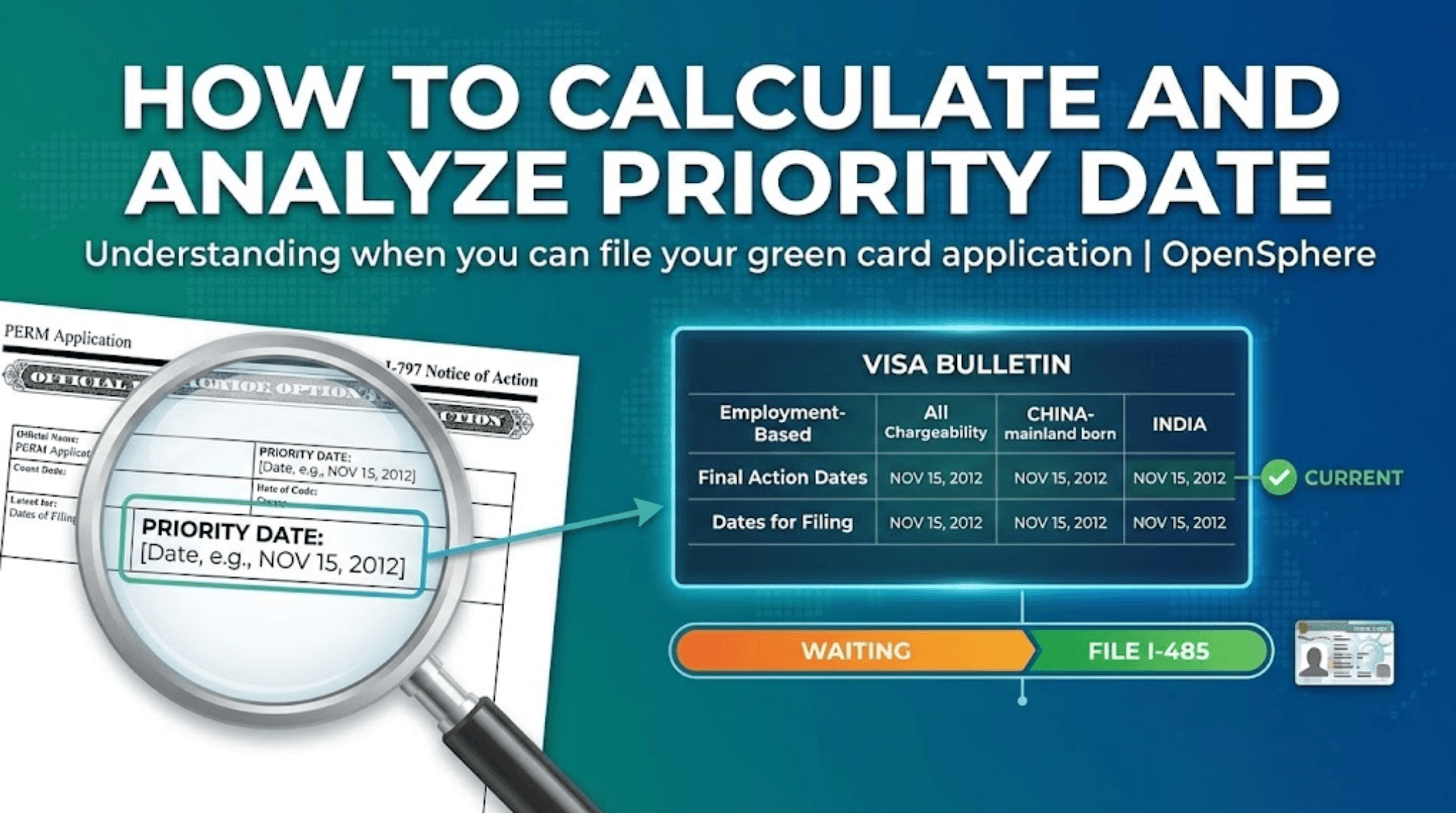
Your priority date is the date that establishes your place in the green card queue. For employment-based cases, it is typically either the date your PERM labor certification application was filed or the date your I-140 petition was filed (if no PERM was required). You can file for your green card (I-485 adjustment of status or immigrant visa) when your priority date is earlier than the "Final Action Date" published in the monthly Visa Bulletin for your category and country of birth.
• Priority date determines queue position: Earlier dates move through the line first.
• Source varies by category: PERM filing date for most EB-2/EB-3; I-140 filing date for EB-1 and NIW.
• Country of birth matters: India and China face longer waits due to per-country limits.
• Visa Bulletin is updated monthly: Check the Department of State publication to see current cutoff dates.
• Two charts exist: "Final Action Dates" determines when you can complete your green card; "Dates for Filing" determines when you can submit applications.
• Priority dates can be retained or ported: Under certain circumstances, you can keep your date even if changing employers or categories.
The U.S. green card system has more demand than available visas in many categories. The priority date system creates an ordered queue so applicants are processed in sequence.
Your priority date essentially marks when you "got in line." When your priority date becomes "current" (earlier than the published cutoff date), you can take the final step toward permanent residence.
For employment-based categories:
EB-1 (Extraordinary Ability, Outstanding Researchers, Multinational Managers): Priority date is the I-140 filing date (no PERM required).
EB-2 NIW (National Interest Waiver): Priority date is the I-140 filing date (no PERM required).
EB-2 (Advanced Degree/Exceptional Ability with PERM): Priority date is the PERM application filing date.
EB-3 (Skilled Workers/Professionals with PERM): Priority date is the PERM application filing date.
For family-based categories:
Priority date is typically the I-130 filing date.
Your priority date appears on:
Form I-797, Notice of Action: When your I-140 or I-130 is approved, the notice includes your priority date.
PERM application: If your case required labor certification, the priority date is the date DOL accepted your PERM application.
USCIS case status: Online status updates may reference your priority date.
If you are unsure of your priority date, contact your employer's immigration counsel or USCIS directly.
The Department of State publishes the Visa Bulletin monthly, showing cutoff dates for each preference category and country of chargeability (typically country of birth).
Two charts:
Final Action Dates: Shows when USCIS can make a final decision (approve) your green card case. Your priority date must be earlier than this date to receive your green card.
Dates for Filing: Shows when you can submit your adjustment of status application (I-485), even if a visa is not immediately available. This allows you to get in line and obtain work/travel authorization while waiting.
How to read the bulletin:
Find your preference category (EB-1, EB-2, EB-3, etc.).
Find your country of chargeability (usually country of birth).
Compare the published date to your priority date.
If your priority date is earlier than the published date (or the category shows "C" for current), you can take action.
Example:
If the Visa Bulletin shows EB-2 India Final Action Date as December 1, 2012, and your priority date is November 15, 2012, it is current. If your priority date is December 5, 2012, it is not yet current.
The country that determines your queue is typically your country of birth, not citizenship. Per-country limits cap how many green cards can go to nationals of any single country each year (7% of the worldwide limit).
Countries with high demand—particularly India and China—have significant backlogs. Applicants from these countries may wait years longer than applicants from lower-demand countries with identical priority dates and categories.
Cross-chargeability: In some cases, you may be able to use your spouse's country of birth if their country has shorter waits. This applies only if you are immigrating together.
Your priority date is not necessarily lost if circumstances change:
Approved I-140 retention: If your I-140 was approved, you generally retain that priority date even if:
You change employers (after 180 days of I-485 pending)
Your original employer withdraws the petition
You change to a different preference category
Category downgrade: You can use an EB-2 priority date for an EB-3 application (downgrading) if EB-3 dates are more favorable—though this is counterintuitive, it sometimes makes sense due to varying backlog movement.
Multiple petitions: If you have multiple approved I-140s with different priority dates, you can use the earliest one for any qualifying petition.
The Visa Bulletin cutoff dates move based on:
Visa supply: The annual limit of employment-based visas (approximately 140,000) and the 7% per-country cap create the baseline supply.
Demand: How many applicants in each category are documentarily qualified and ready to complete their cases affects how quickly dates advance.
Spillover: Unused visas from one category may "spill over" to others, accelerating movement in receiving categories.
Fiscal year changes: Each October (new fiscal year), new visa numbers become available, often causing date movement.
Policy changes: Legislation increasing visa numbers or changing per-country limits would significantly impact wait times (though such changes are rare).
Strategies for monitoring:
Check the Visa Bulletin monthly (published mid-month for the following month).
USCIS publishes guidance on which chart to use for filing I-485.
Track historical movement patterns for your category and country.
Join online communities that analyze and predict Visa Bulletin trends.
Understanding when you can file for permanent residence depends on your priority date, category, and country. OpenSphere's evaluation considers these factors in your overall immigration strategy.
Start your evaluation: https://evaluation.opensphere.ai/best-visa-for-you
Q: Can I speed up my priority date?
A: No. The priority date is fixed when your petition is filed. You can only change categories (potentially to one with faster movement) or pursue categories that do not require waiting (like EB-1A which is often current).
Q: What does "C" mean in the Visa Bulletin?
A: "C" means current—any priority date in that category and country can proceed immediately.
Q: What is "retrogression"?
A: Retrogression occurs when cutoff dates move backward (to an earlier date), meaning fewer applicants can proceed. This happens when demand exceeds supply in a given period.
Q: Can my employer change affect my priority date?
A: If your I-140 was approved and you have had I-485 pending for 180+ days, you can port to a new employer and retain your priority date under AC21.
Q: Does my birth country ever change?
A: Your country of birth is fixed, but you may be able to cross-charge to your spouse's country if immigrating together.
Q: How accurate are priority date predictions?
A: Predictions are educated guesses based on historical patterns. USCIS and DOS do not guarantee future movement, and unexpected changes occur regularly.
Q: What if my category becomes unavailable?
A: If dates retrogress past your priority date, you cannot complete your green card until dates advance again. Your pending I-485 remains pending.
Q: Can I file I-485 based on Dates for Filing even if Final Action is not current?
A: Only if USCIS announces they are accepting filings based on that chart. USCIS announces monthly which chart applies.
Q: What happens to my priority date if my I-140 is denied?
A: If denied, that priority date is no longer valid. If you file a new petition, you get a new priority date.
Q: Does EB-1 have wait times?
A: EB-1 is often current for most countries, but India and China have experienced backlogs in EB-1 in recent years.