What are the most common NIW RFE reasons?
Understanding why USCIS requests additional evidence and how to avoid these mistakes
Understanding why USCIS requests additional evidence and how to avoid these mistakes

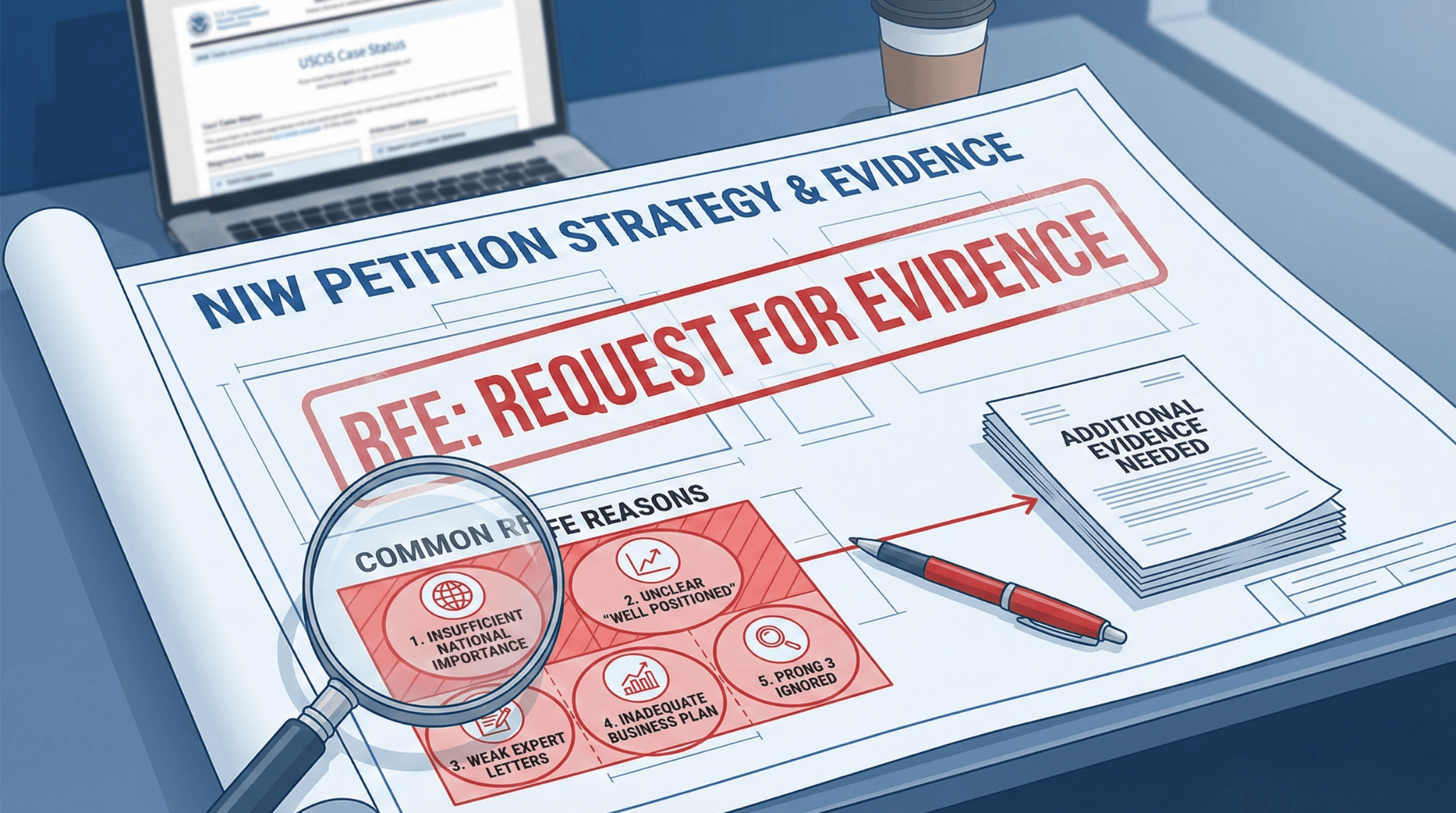
The most common Requests for Evidence in NIW cases relate to insufficient proof of national importance, unclear evidence of being "well positioned," vague or generic expert letters, weak business plans, and failure to explain why waiving labor certification benefits the United States. RFEs typically indicate that your petition met minimum requirements but lacked persuasive evidence on one or more Dhanasar prongs.
• RFE is not denial: A Request for Evidence is an opportunity to strengthen your case, not a rejection.
• Prong one problems are most common: Failing to establish national importance—not just industry importance—triggers many RFEs.
• Vague letters fail: Generic expert letters that do not specifically address why you are well positioned generate RFEs.
• Business plans matter: Entrepreneurs often receive RFEs for plans lacking specific projections, evidence of market demand, or explanation of funding sources.
• Prong three is overlooked: Many petitioners focus on qualifications and forget to explain why waiving PERM serves national interests.
• Response deadlines are strict: You typically have 30–90 days to respond, with no extensions.
The most frequent NIW RFE asks petitioners to better demonstrate that their endeavor has "national importance" rather than just general value.
Common problems:
Claiming your industry is important without explaining why your specific work matters
Asserting economic impact without supporting projections or evidence
Confusing personal career benefits with national benefits
Failing to connect localized work to broader national concerns
Fixing this issue requires specific evidence that your particular endeavor—not just your field generally—addresses issues of national concern. If you are developing medical technology, explain what problem it solves and how many people are affected. If you are creating jobs, provide specific projections with supporting assumptions.
Generic statements like "AI is transforming industries" do not establish that your AI work has national importance.
Prong two requires showing you are specifically well positioned to advance your proposed endeavor. RFEs often ask for more evidence of:
Record of success in similar efforts (with documentation, not just claims)
Progress already made toward the endeavor
Specific plans or models for future activities
Evidence of interest from relevant parties (investors, customers, partners)
Connection between your qualifications and the specific endeavor
Common problems:
Describing qualifications without connecting them to the proposed work
Lacking evidence of past success in similar efforts
Having vague future plans without specific milestones
Missing third-party validation of your positioning
Strong responses include: documentation of past achievements in the same field, evidence of funding or partnerships secured, letters from relevant parties expressing interest in your work, and detailed plans with realistic milestones.
USCIS consistently issues RFEs when expert letters fail to provide substantive analysis. Problems include:
Letters that describe general qualifications without addressing the Dhanasar factors
Letters from collaborators only, with no independent expert perspectives
Letters that sound formulaic or appear template-based
Letters lacking specific examples of achievements and impact
Letters that do not explain the author's qualifications to opine
Effective letters should: be written by recognized experts in the field, specifically address each Dhanasar prong, provide concrete examples of your achievements and their significance, explain the author's basis for their conclusions, and ideally come from people who know your reputation rather than just personal acquaintance.
Entrepreneurs frequently receive RFEs asking for more detailed business documentation:
Projections without supporting assumptions or market research
No evidence of financial backing or realistic funding paths
Staffing plans without basis for hiring projections
Revenue claims without market analysis supporting them
Overemphasis on past achievements without clear future plans
USCIS is not evaluating your business for investment purposes, but they want to see that your proposed endeavor is credible and that you have thought through implementation. Provide specific, realistic projections with supporting evidence and assumptions.
The third Dhanasar prong—explaining why waiving labor certification benefits the United States—is often overlooked or addressed superficially.
Common problems:
Ignoring the prong entirely and hoping it passes
Generic claims that your work is important without explaining the waiver benefit
Failing to explain why requiring PERM would be impractical or harmful
Not addressing the balance between labor market protections and national benefit
Strong responses explain: why it would be impractical for you to obtain a job offer or PERM (especially for entrepreneurs), why your work is time-sensitive and would be delayed, why the United States benefits more from your contributions than from protecting the labor market in your particular case, and any unique aspects of your situation that make the normal process ill-suited.
When you receive an RFE:
Read carefully: Identify exactly what USCIS is asking for. RFEs are specific about evidentiary gaps.
Respond comprehensively: Address every issue raised, even if some seem minor.
Provide new evidence: RFE responses that simply re-argue the original case rarely succeed. Add documentation, new letters, or more detailed analysis.
Stay consistent: Do not contradict your original petition. Clarify and supplement, but maintain consistency.
Organize clearly: Use a cover letter addressing each RFE point in order. Label exhibits clearly. Make it easy for the officer to find what they requested.
Meet the deadline: Standard response periods are 30–90 days with no extensions. Submit well before the deadline.
Consider professional help: If the RFE identifies fundamental weaknesses, an immigration attorney's guidance may be valuable.
The best RFE strategy is prevention. OpenSphere evaluates your profile against USCIS standards and identifies potential gaps before you file.
Start your evaluation: https://evaluation.opensphere.ai/best-visa-for-you
Q: Does receiving an RFE mean I will be denied?
A: No. RFEs indicate USCIS needs more information to approve, not that they have decided to deny. Thoughtful responses often lead to approval.
Q: How long do I have to respond?
A: Typically 30–90 days, as specified in your RFE notice. There are no extensions, and USCIS will deny your petition if you miss the deadline.
Q: Can I submit a partial response?
A: You can, but it is treated as a request for decision on the existing record—essentially asking USCIS to decide with incomplete evidence. This is rarely advisable.
Q: What if my RFE asks for information that does not exist?
A: Address this directly. Explain what documentation is unavailable and why, and provide alternative evidence that supports the same conclusion.
Q: Should I hire an attorney for RFE response?
A: If the RFE identifies significant weaknesses, professional help can be valuable. If the request is for straightforward missing documentation, you may be able to handle it independently.
Q: Can premium processing help with RFEs?
A: Premium processing does not prevent RFEs, but it ensures USCIS responds to your RFE response within the premium processing timeframe (15–45 days depending on category).
Q: Will responding to an RFE delay my case significantly?
A: Yes. After you submit your response, USCIS processing restarts. Without premium processing, expect 60+ days additional processing time.
Q: What happens after I respond?
A: USCIS reviews your response and issues either an approval, denial, or in rare cases, a second RFE. Most RFE responses result in final decisions.
Q: Can new evidence be submitted that was not in the original petition?
A: Yes, and you should. RFE responses that provide new, substantive evidence are more likely to succeed than those that simply re-argue original points.
Q: What if I disagree with the RFE's characterization of my case?
A: You can respectfully explain why USCIS may have misunderstood aspects of your case, but do so while also providing the evidence requested. Purely argumentative responses rarely succeed.