Quick answer
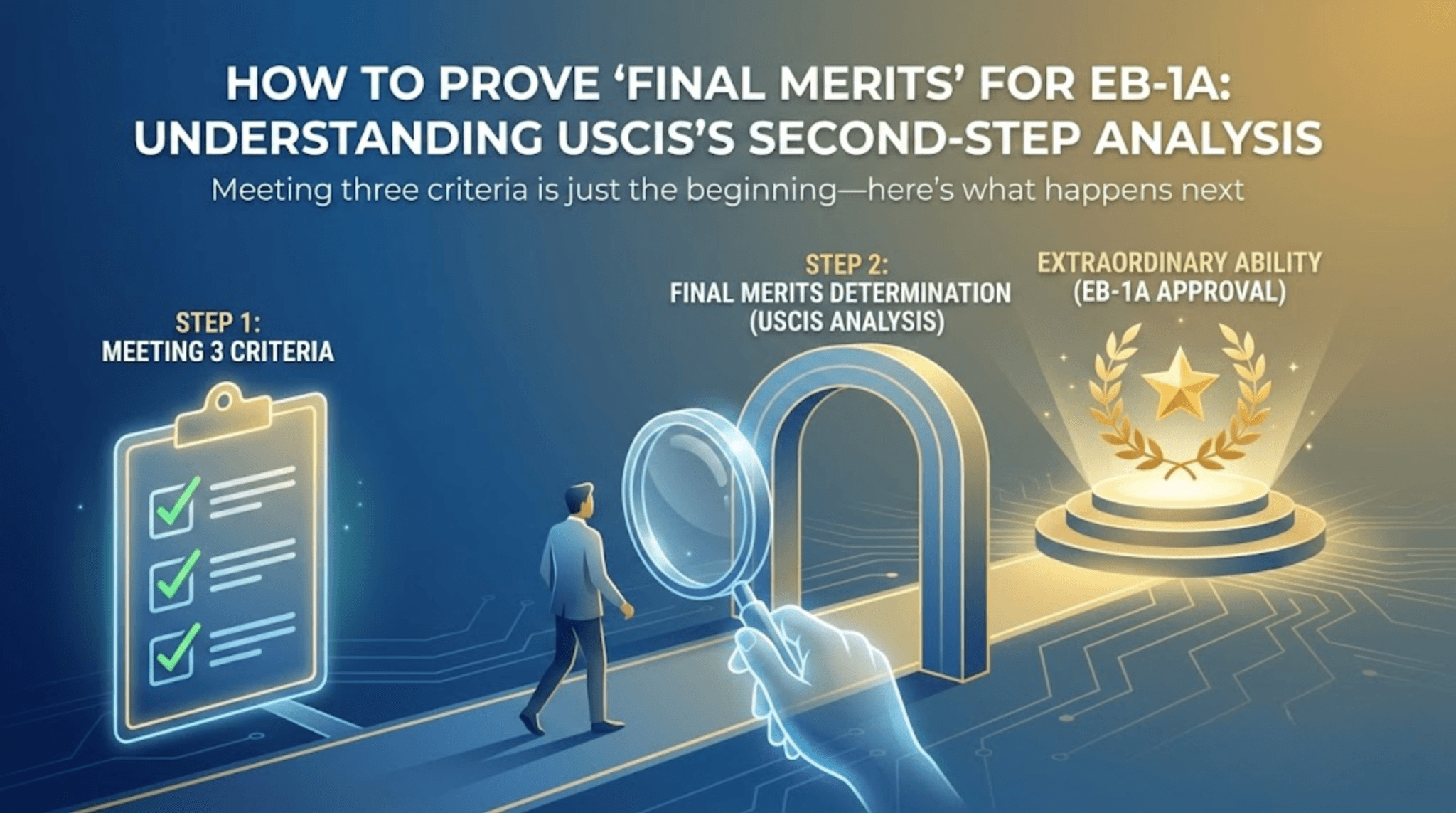
The "final merits determination" is USCIS's second step in evaluating EB-1A petitions. After determining whether you meet at least three of the ten regulatory criteria, USCIS evaluates whether the totality of your evidence demonstrates you are truly among the small percentage at the very top of your field with sustained national or international acclaim. Meeting three criteria is necessary but not sufficient for approval.
Key takeaways
• Two-step analysis is standard: Since the 2010 Kazarian decision, USCIS uses a two-part approach—criteria counting first, then holistic evaluation.
• Three criteria does not guarantee approval: You can meet the plain language of three criteria and still be denied if your overall record lacks sufficient distinction.
• Quality matters enormously: In the final merits phase, USCIS evaluates whether your evidence reflects genuine top-tier standing, not just technical compliance.
• Sustained means ongoing: One-time achievements from years ago without continued recognition may be questioned.
• Context is essential: You must explain why your achievements matter relative to others in your field.
• Strong narratives win: The best petitions tell a coherent story connecting all evidence to extraordinary ability.
What is the Kazarian framework?
In Kazarian v. USCIS (2010), the Ninth Circuit Court of Appeals established the two-step process that USCIS now uses for EB-1A adjudication.
Step one: The officer determines whether you have submitted evidence satisfying the plain language requirements of at least three of the ten regulatory criteria (or evidence of a major internationally recognized award like a Nobel Prize).
Step two (final merits determination): The officer evaluates whether the totality of evidence demonstrates that you have "sustained national or international acclaim" and are "one of the small percentage who have risen to the very top of the field of endeavor."
The critical insight from Kazarian is that meeting criteria in step one does not automatically mean you pass step two. USCIS must make a qualitative assessment of whether your evidence truly establishes extraordinary ability.
Why petitioners fail at final merits
The most common failures at the final merits stage share common patterns:
Evidence lacking context: You present publications, citations, or awards without explaining their significance relative to field norms. USCIS officers are immigration specialists, not experts in your technical field. Without context, they cannot assess whether your achievements are exceptional or ordinary.
One-time or outdated achievements: A major award from eight years ago without evidence of continued recognition raises questions about "sustained" acclaim. USCIS evaluates whether you maintain a comparable level of standing, not just whether you once achieved it.
Weak or generic expert letters: Letters that describe you as accomplished without articulating specifically why you stand above peers fail to support final merits claims. Letters must provide detailed analysis of your impact and standing.
Lack of independent recognition: If your evidence consists primarily of self-reported achievements or recognition only from direct collaborators, USCIS may question whether your acclaim extends beyond your immediate circle.
Narrow geographic or institutional scope: If your recognition is limited to one institution, one region, or one organization, it may not demonstrate the national or international scope expected.
How to build a strong final merits case
Provide comparative context: For every piece of evidence, explain what it means. If your citation count is high, provide benchmarks showing how it compares to average researchers. If you received an award, document how many people competed for it and what selection criteria applied.
Show sustained achievement: Present a timeline demonstrating ongoing recognition, not just a single peak moment. If your major contribution was several years ago, show that you continue to be recognized for it through ongoing citations, invitations, or media coverage.
Obtain letters from independent experts: USCIS places particular weight on letters from people who know you by reputation rather than through direct collaboration. These individuals can credibly attest that you are recognized beyond your immediate professional circle.
Connect the dots explicitly: Do not assume USCIS officers will make connections between different pieces of evidence. Your petition letter should explicitly explain how each piece of evidence demonstrates extraordinary ability and how they combine to paint a complete picture.
Address potential weaknesses: If any element of your record could raise questions, address it proactively. If your citations are concentrated in your own work, explain why. If an award is not well-known, document its prestige.
What USCIS evaluates in step two
According to USCIS policy guidance, the final merits determination considers factors including:
Whether awards are genuinely nationally or internationally recognized versus local or institutional
Whether judging responsibilities were for significant work versus internal matters
Whether scholarly articles are cited by others versus generating no response
Whether the petitioner's contributions had demonstrable impact versus remaining theoretical
Whether high salary reflects exceptional ability versus geographic or employer-specific factors
Whether membership organizations genuinely require outstanding achievements versus accepting anyone who applies
The through-line is genuine versus nominal. USCIS asks whether your evidence reflects actual top-tier standing or merely technical compliance with criteria language.
OpenSphere's evidence-first approach
Building a petition that withstands final merits scrutiny requires understanding both what evidence you need and how to present it effectively. OpenSphere's evaluation identifies gaps in your evidence and helps you build the strongest possible narrative.
Start your evaluation: https://evaluation.opensphere.ai/best-visa-for-you
Q: Can USCIS deny me if I clearly meet three criteria?
A: Yes. Meeting three criteria qualifies you for step two review, but the final merits determination evaluates whether your overall record demonstrates extraordinary ability. Petitioners who meet criteria technically but lack sufficient distinction can be denied.
Q: How do I prove "sustained" acclaim if I am early in my career?
A: USCIS explicitly states there is no age requirement or minimum career length. You can demonstrate sustained acclaim by showing continued recognition from the time your work first gained attention through the present, even if that period is relatively short.
Q: What if my field is small or obscure?
A: USCIS evaluates you relative to your specific field. A small field means the pool of top performers is also small. Provide evidence explaining the scope of your field and your standing within it.
Q: Are four or five criteria better than three?
A: Meeting more criteria can strengthen final merits analysis, but quality matters more than quantity. Three rock-solid criteria with excellent evidence beats five weak ones.
Q: How much do expert letters influence final merits?
A: Significantly. Expert letters provide the contextual analysis that helps USCIS understand why your achievements matter. Weak letters are a common reason for denial.
Q: Can comparable evidence help in final merits?
A: Yes. If standard criteria do not fit your field, comparable evidence allows you to present alternative proof. The same quality standards apply—comparable evidence must demonstrate top-tier standing.
Q: What is the "preponderance of evidence" standard?
A: USCIS uses a "more likely than not" standard. Your evidence need not prove extraordinary ability beyond all doubt, but it must make extraordinary ability more probable than not.
Q: How long should my petition letter be?
A: Length varies, but effectiveness matters more than page count. Cover every criterion you claim and provide the contextual analysis needed for final merits. Well-organized, clearly argued petitions of 15–30 pages are common.
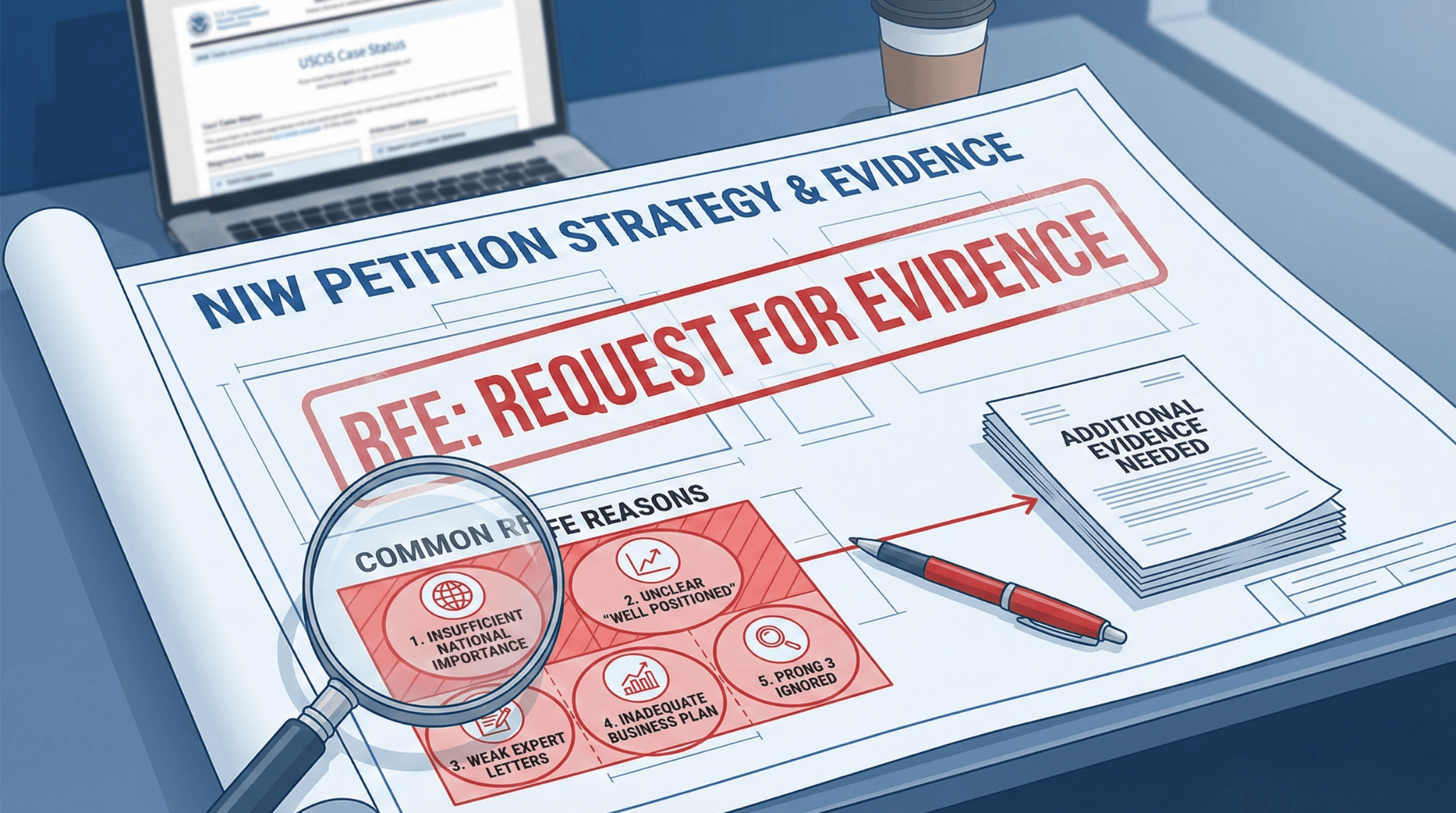
Q: If I get an RFE, does that mean I failed final merits?
A: Not necessarily. RFEs often request additional evidence to support the analysis. A thoughtful RFE response that strengthens your case can lead to approval.
Q: Should I claim every criterion I might arguably meet?
A: Not always. Claiming criteria with weak evidence can undermine your overall credibility. It is often better to claim fewer criteria with strong evidence than to overreach.